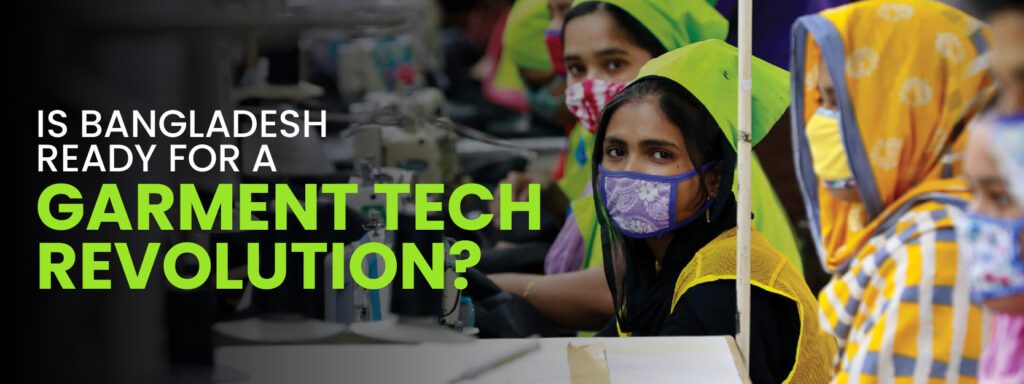
Bangladesh’s ready-made garment (RMG) industry is massive, employing approximately 4.6 million workers (60–65% women) across some 4,600 factories. It generated nearly $39.35 billion in exports (~81.5% of total exports) in FY2024, accounting for ~11% of GDP. However, this sector now faces a new challenge: the “Apparel 4.0” era of automation and smart factories. Global apparel makers are racing to adopt robotics, AI, and digital technologies. India’s Raymond utilises automated “Sewbot” machines, while Chinese factories employ smart fabrics and augmented reality. Vietnam is investing heavily in RFID, 3D printing, and ERP systems. Bangladesh is joining this tech race at home – which raises the urgent question: can its millions of garment workers keep pace?
Worldwide, clothing manufacturers must reduce costs and accelerate production to remain competitive. That pressure is keenly felt in Bangladesh, especially as it graduates from Least Developed Country status in 2026 and will lose duty-free GSP benefits by 2029. In the coming years, Bangladesh will lose “cost advantage” perks and face new agile competitors. Turkey and Mexico, for example, are building sophisticated apparel hubs for Western brands. Domestically, one study highlights that the demand for fast fashion and tapering export growth force Bangladesh to modernise or risk losing market share. In fact, nearshoring (producing closer to the market) is attracting buyers away from Asia’s traditional hubs.
Bangladesh’s Tech Pioneers
Several Bangladeshi firms have already begun upgrading to “Apparel 4.0” gear. For example: Mohammadi Group installed automated knitting machines to boost output and consistency. Envoy Textiles uses robotic autoconer machines, reducing manual yarn changing and stopping auto-batches. DBL Group deployed automatic systems for dyeing and dispensing chemicals in precise measures. Beximco Group relies on the AI-based ThreadSol software to cut fabric waste by optimising cutting patterns and material usage. Robintex Group (a German-Bangladesh joint venture) installed the world’s fastest single-pass digital textile printer (MS LaRio) for all-over prints. Team Group (with a LEED-certified factory) introduced semi-automated production lines, raising productivity by about 10–15% through mechanised material handling. Masco Knitting curates modern circular and rib-knit machines with advanced software, allowing rapid upgrades as technology evolves.
These examples show Bangladesh’s largest exporters testing cutting-edge tools. By integrating robotics in sewing and yarn handling, AI in fabric planning, and digital printing, these firms are slashing lead times and waste. Industry analysts note that such advances have already begun “revolutionising” garment production in Bangladesh – knitting, cutting, printing, and even packaging are getting smarter. The hope is that, by embracing automation, Bangladeshi factories can maintain their edge in cost and quality and remain “leaders in the global apparel market”.
Jobs on the Line: A Double-Edged Sword
For factory owners and economists, automation is a double-edged sword. The efficiency gains sound necessary, with rising wages and eroding trade privileges, automation promises significant benefits: higher productivity, lower unit costs and waste, and more consistent quality. Yet automation comes with risks. A government study in Bangladesh predicts that 60% of current jobs (approximately 5 million RMG workers) could disappear over the next 15 years if plants fully automate. (By comparison, Bangladesh’s export growth began slowing in 2024–25, underscoring the need to boost efficiency.) In short, factories without new tech may soon struggle but adding machines will displace many workers.
Can Workers Adapt? Learning on the Shop Floor
A key factor is the workforce’s ability to learn. Many Bangladeshi garment workers have relatively low formal education (primary or secondary school), raising questions about adapting to machines. Yet recent surveys offer an optimistic counterpoint. For example, Microfinance Opportunities (MFO) found that workers in automated lines generally reported higher productivity and confidence. In these surveys, workers said new machinery could be learned with minimal disruption. Many respondents noted that basic literacy or secondary schooling was sufficient to operate computerised cutting machines or digital knitting machines.
Indeed, the industry has begun tapping more technical talent: graduates from textile-focused universities (BUTEX, BUFT, etc.) are increasingly recruited for shopfloor and supervisory roles in modern factories. These young professionals bridge the gap by programming equipment and training older coworkers. This trend also means fewer foreign experts are needed: local talent is filling roles once held by expatriates.
Shifting the Workforce: Winners and Losers
Despite these positive signs, the transition will be uneven. Bangladesh’s garment sector is fragmented, comprising a few large exporters and thousands of smaller workshops. Smaller factories – which make up a huge portion of the industry – tend to be risk-averse. They often stick to older, manual methods and may adopt automation much more slowly. This “digital divide” means many lower-tier operations might fall behind technologically.
For workers, automation means two things: some will upskill, others must move. Factory owners say they usually reassign (not fire) employees displaced by machines. For instance, a cutter freed by an automatic cutter might shift to fabric inspection or packaging. Older or less-productive workers often gravitate to smaller factories with simpler tasks. Overall, both skilled and unskilled roles will feel the change. Machine operators and line supervisors need new training, while pressers and packers may see cuts. Studies warn that the poorest workers will suffer most, since they have the least ability to operate advanced machines.
Upskilling for Industry 4.0: Learning from Others
If Bangladesh’s garment industry is to flourish, it must learn from other countries that are already upskilling for the future. In Vietnam, for example, manufacturers have embarked on an “Upskilling 4.0” strategy. There, industry groups (like VITAS) partner with technical institutes to train operators on AI-enabled floors. Workers learn not just sewing, but also how to read digital dashboards, troubleshoot machines, and apply data from sensors. Factories use on-the-job digital training (via tablets and VR simulators) and gamified learning platforms so that education happens in short, practical bursts right on the shop floor. A case in point is Saitex (a major denim maker): it trains all workers to manage AI systems and even sustainability tools (water recycling dashboards), effectively turning each operator into a “co-pilot” of technology. Notably, Saitex’s program is inclusive – it has extensions to train differently-abled and disadvantaged staff, showing that “upskilling can be both tech-driven and inclusive”.
Governments and brands also play a role. In Vietnam’s example, export buyers co-invest in skill centers, and factories get tax breaks for training programs. Other countries offer hints too: India’s textile ministry runs the Samarth scheme (train-the-trainer programs and upgraded institutes) for garment skills, while Cambodia’s factories participate in corporate-led soft-skills training to elevate women into supervisory roles. Bangladesh can build on these models. For instance, an industry-wide levy could fund a national training institute for apparel technology, similar to Germany’s well-known dual education in textiles (where students split time between classroom and factory).
Training Program Blueprint and Policy Recommendations
To prepare workers for Automation 4.0, Bangladesh will need robust learning programs and incentives. Here are key measures that could help:
On-the-Job Tech Training: Develop factory-level training labs equipped with the new machines. Experienced operators or trainers (possibly hired from BUTEX/BUFT grads) run modular courses on using CNC cutters, automated sewing machines, smart inventory systems, etc. Short courses and “micro-credentials” (for example, a certificate in digital pattern-making) can quickly upskill current staff.
Curriculum Modernisation: Update textile and engineering university programs to incorporate Industry 4.0 principles. For example, textile engineering degrees could require internships on automated lines. This ensures new graduates arrive job-ready with IoT and data skills. Partnerships between universities and RMG conglomerates can align syllabi with industry needs (like Vietnam’s VITAS–university collaborations).
Public–Private Skill Centers: Establish or expand Centers of Excellence for RMG training (building on ILO or BRAC-initiated programs). These centers would offer mid-career re-skilling in digital manufacturing and quality control, in cooperation with BGMEA/BKMEA. Co-funding by government and industry can lower costs. The success of ILO’s large-scale safety training (reaching over 8,000 managers and 800,000 workers) shows that mass upskilling is feasible if supported.
Financial Incentives: Provide tax breaks or low-cost loans to factories that invest in worker training or high-tech equipment. Similarly, export credit or preferential shipping rates could reward companies that meet certain training benchmarks. Brands and buyers should also be encouraged to pay a “skills premium” for garments made with certified, well-trained workers.
Soft Skills & Management Education: Automation also demands better management. Training must cover not only machines but also problem-solving, digital literacy, and teamwork. Programs should include “learning-to-learn” skills: teaching older workers to adapt to continuous change. This was demonstrated in pilot schemes where even simple digital tablet-based learning helped traditional sewing teams pick up computer-based cutting skills within days.
Equal Access & Inclusion: Special efforts should target women and disadvantaged workers (who form the majority of RMG labor). Drawing on models like Saitex’s Rekut initiative, Bangladesh could expand training to rural and marginalized women, perhaps via mobile training vans or local vocational centers. Ensuring women enter mid-level technical roles will require addressing cultural barriers and providing childcare support – but it can also yield big gains in productivity and equity.
Continuous Learning Culture: Encourage factories to adopt continuous improvement mindsets (like kaizen or Lean) coupled with tech. Regular on-site “lunch-and-learn” sessions, digital learning modules, and even gamified competitions (e.g. rewards for highest efficiency on an automated line) keep skills updated. Some apparel firms abroad use simple gamification apps to retrain workers; Bangladesh’s large garment platforms could develop similar local language tools.
Government Oversight and Support: The government should track skills needs and outcomes (through a Skills Inventory as SEIP proposes). Industry-skills councils (drawing from BGMEA/BKMEA and education ministries) can periodically forecast future tech demands and steer vocational training accordingly. Finally, policies such as mandatory continuing education (akin to how some developed countries require technicians to certify every few years) could ensure workers refresh their skills regularly.
By proactively combining automation with mass training, Bangladesh can turn a potential crisis into an opportunity. Automation need not be a threat to the garment worker if it comes hand-in-hand with learning. Upgrading the workforce, from the shop floor to management, will help maintain Bangladesh’s competitive edge. In the coming decade, a garment factory that produces shirts faster and more cost-effectively, while employing a highly skilled and adaptable staff, will set the global standard. Bangladesh’s future in apparel depends on bridging the gap between machines and humans. With the right policies and programs, its millions of workers can become the beneficiaries, not the victims, of the Apparel 4.0 revolution.
Author: Tasnim Safwan