Introduction
Some call AI the world’s eighth wonder, and for good reason. It can write, speak, analyze, and solve problems faster than most humans ever could. But here’s the interesting part: AI didn’t invent itself. A human did. In the age of OpenAI and rapid automation, companies face a big question: should they replace people with technology, or help people grow alongside them?
Unfortunately, many have already chosen replacement, and workers are losing jobs, not because they’re lazy, but because they lack the skills modern technology demands.
When calculators arrived, people said math would disappear. The same was said about computers when they came along. Many people predicted they would lose their jobs and face numerous other challenges, but history tells a different story. Nothing has replaced humans. We adapt, we evolve, and we improve.
The Rise of Artificial Intelligence
AI is relatively new to many people, but its journey began decades ago. From an ordinary ethics-based system in the 1950s to machine learning algorithms in the 2010s. AI has made up nicely in the background until today. Tools like ChatGPT, Gemini, and others advance models that have made AI visible, powerful, and accessible to the masses. It can do a lot of things: write, design, diagnose, calculate, and even create. Based on all this, AI is not just a tool; it’s a revolution.
Development is the Key
Development is one of the most important things humans need to understand because we can’t move forward without it. Every day, new technology arrives on the table. If we can’t adapt to it, we fall behind. And when that happens, companies might not wait; they’ll look for someone else who’s ready. So, what should we do?
The answer is simple: be open to learning. Humans are capable of anything if they set their minds to it. We must pay attention when something new shows up, whether it AI, a trend, or a task. Every new thing has potential. What matters is choosing the right skill to learn at the right time. If we do that, we won’t just survive change, we’ll grow with it. That’s how humans can rise, and even enjoy working with technology instead of fearing it.
Technology is the Best Friend
Technology is like a best friend to humans today. And what does a true friend do? They support you, and that’s exactly what technology does. Without its help, we can’t go far. But with it, we can go further than ever before. Technology is present at every table and field; it’s waiting for us to use it.
But here’s a question: Why is technology always going up, never down? The answer is simple: It’s constantly changing and improving. That’s why reskilling is essential. It’s not just the individual’s responsibility to keep up; companies also have a role to play. When a new invention emerges, companies should prioritize updating their employees’ skills rather than replacing workers. That’s how we grow together.
Replacement is the Culture
Replacement is a word we hear everywhere these days. And honestly, it’s easier to replace someone than to reskill them. But here’s the truth: the easy path doesn’t always lead to the best result. Hard things come with value. Reskilling may be challenging, but it yields long-term benefits that simple replacement cannot.
When a company replaces a worker, they get a new face, maybe even someone faster or more tech-savvy. But what happens to the one who was let go? What happens to their family, their livelihood, their future? These questions matter. They deserve answers.
In today’s AI-driven world, replacement is happening fast, but it doesn’t have to be this way. If we choose to start reskilling now, it can spark a new kind of revolution, a positive one. History shows that revolutions change the world. A reskilling revolution can achieve the same impact, not just for companies, but for societies everywhere. A recent survey in the U.S. found that more than 40% of managers are considering replacing employees with AI. But what if they considered upgrading their teams with the proper training instead?
Challenges are the Solution
Reskilling is challenging and costly, but easy and simple things don’t build the best futures. When we invest in people, we invest in progress that lasts a long time. A machine can work fast and more, but a human can think, feel, and create like no machine can ever do.
The future doesn’t have to be about the replacement. It can involve mutual collaboration among humans, AI, employees, and employers. If companies take the initiative instead of replacing, they will get more than just skilled workers; they will earn trust, loyalty, and innovation.
Conclusion
AI is here to rule; that is not the issue. The real problem is how to deal with it. Do we replace the people who invested their time and effort in building the companies, or do we support them and help them to flourish?
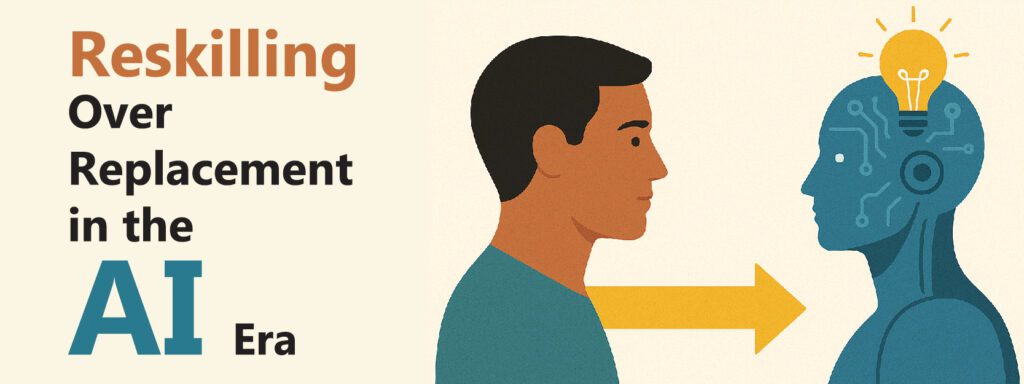
The companies that will progress in the future will be those that invest in people, not just in tools. Reskilling is not just a charity; it’s a strategy. It makes creative teams, different companies, and a better world. The choice is here: replace people and run fast, or reskill people and run long together. That’s why reskilling is critical now and for the future. Instead of replacing workers, companies can invest in them, train them in new technologies, and help them flourish, thereby developing a future where humans and machines work together. This development not only improves the employees but also builds immense trust. And trust like AI can be impactful, maybe even a wonder of its own universe.
Case Study (According to Beautiful.ai, 64% of managers noted that their employees fear becoming less valuable at work due to AI tools in 2025. Additionally, a majority of managers (62%) reported that employees are aware that AI tools could eventually lead to job loss.)
Author: Nadim Ahmed
M.A. in English Language Teaching
Jahangirnagar University
Email: nadim@bangladeshbrandforum.com