How Guardian Life turned Bangladesh’s most avoided conversation into its most effective campaign.
Picture this.
You’re a financial advisor. Your client’s quarterly meeting is happening this week. You begin preparation for the meeting and review the numbers. You realize something.
Your client needs life insurance, so you add additional materials to present this at the meeting.
The day of the meeting arrives. You’re ready.
You sit down. You open with the benefits. Legacy transfer. Wealth building. Financial security for the people they love most.
Your client seems invested. So you carry on. And then you say the word. Death.
The energy in the room changes instantly.
Your client laughs nervously. Says they’ll think about it. Asks about your other products. Talks about kids. Family. Anything. Everything. Except the conversation you came here for.
You leave with a “let’s connect next week,” but you both know that usually means never.
As a former Finance bro, I’m intimately aware of such conversations, and here’s the kicker: this happens everywhere.
In Bangladesh, death isn’t just an uncomfortable topic. It’s a superstition.
Talking about it is widely believed to invite it. Which makes selling life insurance in Bangladesh one of the hardest marketing problems imaginable. Your entire product category is built around the one conversation nobody wants to have.
Guardian Life didn’t solve that problem by being braver or louder. They solved it by being smarter.
They made an ad that never once mentions death, never once mentions risk, and never once asks you to think about the future.
And it’s one of the most behaviorally precise pieces of marketing I’ve seen in a long time.
Here’s the full breakdown.
The Setup: What The Ad Actually Does
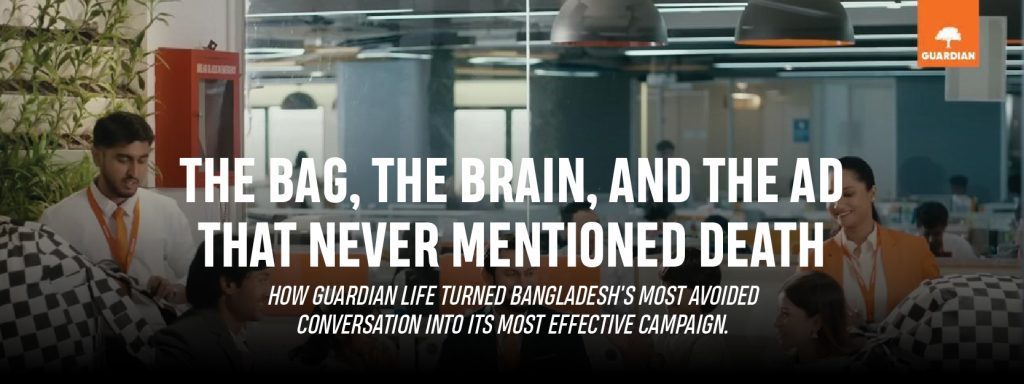
The ad centers on a single visual: a large, overstuffed, checkered backpack.
Different people carry it throughout students, parents, professionals, everyday people navigating everyday life.
The bag is heavy, awkward, uncomfortable, and impossible to ignore. It’s the physical personification of something invisible, something abstract, something that can’t quite be put into words: the quiet psychological weight of financial anxiety, family responsibility, and an uncertain future.
Then someone puts the bag down. And something interesting happens.
You feel that relief. The relief of letting go of the burden, the weight of the bag. Even through a screen. Even in a language you don’t speak.
That’s not an accident. That’s the result of at least three behavioral science principles working in precise coordination.
Principle 1: Present Bias
The human brain has a complicated relationship with time. It’s terrible at valuing future rewards when they require sacrifice in the present.
Behavioral scientists call this Present Bias — our tendency to heavily discount benefits that arrive later for what feels real right now.
This is why insurance is such a hard sell. The product asks you to pay today for a benefit that arrives years from now, possibly never (at least not in your lifetime). Your brain automatically rejects such trades because it can’t process information that’s too far-fetched in the future.
Most insurance brands make this problem worse without realizing it. Their ads lean on fear.
Think of flashing images of accidents, grieving families, financial ruin. They’re trying to scare you into buying. And while fear is a powerful motivator, it also makes the product feel like a threat response. Something that you buy when you’re terrified, not because it’s something you want. The emotional association to insurance, then becomes fear, loss, and our brains are wired to avoid this for as long as possible.
Guardian Life understood this at a structural level.
Their ad didn’t ask you to run away from worst-case scenarios. Rather, it invites you to move toward something better. They didn’t sell a future death benefit. They sold a present feeling.
The moment the bag comes off isn’t twenty years from now. It isn’t at the end of a policy term. It’s right now, on screen, happening in real time.
They delivered the emotional reward immediately. They didn’t need to change the product. They changed when the benefit feels real. That single shift is the entire campaign.
Principle 2: The Concreteness Effect
People struggle to process abstract concepts.
Risk, mortality, financial uncertainty. These are real things, but they’re hard to visualize and feel, and they increase the cognitive load in our brains. A cognitively slippery slope, I tell you.
And since our brain doesn’t like to take on too much load, it rests on what it does best — defers it for as long as it can.
The checkered backpack solves this problem beautifully. It takes something invisible, our psychological burden, and makes it tangible, physical, and immediate.
You don’t need to understand financial planning to understand that carrying a heavy bag is exhausting. You don’t need to read a policy document to understand that putting it down feels f*ckin good.
This is the Concreteness Effect in action.
By giving anxiety a physical form, Guardian Life reduced the cognitive load of understanding what insurance actually does.
The argument shifts from “protect your family’s financial future” to “Bag = Bad, No Bag = Good.” Simple and precise.
And here’s what makes it even smarter:
In a market with varying literacy levels and complex financial jargon, the backpack becomes a universal language. You don’t need to read anything to understand what it means. You just need to watch.
Principle 3: The Keats Heuristic
This one lives in the title of the ad: “†Ubkb bq, Rxeb‡K A¨v‡Ubkb w`b” roughly translated as “Not tension, give attention to life.”
In Bangla, “tension” and “attention” are near-homophones (same sound, different meaning).
The brain is funny in how it operates. It processes rhyming statements as more credible and more memorable than non-rhyming ones.
This is the Keats Heuristic — named after the poet, John Keats.
Rhyming statements or sounds are easier for the brain to process, increasing fluency in memory and reducing cognitive resistance to an idea.
The entire reframe of the campaign is compressed into that single rhyming line. Stop dreading life. Start living it.
It’s not just good copywriting. It’s a mnemonic device, helping your brain retain it because of how it sounds, not the argument. You remember it before you’ve decided whether you agree with it.
The Emotional Architecture
The behavioral science principles explain the mechanics. But mechanics alone don’t move people. What moves people is emotion. And this ad targets four specific emotional states. Each one deliberate.
- Relief is the primary trigger and the most visceral one. The moment the bag comes off isn’t just visually satisfying. It’s physically felt. Watching someone be released from a burden you recognize as your own triggers a somatic response. Your shoulders drop. Your chest loosens. The ad doesn’t tell you insurance will make your life better. It makes you feel better, instantly, before you’ve bought anything.
- Intellectual Pride is the secondary trigger, and it’s culturally specific. In Bangladesh’s rising middle class, being perceived as modern, calculated, and smart carries significant social weight. It boosts you up the social ladder, which also boosts your ego. Framing insurance as a “smart decision” rather than a safety net reframes the buyer’s identity. Subtle but powerful.
The identity shift doesn’t require the product to change anything about the buyer’s external reality. The daily stressors are still there. The financial pressure is still real. But the moment someone sees themselves as a person who makes smart decisions, their perception shifts. Their brain stops treating every daily hurdle as a threat to their family’s survival. It processes the same information differently. It tells you, “You’re not someone anxious about dying. You’re someone intelligent to have life under control.” In many ways, the product being sold here is the permission to feel in control.
- Agency is the third trigger, and it reframes the provider’s role entirely. In traditional insurance marketing, the implicit story is: “Something bad might happen to you. Plan for it.” That story positions the buyer as a potential victim. Guardian Life flips it. The story here is: “You are someone actively building the path for a secure future for the people you love.” That reframe from worrier to builder is powerful.
- Universal Inclusivity (I made that up!) is the fourth trigger and the one that does its work most quietly. By showing diverse people of different ages, genders, and walks of life all carrying the same bag, the ad dissolves the sense that financial anxiety is an individual failing. These backpack carriers aren’t just suggesting that everyone has anxiety; they’re signaling that taking action is the new normal. It isn’t your private failure. It’s the shared human condition. And if everyone carries this weight, then doing something about it isn’t an admission of vulnerability. It’s simply the smart, modern thing to do.
The Detail That Ties It All Together
There’s one creative choice in this ad that most people will overlook, but I think it is the most strategically intelligent thing about it.
The ad is built around the word “Pera” — a colloquial Bangla term for tension, daily struggle, the psychological weight you carry.
Not death. Not risk. Not the future. Pera is present tense. It’s alive, immediate, and universally relatable. Every single person watching knows what Pera feels like because they felt it this morning.
This isn’t just cultural relatability. Pera does the same cognitive work as Present Bias, but in linguistic terms.
“Death” is future tense — abstract, distant, easy to defer. “Pera” is right now.
By building the entire campaign around that single word, Guardian Life didn’t just avoid a taboo. They grammatically collapsed the temporal gap that makes insurance so hard to sell in the first place.
The backpack makes anxiety visual. The jingle pairs an upbeat, high-energy sound with the product so consistently that the product itself starts to feel upbeat. It peaks with celebration and energy before landing on “smart decision,” so the brain remembers the rhythm and the relief rather than anything morbid.
Pera makes it all present tense. Every single creative choice pulls the exact same lever.
The Bigger Lesson
Guardian Life may have had a bigger budget or a braver brief. But what they certainly did have was a deeper understanding of how their audience actually thinks, feels, and makes decisions.
They understood that you can’t argue with a superstition. You can only reframe it. And the most effective reframe isn’t a counterargument. It’s a feeling that arrives before the argument even starts.
Great strategists aren’t always the most creative. They understand how humans are wired, and they use that understanding to meet people exactly where they are, not where they should be, not where the product needs them to be, but where they actually live.
In the present. Under the weight of their Pera. Looking for something to make it lighter.
A Growth Strategist’s Note: The “Night-Out” Swap
The ad is brilliant at shifting perception. But perception alone doesn’t close.
Here’s the one thing I’d put on the table as a recommendation.
In a price-sensitive market like Bangladesh, “life insurance” still carries the psychological weight of a big, abstract financial commitment. The “smart decision” framing has successfully made it aspirational. The next step is making it feel material, tangible, and effortless.
Here’s how: anchor the cost of a monthly premium to something the audience already spends money on without thinking twice.
A dinner out with friends in Dhaka. A few rounds of tea and snacks at a local restaurant. Something in the 500 to 1,000 BDT range that everyone recognizes as a casual, guilt-free expense.
The message shouldn’t be “sacrifice your night out for financial security.” That’s a moral lecture, and nobody wants to be lectured.
The message should be simpler, painting a different picture through contrast. “For the cost of one evening, you could buy yourself 30 days of weightlessness.”
You’re not giving something up. You’re making a swap and getting the significantly better end of the deal. You’re reinforcing the “smart decision”.
The reframe moves the purchasing decision from “financial planning” to “everyday discretionary spending.” Financial planning sounds too complex. Everyday spending sounds more relatable. Less resistance.
The ad made the benefit feel real. This reframe will make the cost feel small. Marketing + Conversion = Lethal Combo
And this logic isn’t exclusive to insurance. Any product or service with a recurring cost that feels abstract or heavy can use the same swap. Find a familiar expense your audience already makes without hesitation. Do the math. Show them what they’re actually trading. The cost-contrast eases decision-making, making it a no-brainer.