It’s a Friday evening in a Mirpur supermarket, and a schoolteacher has been standing in the oil aisle for a while now, phone in one hand, a bottle of soybean oil in the other. The price tag is only part of it. She’s checking an app in case it’s cheaper there. She’s half sure this bottle was bigger before Eid. And she’s thinking about something her cousin posted in the family Facebook group last week. Finally, she puts the bottle back, takes a slightly dearer one from a company she trusts, and goes off to find the rice.
Anyone who works in marketing here has seen some version of this, and I’d say it tells you more about our shoppers than half the research decks we get sent. Yes, price matters. After three years of inflation that just wouldn’t let up, it matters more than ever. But the sum people do in their heads isn’t the same sum anymore. Value used to mean a decent product at a fair price, full stop. Now there’s a whole list running in the background. Are these people being honest with me? Will this save me time? If it breaks, will anyone answer the phone? Can I feel alright about buying it?
That’s what this cover story is about, really. Value has slowly turned into a relationship, and the brands still fighting purely on discounts are answering a question their customers quit asking a good while back.
Economists got here first
To be fair, economists have been chewing on this for centuries. Adam Smith pointed out the oddity in 1776. Water keeps us alive and costs almost nothing. Diamonds don’t do much at all, and they cost a fortune. Smith, and later the marginalists, decided value lives in the buyer’s head rather than in the object. That was about 250 years ago. Plenty of marketers still haven’t caught up.
Anyone who sat through a marketing course will remember Valarie Zeithaml’s definition from 1988. Perceived value, she wrote, is “the consumer’s overall assessment of the utility of a product based on perceptions of what is received and what is given.” In other words, what I get against what I give. Fine. The trouble in 2026 is that both of those lists have got a lot longer.
A few years later Jagdish Sheth, Bruce Newman and Barbara Gross split value five ways. Functional value is what the thing does. Social value is what it says about you. Emotional value is how it makes you feel. Epistemic value is the small kick you get from trying something new. And conditional value depends on the moment (think of an umbrella when the sky opens over Dhaka). Let’s be honest. For decades, most of our marketing lived in that first box and only visited the second one at wedding season.
Morris Holbrook pushed it further in 1999, calling value an “interactive, relativistic preference experience”. Only an academic could love that phrase. Strip it down, though, and his point is pretty simple. Value moves around. It’s different for you and me, different on an ordinary Tuesday than at Eid, different this year than last. Kotler looked at the same thing from the seller’s side and called it customer-delivered value, total benefit minus total cost. He was always clear that cost meant more than taka. Time counted. So did effort, and worry.
The value equation as it looks in 2026: what we get, and what we now give up
The left column is the list we all learnt in class. The right column is the 2026 bit, where time, effort, risk and even our personal data get added to the bill.
And that’s where this year really begins. Costs that used to sit quietly in the background are now right out in front, and people are totting them up.
Four years of shrinking pockets
Money first, because households here haven’t had much choice in the matter. Inflation hit 11.66 percent in July 2024, the highest in over a decade, and food inflation went past 14 percent. Things have cooled since, but slowly. The Bangladesh Bureau of Statistics puts August 2026 inflation at 8.26 percent, with non-food prices rising faster still, at 9.32 percent.
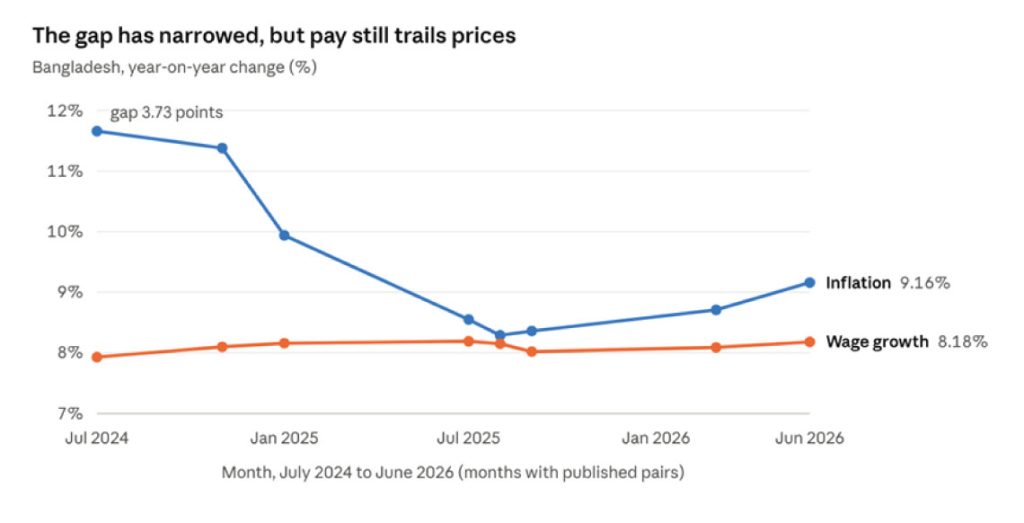
The number I keep coming back to, though, is about wages. In June 2026 wages rose 8.18 percent, while inflation ran at 9.16 percent. That made it 53 straight months of prices beating pay. To find a month when a Bangladeshi worker’s raise actually came out ahead, you have to go back to January 2022. That’s over four years of real income leaking away, a little at a time, too slowly for any single month to feel like a crisis.
Inflation against wage growth, July 2024 to June 2026 (BBS figures as reported by The Daily Star and Dhaka Tribune; July 2024 wage growth worked out from the reported 3.73-point gap)
Yes, the gap narrowed, from 3.73 points to about one. But wages never once got their nose in front.
Four years is more than enough for habits to change, and they have. The family that always bought the 5-litre jar of oil now buys two litres. The mother who used to keep a spare packet of her favourite detergent under the sink now waits for an offer. People squint at pack sizes and unit prices. They read the small print, which hardly anybody used to do. A behavioural economist wouldn’t be the least bit surprised. Kahneman and Tversky showed long ago that a loss stings about twice as much as an equal gain pleases. If every month feels like losing a bit, you start guarding what you have, and you don’t easily forgive a brand that looks like it’s cashing in.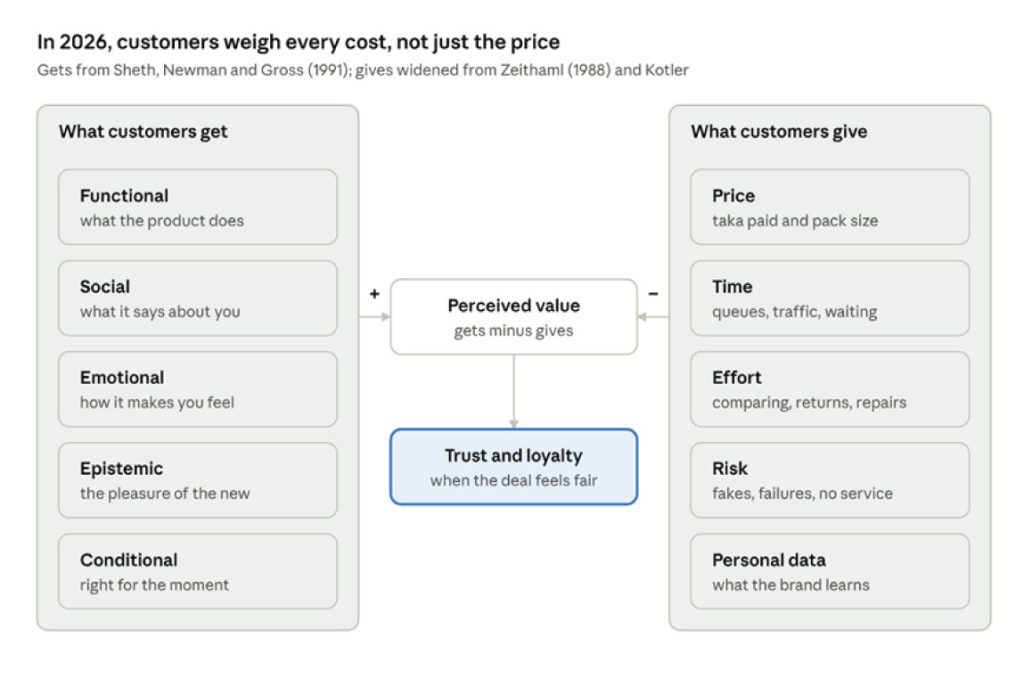
Add the phone to all this. DataReportal counted 82.8 million internet users in Bangladesh at the start of 2026 (5.3 million more than a year before) and 64 million social media identities. TikTok alone reaches an estimated 56 million adults. A price hike, a rude delivery man, a bad batch: any of it can go from Rangpur to Riyadh in minutes. Whatever gap there is between what a brand says and what people actually get, the whole country can see it now.
And people here are young. The median Bangladeshi is 26. Most of today’s shoppers grew up with bKash on the phone, a food app a thumb’s reach away and a Facebook group for every question you could think of. Paying digitally is nothing to them. They compare prices in seconds and switch brands without any guilt at all. They’ve never really known a market without choice, so for them loyalty isn’t a one-time thing. A brand earns it, then has to keep earning it.
 Trust is the last piece. Edelman’s 2026 Trust Barometer special report on brands found that 88 percent of consumers around the world call brand trust an important or critical factor in what they buy. That’s level with value, also at 88 percent, and one point behind quality at 89. More than two-thirds said a brand’s home country matters to them, five points up on 2023. People are drifting back towards what feels familiar, local and safe. I don’t think that’s a coincidence.
What shoppers are actually counting now
Spend some time watching how people shop here, in the aisles or in the comment sections under brand posts, and the same five expectations keep turning up. None of them is new as such. What’s new is that shoppers want all five together, and they’ll spot the one you’ve left out almost immediately.
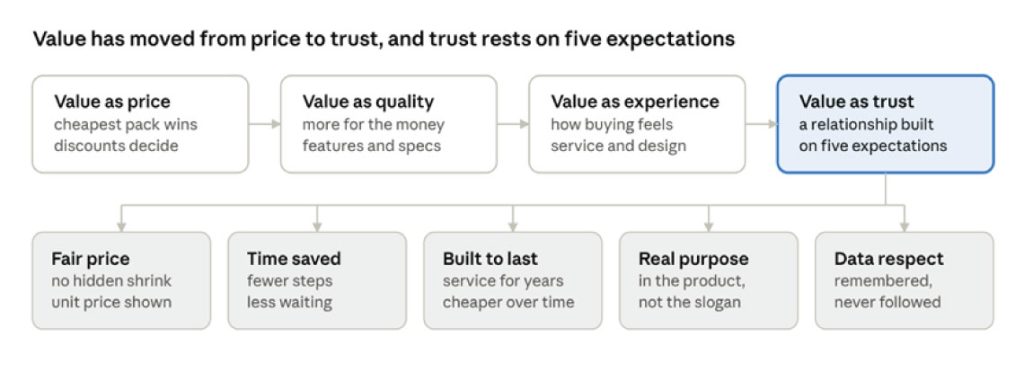 How the idea of value has moved over time, and the five things shoppers expect now
Price, quality and experience still count, obviously. They just don’t seal the deal by themselves anymore.
1. Fair matters more than cheap
In 1986, Kahneman, Jack Knetsch and Richard Thaler ran a survey that still gets quoted everywhere. They described a hardware store that raised the price of snow shovels the morning after a big snowstorm and asked people what they thought. Eighty-two percent called it unfair, even though the shop was only doing what demand allowed. Thaler later gave that feeling a name, transaction utility. It’s the satisfaction, or the sting, of the deal itself, separate from whatever you carry home.
Our shoppers feel this in their bones. Explain a price rise properly and most people will grumble and then accept it. What really gets their back up is feeling cheated. The 500-gram pack that quietly becomes 450 grams. The “special offer” that turns out to be last month’s normal price. In 2023 Carrefour in France started sticking labels on products that had shrunk without getting any cheaper, and shoppers loved it. Then there’s Costco, which has kept its hot dog and soda combo at USD 1.50 since 1985. Nobody seriously thinks Costco makes its money on hot dogs. What it’s really selling is a promise that it won’t squeeze you, and members have rewarded that promise for forty years.
So what does a Bangladeshi brand do with this? Tell people about a price change before they catch it themselves. Put the unit price somewhere they can actually see it. And if the pack really has to shrink, own up to it on the pack.
2. My time costs something too
When bKash let people send money to the village in seconds, money itself didn’t get any cheaper. Time did. It’s the same reason Chaldal was built around getting groceries to your door fast, and why Pathao and Foodpanda became part of daily life in a city where two kilometres can take an hour on a bad day. Talk to any working couple in Dhaka. They’ll tell you the real cost of a thing includes the jam on the way, the queue at the counter and the Saturday that disappears into errands.
Kotler always counted time and effort as costs, so that part isn’t new. What’s new is how much people will now pay to get rid of them. Look at Amazon Prime. Members pay every year, mainly for the comfort of knowing their order will just show up. If a brand can take even one step out of someone’s day, that’s value, even when the product is exactly the same as the one sitting next to it on the shelf.
3. Will it last?
Nobody buys a fridge once. You live with it, ten years or so, through load-shedding, voltage swings and the occasional visit from the repairman. Walton seemed to understand this early. A good chunk of its growth came from its wide service network and local manufacturing, not just its prices. If you lived in a district town, you knew that when something packed up, someone nearby could sort it out. That’s value counted in years. The showroom is only day one.
It’s part of why Toyota and Uniqlo travel so well. A Toyota holds its resale value, and a Uniqlo T-shirt survives wash after wash. When prices keep climbing, buying things that last is a way of saving. People used to ask, “How much is it?” These days they’re more likely to ask, “What will this cost me over the next few years?”
4. Feeling good about what you buy
For years, purpose marketing in Bangladesh felt like a CSR paragraph tacked on to the end of a TVC. People are fed up with it, frankly. What actually lands is purpose that’s baked into the product and into how the company really works.
Aarong is the example everyone grabs first, and fair enough. Buy an Aarong kurta and you’re buying the work of rural artisans, many of them women, and you know that when you pay. That story wasn’t bolted on afterwards. It’s the reason the product exists. SMC’s Joya sanitary napkin is a more recent case. Its campaign to make menstrual hygiene a family priority goes right at a subject plenty of households still avoid at the dinner table, and it puts the brand in the middle of a conversation that matters.
Patagonia probably went further than anyone. It once ran an ad telling people not to buy its jacket unless they really needed it. Then in 2022 its founder handed the company over to a trust and a non-profit set up to fight climate change. Hardly any company will go that far, and nobody’s asking them to. The lesson still holds, though. If your purpose doesn’t cost you anything, people won’t believe a word of it.
5. Remember me, but don’t stalk me
Personalisation used to be a nice-to-have. Now people just assume it. PwC’s 2026 Voice of the Consumer survey, covering nearly 22,000 people in 27 countries, found that 58 percent prefer personalised products and services in health. You can see the same thing at home when a telecom app suggests a data pack that fits how you actually use your phone, or a shop sends offers on the stuff your family really buys.
Which brings us back to trust, again. People want to be remembered. They don’t want to be followed around. Apple turned that tension into a selling point with its line that what happens on your iPhone stays on your iPhone. Our data protection rules are still being worked out, and until they are, any brand that’s open about what it collects, and why, is going to earn a kind of permission its rivals won’t.
What our grandmothers already knew
Honestly, our grandmothers figured all this out long before any textbook did. Shostar tin obostha, they’d say. The cheap thing comes to three bad ends. It’s a warning against confusing price with value, and it feels truer in 2026 than ever. The fan that dies after one summer. The discount that hides a smaller pack. The after-sales service that vanishes the day after you’ve paid. Every one of them ends up costing you more.
Oscar Wilde once said a cynic is someone who knows the price of everything and the value of nothing. Flash sales and coupon codes have made cynics of brands and shoppers alike. What I think is happening now is a quiet drift back to something much older. Medieval thinkers like Thomas Aquinas wrote about the just price, the idea that a deal ought to be fair to both sides and not merely legal. The shopper in Mirpur would never put it like that. But when she says a brand “doesn’t cheat”, she means exactly the same thing.
Amartya Sen gives us a more modern lens. His capability approach says we should judge wellbeing by what people are able to do and to be, not by what they own. Look at it that way and a mobile wallet matters because it lets a garment worker in Gazipur look after her parents in Kurigram. A sanitary napkin matters because a girl doesn’t have to stay home from school a few days every month. The brands that do best here, in my view, are the ones that make their customers’ lives a bit bigger.
Muhammad Yunus has been saying for years that a business can be set up to solve problems and not only to make money. You needn’t sign up to every part of his social business model to see his point. When people are stretched thin, they notice who’s on their side. And they don’t forget.
Six hunches worth testing
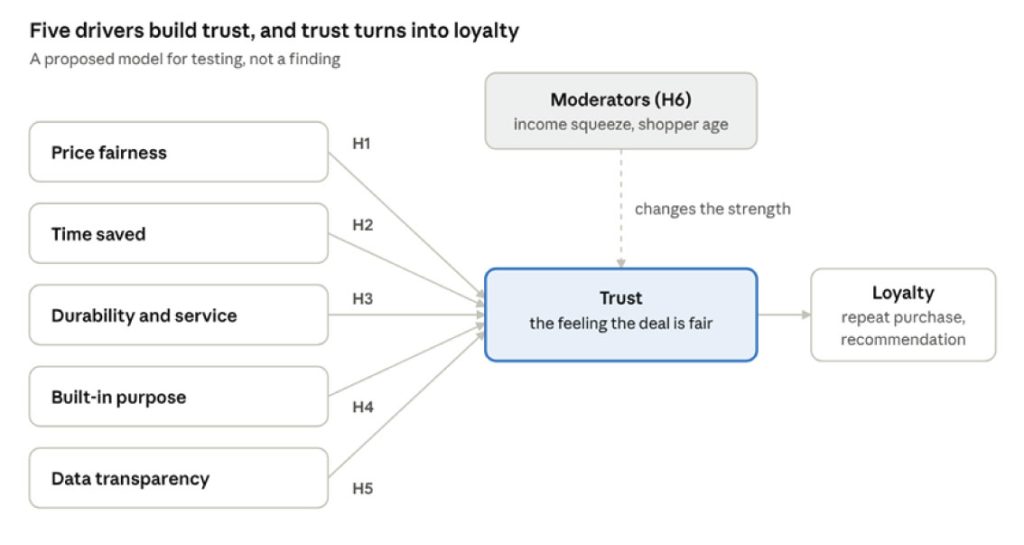
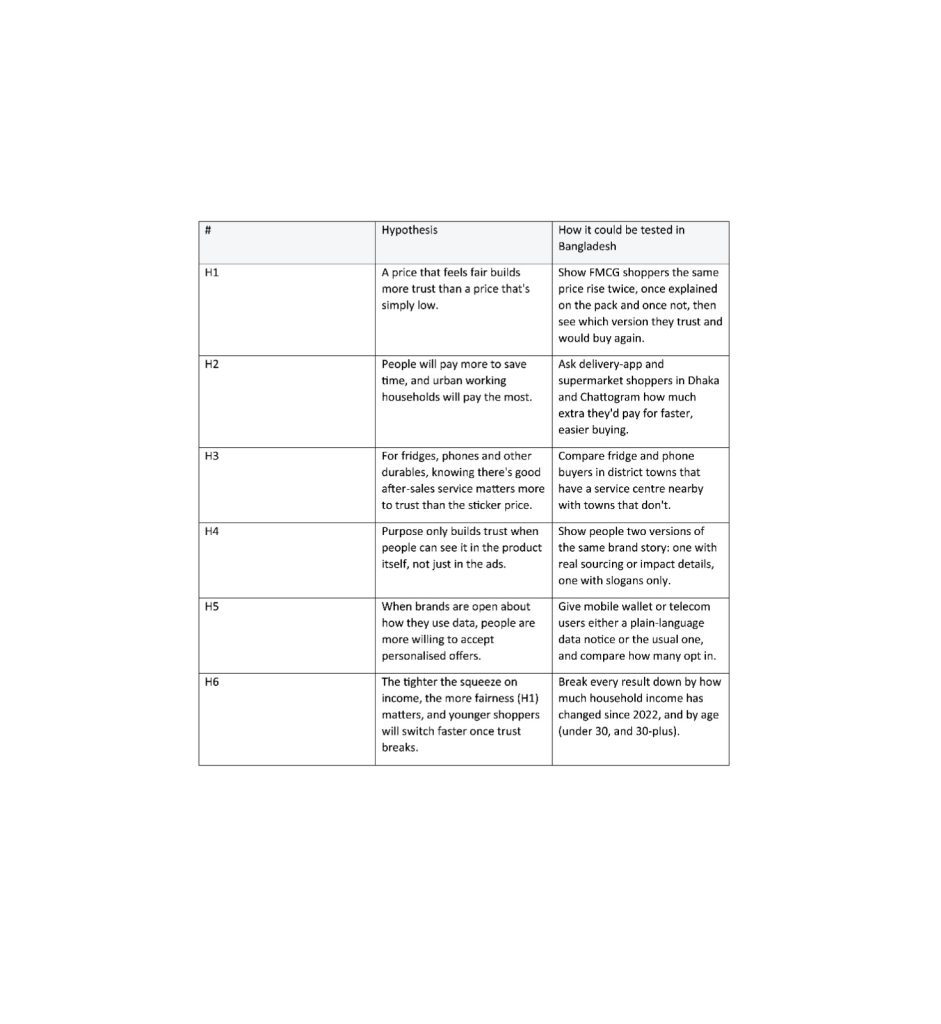
I should be upfront here. Everything so far rests on theory, global surveys and what any of us can see in the market. Nobody has properly tested it on Bangladeshi consumers. So the model below turns the argument into six propositions that researchers, brands, or a university partner like AIUB could go out and check.
The proposed model: five drivers, trust in the middle, and two things that could change the picture
Trust sits at the centre. Each of the five drivers ought to lift trust, and trust, in turn, ought to lift loyalty. Two other conditions could make those links stronger or weaker.
| # | Hypothesis | How it could be tested in Bangladesh |
|---|---|---|
| H1 | A price that feels fair builds more trust than a price that’s simply low. | Show FMCG shoppers the same price rise twice, once explained on the pack and once not, then see which version they trust and would buy again. |
| H2 | People will pay more to save time, and urban working households will pay the most. | Ask delivery-app and supermarket shoppers in Dhaka and Chattogram how much extra they’d pay for faster, easier buying. |
| H3 | For fridges, phones and other durables, knowing there’s good after-sales service matters more to trust than the sticker price. | Compare fridge and phone buyers in district towns that have a service centre nearby with towns that don’t. |
| H4 | Purpose only builds trust when people can see it in the product itself, not just in the ads. | Show people two versions of the same brand story: one with real sourcing or impact details, one with slogans only. |
| H5 | When brands are open about how they use data, people are more willing to accept personalised offers. | Give mobile wallet or telecom users either a plain-language data notice or the usual one, and compare how many opt in. |
| H6 | The tighter the squeeze on income, the more fairness (H1) matters, and younger shoppers will switch faster once trust breaks. | Break every result down by how much household income has changed since 2022, and by age (under 30, and 30-plus). |
If even half of these hold up, the message for brands is fairly obvious. Looking after trust might be worth more than winning the next price war.
So what do brands do on Monday morning?
None of this needs a bigger budget, which is the good news. It needs a different habit of mind. These are the questions I’d want on the table at every marketing meeting this year.
- Would we be happy for customers to see exactly how we set this price? If the honest answer is no, you’ve got a pricing problem. It isn’t a communication problem.
- What’s one step we can take out of the customer’s day? Delivery, payment, returns, repairs. That’s where value is won or lost now.
- What happens after they’ve paid? The ad that really counts is the service visit three years later.
- Is our purpose something we do, or just something we say? Customers can tell, usually within a single comment thread.
- Are we treating customer data as a favour we have to repay? Once that permission’s gone, good luck getting it back.
The brands that come through this inflation in decent shape won’t be the ones with the biggest discount banners. They’ll be the ones people trust to be straight with them when money’s tight. That kind of trust adds up over time. It’s also the only loyalty I know of that survives a cheaper shop opening next door.
Go back to that teacher in Mirpur for a second. She put the cheaper bottle down and paid a little extra for one she trusted. She wasn’t being careless with her money, far from it. She was making a careful call about which company wouldn’t let her down. Millions of people make that same call every day, all over Bangladesh. That’s what value means in 2026. The price is just where the conversation starts.
Sources
- August inflation eases to 8.26%, The Daily Star, September 2026
- Inflation increases to 11.66pc in July, BSS, August 2024
- Inflation exceeds wage growth for 53rd straight month, Dhaka Tribune, July 2026
- Digital 2026: Bangladesh, DataReportal
- 2026 Edelman Trust Barometer Special Report: Brand Growth in an Insular World, Edelman
- Voice of the Consumer 2026, PwC
- Zeithaml, V. (1988), “Consumer Perceptions of Price, Quality, and Value”, Journal of Marketing
- Sheth, J., Newman, B. and Gross, B. (1991), “Why We Buy What We Buy: A Theory of Consumption Values”, Journal of Business Research
- Kahneman, D., Knetsch, J. and Thaler, R. (1986), “Fairness as a Constraint on Profit Seeking”, American Economic Review
- Holbrook, M. (1999), Consumer Value: A Framework for Analysis and Research
Author: Sajid Mahbub
Group CEO & Executive Editor, Bangladesh Brand Forum