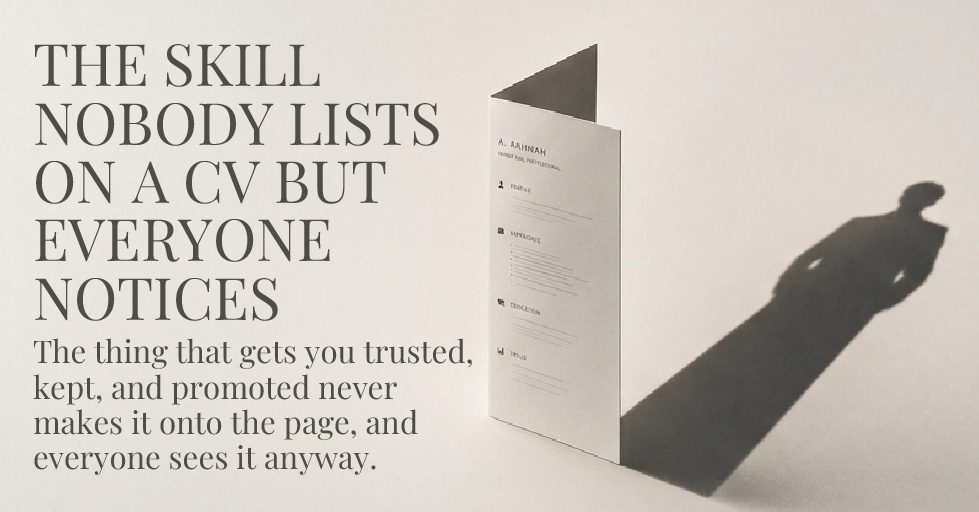
The thing that gets you trusted, kept, and promoted never makes it onto the page, and everyone sees it anyway.
There’s one skill that decides who gets trusted with real work, and it isn’t on your CV. You can’t put it there, not convincingly, because the moment you claim it, you weaken it. But everyone you work with sees it within about two weeks.
It’s whether you do what you said you’d do.
It sounds unglamorous, and it is. You spent years earning a degree, learning the software, building a portfolio, and you want to be hired for the impressive things. You will be, partly. But you’ll be kept and promoted for something much quieter: reliability. The person who closes the loop. Who sends the file when they said they would. Who remembers the small thing mentioned in passing and follows up without being chased.
Consider one number. In a survey of more than a thousand US hiring managers by Express Employment Professionals, dependability came out as the top soft skill, called essential or very important by 90 percent of them, ahead of communication and willingness to learn. Read that again. Ahead of communication. The people doing the hiring are saying plainly that what they want most is someone they don’t have to worry about.
So here is the advice worth taking to heart early.
Be early to the boring stuff. Anyone can perform for the big presentation. What people notice is whether you show up prepared for the Tuesday status call nobody cares about. Those small, low-stakes moments are where you actually build your reputation, because that’s where most people relax and let things slip. Stay consistent there and you stand out without trying.
Underpromise in the room, then quietly overdeliver. When a manager asks if you can have something by Thursday, resist the urge to say yes just to look eager. Say Friday, and hand it in Thursday afternoon. You’ve done two things: protected yourself from a missed deadline, and trained everyone around you to trust your word. A reputation for being accurate about your own time is worth more than any single piece of work.
Close the loop, always. This is the cheapest, most overlooked habit in professional life. Someone asks a question, you reply. A task finishes, you tell the person who was waiting. You can’t make a meeting, you say so in advance. None of this is hard. Most people simply don’t do it, which is exactly why doing it makes you visible.
Treat your composure as part of the job. When something breaks, and it will, the people watching won’t remember the problem nearly as much as they remember how you handled it. The colleague who stays steady, names the issue, and starts solving it earns a kind of trust that can’t be manufactured later. Panic is loud. Calm gets noticed.
Make other people look good. The quietly powerful person on any team is the one who gives credit away and makes colleagues better at their jobs. It costs nothing, and it comes back in every reference and every quiet word said about you in a room you’re not in.
The CV gets you into the room. Your reliability gets you the job.
Now the part that matters for the job hunt itself. You can’t write “reliable” on your CV and expect it to land. Everyone writes that. You prove it in the process. You reply to emails when you say you will. You arrive on time for the interview, having done your homework. You send the follow-up you promised. By the time they’re deciding, you’ve already shown them the thing they most want to see, without once naming it.
Picture two equally qualified people going for the same role, identical on paper. The one who gets it is usually the one who felt safer to bet on. They returned calls. They remembered details. They did the small things they said they’d do, all the way through. The CV got them into the room. Their reliability got them the job.
There’s a real irony here. The things that get you hired are the things you can list: your qualifications and your experience. The things that get you trusted and promoted are the things you can’t. They live off the page, in how you carry yourself when nobody’s grading you.
So polish your CV. Learn the hard skills, all of them. But understand that the document is only your ticket to the table. What you do once you’re there, whether your word holds, whether you finish what you start, whether people can stop worrying about you, that’s the part everyone notices and nobody can fake for long.
Be the person others don’t have to chase. When everyone has talent, that alone will set you apart.
— BBF Monthly