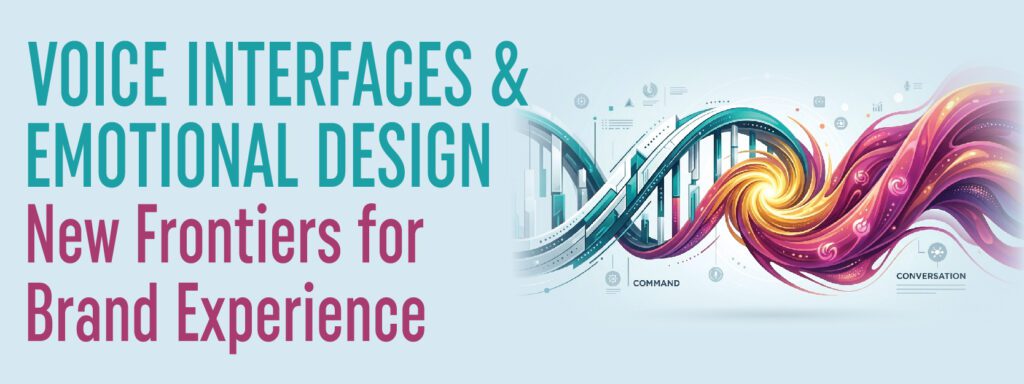
From Commands to Conversations: The Voice Revolution
Not long ago, voice interfaces were novelties — party tricks that set timers and played requested songs. That era is over. In 2026, voice technology has crossed from experimental convenience to mission-critical brand infrastructure. The United States alone will have approximately 157 million voice assistant users by year-end, according to eMarketer. Globally, 82% of companies are already deploying voice technology, with 85% anticipating widespread adoption within five years. The conversational AI market is projected to grow from $14.29 billion in 2025 to $41.39 billion by 2030, at a compound annual growth rate of 23.7%.
What has changed is not merely scale, but character. Early voice assistants — Alexa, Siri, Google Assistant — were transactional, scripted, emotionally neutral command-response systems. The voice interfaces of 2026 are categorically different. Powered by large language models and emotional AI, they parse not just what users say but how they say it — detecting stress in pitch variation, joy in tempo acceleration, frustration in hesitation patterns. Startups like Hume AI are building voice systems expressly designed to read and respond to nuanced emotional cues. OpenAI’s latest multimodal models interpret tone and imagery simultaneously. Voice has crossed a threshold: it is no longer a channel. It is a relationship.
For marketing strategists, this demands an urgent rethink. In a world where consumers initiate buying journeys through voice — searching, comparing, ordering, evaluating through spoken conversation — the quality of a brand’s voice presence is as strategically vital as its visual identity. Brands that ignore this frontier do not simply miss an opportunity. They cede control of their most intimate customer touchpoints to platforms and competitors who have already mastered the art of sounding human.
What Is Emotional Design — and Why It Matters for Brands
The concept of emotional design is not new. Don Norman articulated its foundations decades ago, identifying three psychological levels at which products engage users: the visceral (immediate sensory impact), the behavioural (ease and effectiveness), and the reflective (the meaning and identity a product confers on its user). What is new is the ability to engineer emotional experiences across all three levels simultaneously, at scale, through AI-powered voice — adapted in real time to each individual user’s emotional state.
For brands, emotional design represents a fundamental evolution in how value is created. Functional design solves a problem. Emotional design creates a feeling. And feelings drive loyalty far more powerfully than features. Harvard Business Review research shows that emotionally connected customers are more than twice as valuable over their lifetime as highly satisfied customers who lack emotional connection — they buy more, recommend more, and are dramatically less price-sensitive. The fastest-growing companies of 2025-26 are not those with the best products alone. They are those generating the strongest emotional resonance across their touchpoints.
Voice is uniquely powerful as an emotional medium. Sound reaches the brain’s emotional centres — the amygdala and hippocampus — faster than visual stimuli. A calm voice slows breathing; warmth in vocal texture generates trust; energetic cadence increases alertness. Where a visual logo communicates brand identity to the conscious mind, a voice communicates it to the nervous system. Every element of a brand’s voice — its pace, pitch, timbre, vocabulary, emotional responsiveness — is simultaneously a marketing decision and a psychological intervention.
The Architecture of Voice Brand Experience
Sonic Identity: The New Brand Logo
Every mature brand has a visual identity system. In the age of voice-first interfaces, its equivalent is a sonic identity — a strategically designed audio persona spanning voice tone, notification sounds, music, vocabulary, and the emotional register of every interaction. Research consistently validates the commercial case: consistent sonic branding increases brand recognition by 36% compared to visual branding alone. MasterCard’s comprehensive sonic brand delivered a 77% boost in brand trust metrics. Companies implementing structured audio brand strategies achieve 73% higher brand recall rates.
The most instructive examples reveal what separates sonic identity that works from sonic identity that merely exists. Netflix’s two-second ‘ta-dum’ — now identifiable to 93% of users from sound alone — sets emotional context in under two seconds without a word or image. Intel’s five-note chime has sustained brand recognition across three decades. Air France’s use of ‘The Flower Duet’ communicates luxury and serenity before a passenger boards. These are not decorative choices — they are precision emotional engineering, deploying sound to trigger specific psychological states that reinforce brand positioning.
Voice Persona: The Brand as a Person
Beyond sonic logos, leading brands in 2026 are investing in a complete voice persona — a distinctive, consistent personality expressing brand values through every spoken interaction. A luxury label deploys a calm, measured, intimate tone signalling exclusivity. A fintech challenger uses a brisk, reassuring voice communicating confidence. A children’s platform maintains warmth and gentle encouragement throughout. Each is a deliberate architecture of emotional cues, as considered as a flagship store’s interior design. The risk of AI-generated voice is homogeneity: brands using generic models risk sounding indistinguishable from their competitors. The brands winning this space invest in genuinely proprietary vocal identities — voices that could not belong to any other brand.
| BRAND IN ACTION
Netflix |
The Two-Second Emotional Contract
The iconic ‘ta-dum’ sonic logo — just two seconds of audio — is identifiable to 93% of users from sound alone. It sets anticipation, comfort, and the promise of immersive storytelling before a frame plays, functioning as the most effective brand logo in modern marketing. |
| BRAND IN ACTION
Starbucks |
Voice Ordering as Relationship
Starbucks’ voice ordering system — ‘Order my usual coffee’ — learns and remembers individual preferences across interactions. The result feels not like a transaction but like a relationship with a barista who knows your name, transforming convenience into emotional connection. |
| BRAND IN ACTION
Domino’s India |
Emotion-Aware Ordering at Scale
DomVoice, deployed across WhatsApp Voice and in-car assistants, detects hunger urgency and excitement levels from vocal tone, then recommends meal combinations dynamically — increasing upsell rates while making customers feel intuitively understood. |
Emotional AI: When Brands Learn to Listen
The most transformative development in voice brand experience is not voice output — it is voice input. Emotional AI gives brands, for the first time, the ability to listen to how their customers feel, not just what they say. Systems from Hume AI and others can now adapt tone, pace, vocabulary, and emotional register based on continuous real-time analysis of the user’s vocal cues. Gartner reports that emotionally intelligent voice systems reduce customer service escalations by 25% — not by resolving issues faster, but by making customers feel genuinely heard. The emotional AI market is growing to $37.1 billion by 2026, at an 11.3% annual rate.
The marketing implications extend far beyond customer service. A retail brand whose voice interface detects mild uncertainty in a shopper’s voice during product exploration can shift automatically into a warmer, more patient mode — reducing purchase anxiety and increasing conversion. A financial services platform sensing stress during a complex transaction can slow its cadence, simplify its language, and express empathy before continuing. Automotive brands are among the most advanced adopters: several 2026 vehicle models include mood-aware systems that adapt interior lighting, music, and voice personality based on real-time driver stress signals. The car, in this design paradigm, becomes a brand experience that knows you.
The Ethics of Emotional Design: Trust, Not Manipulation
The power of emotional voice design carries proportional ethical responsibility. The ability to detect frustration and engineer emotional states in real time is, at its best, genuine empathy at scale. At its worst, it is manipulation — using intimate knowledge of a consumer’s psychological state to push decisions they might otherwise avoid. Leading brands and UX practitioners have coalesced around three principles: transparency (being explicit with users about what emotional data is collected and how it is used), consent (giving users real control through simple opt-out mechanisms), and genuine utility (designing emotional responsiveness that serves the user’s actual needs, not only the brand’s conversion targets). As the UX Design Institute notes, designers must ensure emotional features ‘feel natural and supportive, while being transparent about what the system is doing.’
Privacy is equally critical. Voice data is among the most intimate data a person can share — it carries emotional state, health signals, and social context that far exceeds what a click-stream can reveal. Brands deploying emotional voice AI must match their data governance to the sensitivity of what they collect. The brands earning lasting consumer trust in this space will be those treating emotional data as a sacred trust, not a marketing asset to be mined.
What Brand Leaders Must Do Now
The strategic imperative is clear — and the execution window is narrowing. Voice and emotional design are moving from early-adopter advantage to category expectation at pace. Four priorities define the roadmap for brands that intend to lead. First, audit your existing voice presence. Most brands have accumulated a scattered sonic identity across IVR systems, apps, advertising, and customer service — inconsistent in tone, emotional register, and vocabulary. A comprehensive voice audit maps what emotional signals are currently being sent, versus those that should be. Second, define your voice persona with the same rigour applied to visual identity: who is your brand when it speaks? What emotional states does it create? Document the answers in a Voice Brand Guidelines document as formal as any visual style guide.
Third, invest in proprietary sonic assets. A custom voice AI, distinctive notification sounds, a brand-specific audio logo — these are the sonic equivalent of a trademark in 2026. Brands relying on generic platform voices risk disappearing into an undifferentiated market. Fourth, measure relentlessly. Brand recall tests, emotional response surveys, sentiment analytics tied to voice touchpoints, and NPS movements should form a continuous feedback loop. Emotional design, like any design discipline, improves through rigorous testing and evidence-based iteration.
“Function earns a transaction. Emotion earns loyalty. Voice is the medium through which emotional brand experience is most directly — and most powerfully — delivered.”
Conclusion: The Brand That Feels Wins
The convergence of voice interfaces and emotional design represents one of the most significant shifts in brand experience since the emergence of the internet. At its core, it reflects a fundamental truth about how people form relationships with brands: they choose brands they feel connected to, trust brands that make them feel understood, and advocate for brands that make them feel something worth sharing. Voice, in 2026, is the medium through which that emotional contract is most directly honored. The brands investing now in sonic identity, voice persona, emotional responsiveness, and ethical data governance are not simply preparing for a new channel. They are building the most durable competitive asset available in modern marketing — a brand that does not just speak to its customers, but genuinely listens to them.
KEY SOURCES & REFERENCES
eMarketer — Voice Assistant User Forecast 2025–2026 · Springs AI — Conversational AI Trends 2025-2026 · Hume AI — Emotional Voice Intelligence Research · UX Design Institute — Top UX Design Trends 2026 · Kantar — Sonic Branding & Brand Power Research · Spinta Digital — Voice AI Marketing 2026 · Harvard Business Review — Emotional Connection & Customer Value · Don Norman — Emotional Design (Foundational Framework) · Masterofcode — Voice Assistants: AI Use Cases for Businesses 2026 · Next Level AI — Voice AI Trends: Enterprise Adoption & ROI
Author: BBF Marketing Desk