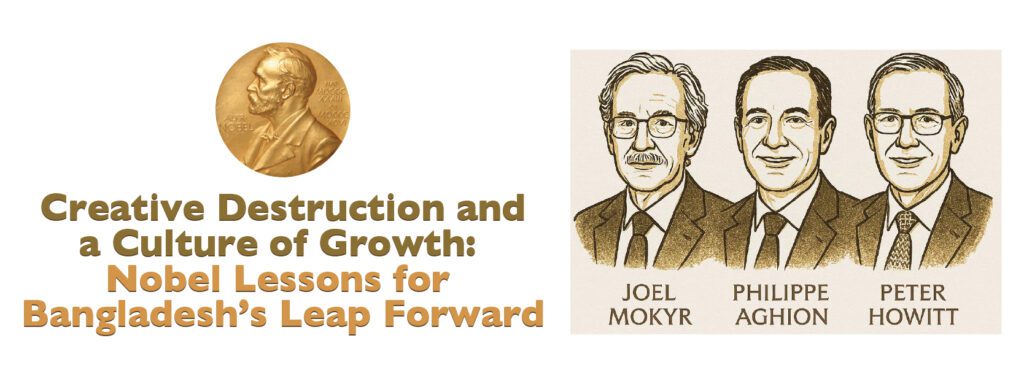
As an economics student, I often wonder: Why do some countries sustain growth while others stagnate? The 2025 Nobel Prize in Economic Sciences gave us a powerful answer to this thought. The Nobel Memorial Prize in Economic Sciences went to Joel Mokyr, Philippe Aghion, and Peter Howitt for their work on innovation-driven growth and creative destruction, the process by which new technologies replace old ones, driving productivity forward.
Bangladesh is at a turning point. With LDC graduation scheduled for November 2026, the country will lose some trade preferences and face tougher global competition. To thrive, we need more than cheap labor; we need innovation, strong institutions, and openness to change. That’s exactly what the Nobel winners emphasise.
What Did the Nobel Winners Teach Us?
- Joel Mokyr explains that sustained growth comes from a culture that values knowledge and openness. During the Industrial Revolution, societies that embraced science and technology surged ahead.
- Philippe Aghion & Peter Howitt developed the Schumpeterian growth model, showing that economies grow when firms innovate and old technologies are replaced in a cycle called creative destruction. They also highlight the role of competition policy: enough rivalry to push innovation, but not so much that firms can’t recover R&D costs.
What Makes Their Work Revolutionary?
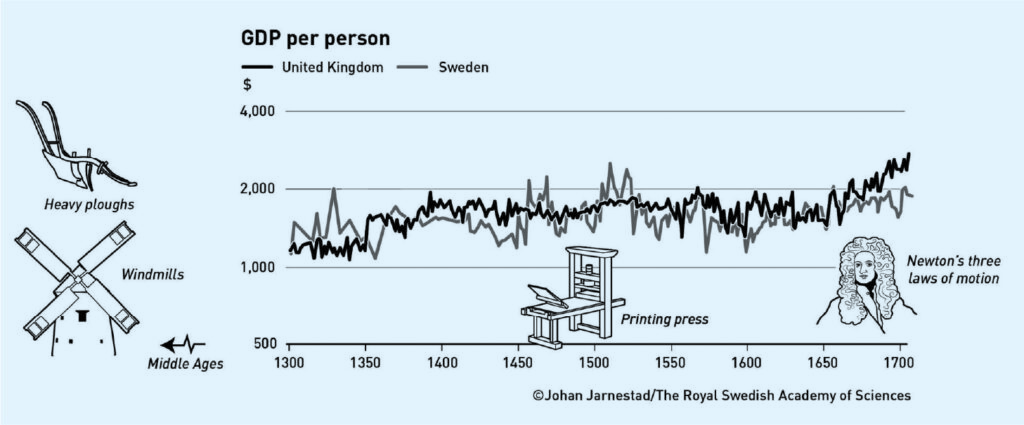
For most of human history, economies barely grew. Technological breakthroughs happened occasionally, but progress stalled because societies lacked the mindset and institutions to sustain innovation. The 2025 Nobel laureates, Joel Mokyr, Philippe Aghion, and Peter Howitt, explained why this changed and how it continues to shape the modern world.
Joel Mokyr: The Historian of Ideas and Growth
Mokyr’s research answers a fundamental question: Why did sustained growth begin in Europe after centuries of stagnation? His books, such as A Culture of Growth and The Enlightened Economy, argue that the Industrial Revolution was not just about coal or machines; it was about ideas. During the Enlightenment, Europe embraced curiosity, scientific reasoning, and openness to change. This cultural shift created what Mokyr calls the Industrial Enlightenment, where practical know-how (“how things work”) combined with scientific understanding (“why things work”).
This fusion allowed continuous improvement. For example, the steam engine advanced because scientists understood atmospheric pressure, and steel production improved through insights into oxygen’s role in refining iron. Mokyr also showed that institutions mattered not just governments, but networks of craftsmen, academies, and professional societies that spread knowledge. His work reminds policymakers today that innovation thrives in societies that value science, tolerate disruption, and build platforms for knowledge exchange.
Philippe Aghion & Peter Howitt: Making Creative Destruction Operational
While Mokyr looked back, Aghion and Howitt looked forward. In their landmark 1992 paper in Econometrica, they transformed Joseph Schumpeter’s famous phrase “creative destruction” into a rigorous economic model. Their Schumpeterian growth theory shows that economies grow when firms innovate to climb a “quality ladder.” Each new product or process replaces an older one, creating winners and losers. This cycle is both creative (new ideas raise productivity) and destructive (old technologies and jobs disappear).
Their model explains why competition and innovation are linked: firms race to innovate because temporary monopoly profits reward success. But it also warns that too much protection for incumbents stifles innovation, while too little protection for inventors kills incentives. This framework now underpins debates on R&D subsidies, patent policy, and competition law worldwide. It has been cited over 17,000 times and applied to issues like trade, inequality, and climate policy.
Why It Matters Globally
The laureates’ insights explain real-world patterns. In the U.S., about 10% of firms exit annually while new ones enter, showing the churn behind steady GDP growth—similar dynamics power tech hubs from Silicon Valley to Shenzhen. Globally, innovation-driven growth has lifted billions out of poverty: world GDP per capita rose more than 10-fold since 1820, breaking the Malthusian trap. Today, countries invest heavily in R&D, and corporate spending reached US$1.2 trillion in 2023, led by the pharma and ICT sectors. Yet the Nobel committee warns: growth is not automatic. Without openness, competition, and investment in ideas, economies risk stagnation.
South Korea exemplifies Aghion and Howitt’s creative destruction in practice. After decades of export-led growth, Korea shifted toward innovation-driven policies in the 1990s, investing heavily in R&D (4.9% of GDP in 2024, among the world’s highest). This enabled global leadership in semiconductors, EV batteries, and AI manufacturing. Firms like Samsung and LG climbed the “quality ladder,” displacing older technologies and creating new markets. Government-backed programs scaled SMEs and startups, while competition policy ensured dynamic churn. Today, Korea ranks 6th in the Global Innovation Index, proving that sustained growth requires openness, strong institutions, and relentless innovation.
For Bangladesh, these ideas mean one thing: we must welcome disruption and prepare for it.
Bangladesh’s Economic Reality: Progress with Pressure
- Exports: Bangladesh earned US$50 billion in exports in 2024, mostly from ready-made garments (RMG), but other sectors like footwear and agro-products are growing.
- Inflation: Prices remain high at 8.36% in September 2025, after easing slightly in August. This hurts households and raises wage pressures.
- Growth outlook: Global institutions project moderate GDP growth (around 5%) for FY2024–25, with risks from global demand and domestic reforms.
- LDC graduation: On 24 November 2026, Bangladesh will lose duty-free access in some markets. Competing will require higher productivity and compliance with global standards.

Creative Destruction in Action: The RMG Example
Our garment sector, the backbone of exports, is automating fast. A 2024–25 study found 30–31% fewer jobs in some production lines due to automation, especially in sweater factories and cutting sections. New roles demand higher skills. Researchers call for a “Just Transition”: reskilling, redeployment, and social dialogue.
This is Schumpeter’s “gale of creative destruction” in real life. If we manage it well, automation can boost productivity and competitiveness. If not, it can deepen inequality and unrest.
Building a Culture of Growth: Nobel Lessons Applied
- Openness to Ideas (Mokyr’s Insight)
Bangladesh needs institutions that welcome innovation, transparent rules, reliable data, and fair competition. Without trust in the system, entrepreneurs won’t take risks.
- Innovation and Competition (Aghion & Howitt)
Policies should encourage R&D, protect intellectual property, and ensure healthy competition. Too much monopoly kills innovation; too much cut-throat rivalry kills profits.
- Diversification and Digitalization
- Export Policy 2024–27 aims to reduce dependence on garments by promoting ICT, agro-processing, and light engineering.
- Digital adoption is enormous: 185 million mobile connections and 77.7 million internet users. Bangladesh Bank’s interoperable payment system (NPSB), launched in November 2025, has cut transaction costs and boosted financial inclusion.

- Energy Transition for Competitiveness
Bangladesh targets 20% renewable energy by 2030. Solar is growing, but financing and policy consistency are key. Clean energy lowers costs and meets global sustainability standards.
- Managing Inequality and Reskilling
Poverty was 18.7% in 2022, and inequality (Gini = 0.499) is rising. Safety nets must improve targeting, and large-scale skills programs are needed to help workers move from routine jobs to tech-driven roles.
Ten Practical Steps for Bangladesh
- Negotiate trade deals post-LDC graduation to keep market access.
- Boost R&D funding and protect intellectual property.
- Expand startup financing through venture funds and angel networks.
- Scale renewable energy with bankable contracts and rooftop solar.
- Enforce digital interoperability to formalize MSMEs and enable credit scoring.
- Upgrade education with STEM and vocational training.
- Reskill garment workers for automation-era jobs.
- Improve safety nets with digital targeting and shock response.
- Strengthen competition policy to prevent monopolies and encourage innovation.
- Publish reliable data to build investor confidence.
Bangladesh’s success so far came from a cost advantage. The next leap will come from ideas and institutions. The 2025 Nobel winners remind us: growth is not just about adding factories, it’s about creating an environment where innovation thrives, and society adapts.
Creative destruction is not a threat; it’s an opportunity, if we build a culture that turns disruption into progress.
Sources
- Nobel Prize 2025: Royal Swedish Academy of Sciences; CNBC; NBER. [econlib.org], [jstor.org]
- Bangladesh exports: The Daily Star.
- Inflation: TradingEconomics; The Daily Star.
- RMG automation: BLF/BRAC University study. [cpd.org.bd]
- Export diversification: Govt Export Policy 2024–27. [ubs.com]
- Energy transition: Chambers; Financial Express. [data.worldbank.org], [nobelprize.org]
- Poverty & inequality: UNICEF COAR; CPD analysis. [worldometers.info], [just-style.com]
Author: Abu Yousuf Abdullah