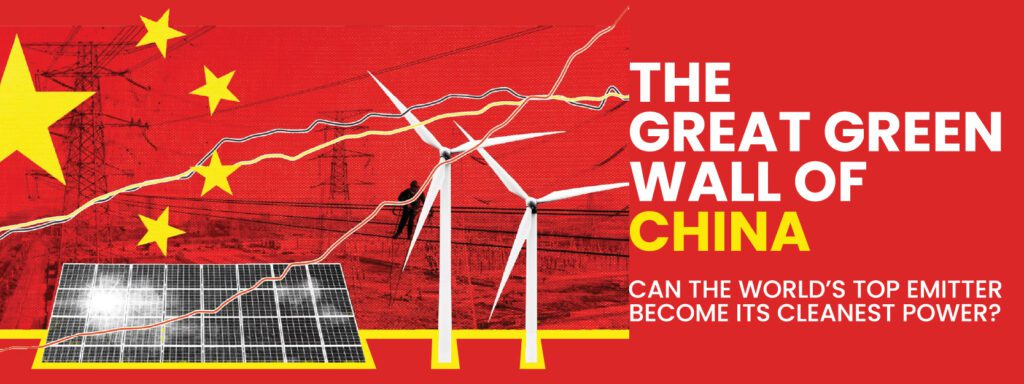
Speaking via video at the UN Climate Summit in New York, China’s president Xi Jinping outlined his country’s climate ambitions. Although the stated goals may not have been as ambitious as some environmentalists desire, Xi at least reaffirmed China’s commitment to green initiatives.
“Despite some countries going against the trend, the international community should stay on the right track, maintain unwavering confidence, unwavering action, and undiminished efforts,” he said. Any reference to Donald Trump and the United States was surely intended.
The world is a long way from the COP26 conference in November 2021, when addressing the threat of climate change seemed like a top global priority. A few months later, Russia invaded Ukraine; the resulting energy crisis and inflation pushed climate issues further down many political agendas.
While Joe Biden and the United States responded to soaring prices with the Inflation Reduction Act, which focused on investing in renewable energy, Donald Trump later withdrew the US from the Paris Agreement—an international treaty to curb global warming—for a second time. The European Union has also faltered: Too internally divided, it failed to go beyond a lacklustre declaration of intent at the UN Climate Summit. There hasn’t been much progress from India, a country of nearly 1.5 billion people. And other nations’ emissions are simply too small to be significant.
Given this background, it becomes easy to understand how, in this scenario, China has become a global leader in the clean energy transition.
BEIJING, ALONE, THE HONOURED ONE?
China has committed to reaching peak carbon emissions before 2030 and achieving carbon neutrality by 2060. It is rapidly developing new industries and energy infrastructure on an unprecedented scale and pace worldwide. This pledge, supported by investments, encourages a new wave of companies to invest in research, leading to nearly a 70% rise in spending from 2018 to 2023.
Mobility has historically been a challenge for China, transitioning from bicycles, which were common until the 1990s, to a widespread automobile culture. The images from the 2008 Beijing Olympics are unforgettable: a thick smog covered the city. Recently, the government has significantly promoted electric mobility. China leads the world with the largest producers of lithium-ion battery components, essential for EVs. Chinese EV battery manufacturers held a 60% share of the global market and increased their exports by 30% year-over-year in 2023. Additionally, the country is home to major automotive companies like BYD and CATL, which supply batteries to around 50 international brands, including Tesla and Volkswagen.
In New York, Xi recognised the importance of the transition and agreed to reduce greenhouse gases, moving beyond just promising to slow emissions. China’s goals are a 7% and 10% reduction by 2035. Although vague, this is significant; previously, China only promised to peak emissions by 2030, linked to economic growth. Xi’s speech signals China shifting from a developing-country approach to one more like that of industrialised nations, whose emissions have declined for decades.
China is equally committed to low-emission hydrogen, a clean energy source that produces steam instead of smoke. The largest green hydrogen project globally is in China, which also hosts about 40% of the world’s hydrogen refuelling stations. These stations support a small but rapidly expanding number of hydrogen fuel cell vehicles.
The International Energy Agency’s assessment of the goal to triple renewables by 2030 noted that China was mainly responsible for the 50% rise in global renewable installations in 2023. In 2022, China installed nearly as much solar PV capacity as the rest of the world combined. In 2023, it doubled new solar capacity, increased new wind capacity by 66%, and nearly quadrupled energy storage additions.
China’s affordable solar panels are powering rural communities in Zimbabwe, while Chinese electric vehicles- offering affordable, clean transportation from Mexico to Thailand- are gaining popularity. The country’s focus on sustainable development also eases emission reduction efforts for others. In New Zealand, aiming for net-zero emissions by 2050, China supplied 89% of solar PV equipment by value in 2023.
China’s power market reforms have shifted electricity trading from fixed tariffs to competitive wholesale markets, market-based ancillary services, and cost shifts to consumers. Renewable projects face intensified price cannibalisation due to expanding spot markets.
Before 2015, developers competed by expanding capacity quickly and leveraging government ties for approvals. The model became unsustainable as demand slowed, prompting reform. Progress varies across provinces, and China’s market remains different from global norms, presenting both challenges and a unique case study for the global energy transition.
Over 800 large Chinese companies have committed to achieving carbon neutrality by 2050. They are implementing energy-efficient automated processes and AI across various sectors, from agriculture to manufacturing. A prominent Chinese cloud computing firm uses AI to optimise energy use in data centres, commercial buildings, and Olympic stadiums. Additionally, automation has enabled a major dairy company to boost operational efficiency by 19%.
Some companies are directly benefiting from sustainable AI. A Chinese agri-tech startup uses drones and algorithms to gather and analyse soil and weather data, aiming to reduce water and fertiliser use while boosting crop yields. A prime example is Sichuan’s first zero-carbon factory, where AI continuously monitors data and algorithms optimise energy use, helping the company cut 400,000 tons of carbon emissions annually, according to reports.
China has been the world’s largest emitter of greenhouse gases for two decades, using as much coal as the rest of the world combined. How did it become a renewable powerhouse?
PLAYING THE LONG GAME
Some of the answer traces back to investment choices made in the mid-2000s, when China’s long-standing rapid GDP growth was slowing down. Increasing labour costs and China’s development approach—heavily reliant on coal—led to multiple crises involving air, soil, and water pollution. During the first decade of this century, China’s emissions more than doubled, and by 2006, it had surpassed the U.S. to become the world’s largest greenhouse gas emitter by volume.
China’s leadership was aware of the diplomatic risks of being the world’s worst polluter, especially for vulnerable countries. Meanwhile, climate impacts, pollution, and public unrest were growing concerns in Beijing’s top policy talks. China sought investments for advanced technology, environmental cleanup, and emission reduction, aligning with global efforts to develop renewable energy to prevent a climate disaster.
In every five-year plan, China invested strategically in renewable tech like solar, wind, green hydrogen, geothermal, and battery supply chains. During the 1990s industrial growth, China licensed foreign technologies. Now, it aims to dominate the field and become a leading global supplier in a carbon-constrained world.
Within a decade, China largely achieved dominance in solar and wind tech, establishing a near monopoly over supply chains, including mining and processing rare-earth and strategic minerals vital for clean energy. Today, China holds over 80% of global solar manufacturing. Its vast renewables output has lowered prices globally, helping poorer countries adopt renewable systems.
While China has been clear about the opportunities presented by climate change, it has been less eager to reduce its own emissions. During the first two decades of the century, its economy heavily relied on coal, and China argued that strict emission cuts would unfairly hinder its development rights. This stance began to shift when President Xi Jinping unexpectedly announced at the 2020 U.N. General Assembly that China would peak its emissions “well before” 2030, fulfilling its 2015 Paris Agreement commitments. Additionally, China committed to achieving carbon neutrality by 2060. Meeting these ambitious targets will require a significant expansion of renewable energy programs.
Xi Jinping’s announcement drew global attention, but its strongest impact was domestically. It signalled strong support for renewable investments in China, prompting state-owned enterprises, including traditional energy firms, to take notice of Xi’s message and related policies. The National Energy Administration (NEA) acknowledged new policies and mechanisms were necessary to meet Xi’s targets.
Massive wind farms operate in northern China, and new utility-scale clean energy bases are planned for the western deserts. These combine solar arrays and wind farms connected to eastern markets via high-speed transmission lines, leveraging high solar radiation and cheap land. China aims to build over 200 bases to reach about 3.9 terawatts of renewables capacity by 2030, tripling its 2022 total.
Besides desert projects, the NEA promised in 2021 to improve rural grid transmission and enable village collectives to invest in distributed renewable energy, sharing benefits. To boost rooftop solar, NEA launched the Whole County PV program, a pilot scheme to install photovoltaics in about half of China’s county-level rural areas, covering roughly a quarter of the population. The goals included providing solar to 20% of residences and setting separate targets for commercial buildings.
Utility-scale projects overlooked China’s rural populations. A rural model allowing customers to both draw and sell energy was a radical shift for in China’s traditional grid. The NEA aimed to include rural areas in the renewable push. By end of 2022, 676 counties adopted the scheme, with over 51 gigawatts of distributed solar installed—half on rooftops. China’s total distributed PV capacity reached about 157 gigawatts, more than twice the U.S.
Today, the renewables sector is a rare bright spot in China’s economy, boosted by government stimulus to recover from Covid-19 impacts. The huge real estate market, which supported GDP for over 30 years, is near collapse. The pandemic and global downturns hurt exports, and cautious consumers are hesitant to spend. While renewable energy shows promise, realising its potential requires further radical reforms.
Renewables currently make up 50% of China’s installed capacity. However, there has been a rise in permits for new coal-fired power plants, and approximately 70% of China’s electricity is still produced from fossil fuels. This indicates that the actual use of renewable energy is behind its installed capacity.
Reducing emissions at Beijing’s promised rate would mean about a 1% decrease annually. William Lamb of the Potsdam Institute for Climate Impact Research noted that this is slower than the reduction rates of most industrialised nations. For instance, Italy has cut emissions by an average of 3.2% each year since their peak in 2006; the UK by 2.8% since 2004; and France by 2.3%.
“China has often promised little and achieved much,” notes Andreas Sieber, associate director for policy and campaigns for the global climate nonprofit 350.org, suggesting that China might overdeliver. The country’s lack of democracy also means its policies are not at risk of reversal every election cycle.
To maximise its renewable capacity, China acknowledges that power system reforms are essential and long overdue. The National Development and Reform Commission has outlined plans to establish a unified national power market by 2030, which involves integrating its six regional grids into a single nationwide electricity system to more effectively manage supply and demand variations. Successfully implementing this could strengthen China’s role as the world’s leading producer of renewable energy and improve its utilisation of clean energy sources.