Scroll through your phone right now. Past the third screen. The fourth. The apps you downloaded after a friend recommended them, the habit trackers you used for three days in January, the delivery service you tried once and forgot, the fitness app from last year’s resolution, the meditation tool you told yourself you needed. Most of them have not been opened in months. Some have never been opened a second time.
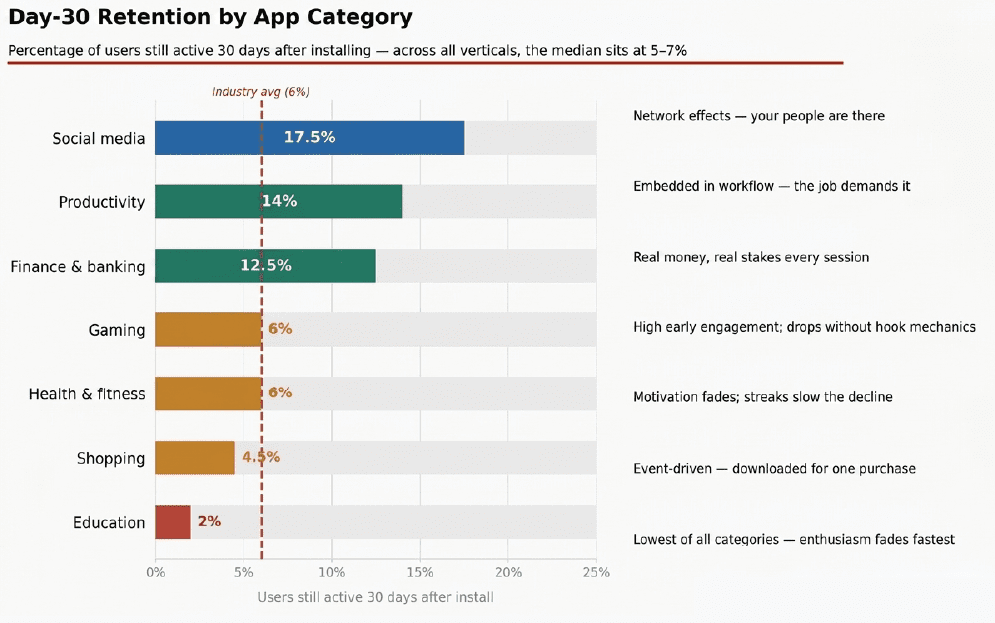
You are not unusual. 25% of apps downloaded globally are opened once and never opened again. 77% of users abandon an app within 3 days of installing it. By day thirty, ninety percent are gone. The average day-thirty retention rate across all app categories is between 5% and 7%. In education apps, it drops to two percent. In entertainment, three percent. The app economy generates over $377 billion annually and continues to grow. It is also, by any measure of user engagement, a graveyard.
The more interesting question is not why people abandon apps. It is why they downloaded them in the first place — and what that gap between intention and behaviour reveals about consumer psychology, digital product design, and the limits of an industry built almost entirely on the assumption that more downloads means more value.
Why we download things we will never use
The download is an act of optimism. When someone taps the install button on a meditation app at 11pm, they are not making a rational calculation about their future behaviour. They are imagining a version of themselves — calmer, more focused, better organised — who will use this tool and become that person. The app is not really the product being purchased. The self-improvement narrative is.
Behavioral psychologists call this the intention-behavior gap: the well-documented tendency of human beings to overestimate how much they will act on their intentions. People consistently predict they will exercise more, eat better, and save more money than they actually do. Digital apps sit inside this gap with particular comfort, because the act of downloading costs almost nothing. There is no financial commitment to weigh. No scheduling friction to navigate. The download takes four seconds. It creates the sensation of having done something productive without requiring any of the effort that the app itself would demand.
The tool psychologists use to describe this is optimism bias — the tendency to believe that future-you will behave differently from present-you. Present-you downloads the app and feels, briefly, that the project has begun. It rarely has.
There is a second psychological driver operating below the optimism: what researchers call digital hoarding. The zero marginal cost of downloading creates a collector instinct. Physical objects have weight, price, and spatial limits. A book you never read occupies shelf space. An app you never open occupies forty-seven megabytes and a spot on page four of your phone. The cost of keeping it is so low that deleting it feels like closing a door. You might need it. You might go back to it. The app stays, and so does the fiction that you might use it.
“High levels of screen time have a dual negative impact on our bodies and nervous system. They keep our nervous system in a constant state of stimulation and arousal, while also pushing it toward shutdown or dissociation. Our bodies are not designed to take in or process the volume of information and sensory input that extensive screen use demands.”
Social influence adds another layer. Apps spread through social environments — a colleague mentions it, a group chat shares a link, an influencer features it in a routine video. The social signal is powerful enough to trigger a download even when the use case is thin. The app arrives on your phone as a social artifact as much as a functional tool. Once the social moment has passed, the functional case was never strong enough to sustain engagement on its own.
How apps are designed for the download, not the return
The mobile app economy is built on a metric that measures the wrong thing. Downloads are visible, trackable, and easy to attribute to marketing spend. They move up and to the right on dashboard charts. They satisfy investors. Retention is slower, messier, and harder to link to any single decision. So the industry built itself around acquisition — acquiring users as cheaply as possible and worrying about engagement afterward.
The downstream consequence is an enormous structural mismatch. At a cost-per-install of around $4, and a day-thirty retention rate of five percent, the actual cost per retained user is $80. A campaign that acquires 100,000 users at $4 each has spent $400,000 to produce approximately 5,000 people who are still active a month later. The other 95,000 are gone. Their data sits in the database.
The product design has often compounded the problem rather than solved it. Onboarding flows that require account creation before a user has experienced any value lose 47% of users at that single step. Apps that take more than two minutes to onboard lose a meaningful share of first-time users before they have seen the core feature. If a user does not experience the app’s primary value within the first three minutes, they are unlikely to return. Apps that deliver value within three minutes see nearly double the retention of those that don’t. Spotify plays a song. Calm starts a meditation. Duolingo starts a lesson. The apps that retain users are the ones that skip the setup and start the thing.
The notification strategy that most apps use as a retention lever has the opposite effect for a significant proportion of users. Push notifications increase engagement by up to 40% when personalised and behaviorally triggered. Generic daily nudges — the kind that most apps send — accelerate deletion.
The backlash and what it tells us
A visible counter-movement has emerged. People are deliberately deleting apps, auditing their phones, and choosing tools with greater care than they did in the first place. The digital minimalism movement — the deliberate reduction of digital tools to only those that serve a clear purpose — has moved from a niche philosophy into mainstream consumer behaviour. A growing number of users are deliberately dumbing down their devices, removing social platforms, and reducing their active app count to the single digits.
The data on how people actually use their phones supports this. The average user has 80 apps installed and actively uses fewer than ten. More than 60% of all time spent on mobile occurs within social media and messaging apps — a handful of platforms that have won the daily habit wars so decisively that everything else competes for the scraps. The apps that survive are the ones that have become genuinely indispensable: maps, messaging, payments, and whichever social platform has colonised the user’s social group. Everything else is auditioned and discarded.
The streaming industry offers a parallel story. Monthly churn in US streaming services hit 5.5% in 2025, more than double the 2% reported in 2019. Nearly a quarter of US streamers have unsubscribed from three or more services within two years. The subscription model that the app industry adopted wholesale from streaming is beginning to show the same structural cracks — users subscribe in a moment of enthusiasm, consume little, and cancel when the billing reminder arrives. Twenty-three percent of users report having paid for a subscription they did not use at all before canceling.
The apps that survive — and what they do differently
Day-thirty retention varies dramatically by category. Finance apps achieve 10 to 15% day-thirty retention. Productivity apps achieve 10 to 18%. Social apps, at their best, hit 15 to 20%. Education apps sit at 2%. The difference is not primarily about marketing spend or acquisition volume. It is about whether the app delivers clear, frequent, and irreplaceable value quickly enough to survive the first week.
Finance apps retain users because they are connected to real money. Every session has stakes. Budgeting apps that show a user they saved Tk 5,000 last month create a retention driver that no push notification strategy can replicate. The value is concrete, personal, and financial. Users come back because the app knows something about their lives that matters.
 Duolingo has become the standard reference for retention mechanics done right. Its streak system, its anthropomorphised owl, its daily nudges with genuine personality — all of it is designed around one insight: habit formation requires a trigger, a routine, and a reward. Duolingo does not assume the user wants to learn Spanish badly enough to sustain the behaviour independently. It builds the psychological infrastructure of a habit around the behaviour until the behaviour becomes automatic. The app has 180 million downloads and retention rates that most apps would consider extraordinary. It achieved that not by making language learning easier, but by making it feel like losing would be worse than continuing.
CashWalk, the fitness app that rewards users with cash for walking, retains 31% of users after 30 days, a category average of around 5%. The reward is not large. The psychological effect of being paid, however small, for doing something you were going to do anyway is disproportionately powerful. The app has simply inserted a reward loop into a behaviour that was previously unrewarded.
The common thread across high-retention apps is that they do not rely on the user’s initial enthusiasm to sustain engagement. They assume the enthusiasm will fade and build structural reasons to return before it does. They deliver value in the first session rather than at the end of an onboarding process.
The strategy shift that the industry has been slow to make
The implications for app development strategy are specific. User acquisition cost has increased 20 to 30% since Apple’s App Tracking Transparency framework reduced the targeting data available to advertisers. Paid acquisition is more expensive and less precise than it was three years ago. Meanwhile, day-thirty retention rates have not improved meaningfully across most categories. The gap between the cost of acquiring a user and the probability of keeping one has widened to the point where the acquisition-first model is financially precarious for any app without network effects or genuine daily utility.
The industry’s logical response — more aggressive monetisation, higher subscription prices, more intrusive notifications — is accelerating the churn rather than reducing it. The subscription model works when users open the app regularly and derive consistent value. It fails when the app is competing for attention it has not earned.
The product teams that are succeeding in 2026 are the ones that have reoriented their primary metric from installs to time-to-value: how quickly does a new user experience the core reason the app exists? Not the onboarding tutorial. The thing. Spotify plays a song in the first thirty seconds. That is not an accident. Every second of delay between install and value is a user closer to the exit.
“The average smartphone contains 80 apps, though studies suggest most people regularly use fewer than ten. Each unused app represents storage space, potential security vulnerabilities, and cognitive overhead when scrolling through screens.”
For brand-owned apps — the loyalty programmes, the retail companions, the banking tools — the implications are equally sharp. A brand app is competing not just with other brand apps but with WhatsApp, Instagram, and every other tool that has already won a daily slot in the user’s routine. The case for opening a brand app has to be made every single session. It cannot survive on the goodwill of the brand alone. The app has to do something the website does not, deliver something the in-store experience cannot, or create a reason to return that has nothing to do with the transaction. The brands that have figured this out — loyalty programmes with genuine rewards, apps that unlock exclusive access, tools that manage something the user actually needs to manage — retain users. The brands that built apps because building apps seemed like the right thing to do at the time are contributing to the graveyard.
The app economy is not in crisis. It is in a correction. The download numbers will keep growing. The retention numbers will continue to be quietly embarrassing. The gap between them will keep costing app businesses money they attribute to acquisition when they should be attributing it to product. The apps that close that gap — the ones that earn the second session, then the thirtieth, then the habit — are the ones that treat the download as the beginning of a conversation, not the end of one. The ones that don’t will sit on the fourth screen of someone’s phone, unvisited, waiting for a moment of relevance that never comes.
Sources: AppsFlyer — State of App Marketing 2025 (Q1 2026) · Business of Apps — App Retention Rates 2026 · UXCam — Mobile App Retention Benchmarks 2026 · AdAction — Mobile App User Acquisition Cost 2026 · Twinr — Why Users Abandon Apps (Jun 2025) · enable3.io — App Retention Benchmarks 2026 · Statista — Mobile App User Retention by Category · RipenApps — Mobile App Industry Statistics 2026 · Adjust — Mobile App Trends 2026 · Minimalist Focus — Digital Minimalism Guide (Mar 2026) · Newsweek — How to Dumb Down Your Smartphone (Dec 2025) · BroadbandTV — US Streaming Churn Data 2025 · Sendbird — Mobile App Retention Benchmarks · JMIR — When and Why Adults Abandon Lifestyle Apps (Dec 2024)