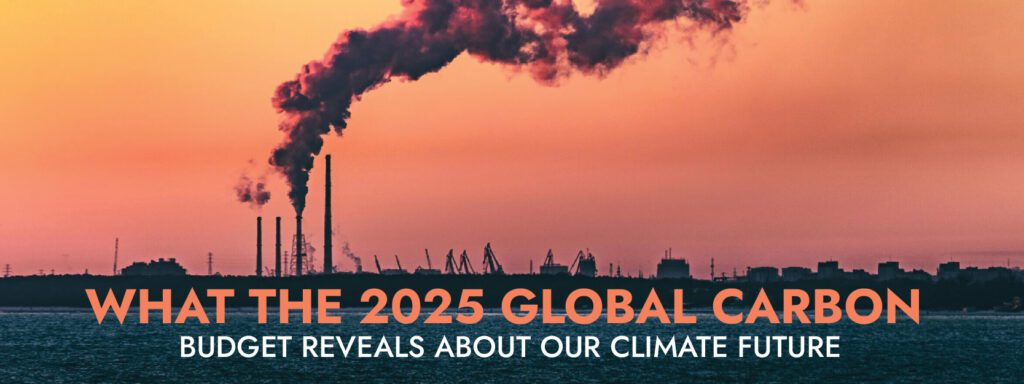
Global carbon emission reduction has been a matter of concern for decades. Although many countries are already working on it, it still seems like a matter of a far-fetched dream rather than a reality, especially after the latest Global Carbon Project assessment, which presented that global fossil fuel emissions will reach the highest point in 2025. The 2025 Global Carbon Budget estimates a 1.1% rise in global CO₂ emissions, surpassing the average growth rate of the last decade. This increase indicates that global emissions have not peaked, which is necessary to meet the Paris Agreement goals in order to curb global warming to a threshold. This alarming increase is an indicator that the world is going in the wrong direction, when emissions should be reduced as much as possible before the worst consequences of climate change occur.
THE PARIS AGREEMENT 2015
The Paris Agreement, adopted in 2015, was aimed at limiting global warming to a significant margin below 2°C, preferably 1.5°C, relative to pre-industrial levels.
It required all 195 participating countries to submit national climate action plans, known as Nationally Determined Contributions (NDCs), on a regular basis and to strengthen them over time.
At its most basic level, the Paris Agreement was expected to ensure that the world reaches peak emissions within the shortest time possible and then quickly reduce them on an annual basis. The 2025 Global Carbon Budget report is alarming as it clearly presents that the world continues to increase its emission levels and is becoming increasingly off track from the target that the Paris Agreement outlined to keep warming within safer levels.
WHY EMISSIONS STILL RISE
Despite many efforts worldwide, carbon emissions are still on the rise. This failure is caused by a combination of a number of interconnected structural and political factors.
The increased world energy demand is partly due to population increase, introduction of excessive energy-consuming technologies, economic growth and post-COVID recovery. Besides, the lack of adequate transition rates in renewable energy, energy efficiency, and other decarbonisation initiatives has grown, and they are too gradual compared to the scale of fossil fuel infrastructure and consumption. Many nations are still largely reliant on coal, oil, and gas as an energy source, heating, transportation, and manufacturing.
The industrial systems around the globe are still essentially dependent on fossil fuels. The 2025 projection highlights that the existing policies and market tools are insufficient to guide the world toward the sharp reduction in emissions mandated by the Paris targets.
THE INDUSTRIAL CARBON EMISSION MARKETS
In 2025, industrial carbon-emission markets are expected to keep growing, and the price of carbon is currently applied to roughly 28% of global greenhouse gas emissions, according to current statistics. The European Union Emissions Trading System, the largest carbon market in the world, remains the best evidence of the effectiveness of carbon pricing. By 2024, the reduction in emissions regulated by the EU ETS was 5% relative to 2023, with total emissions in the system reduced by half compared to 2005, and long-term structural decarbonisation achieved due to higher carbon prices and more precise caps.
ENVIRONMENTAL IMPLICATIONS: WHY IT MATTERS
The environmental effects of carbon emissions growth are significant and far-reaching. And this in turn affects all living organisms and their existence.
Increase in global temperature becomes almost inevitable– as the carbon budget available at 1.5°C is almost exhausted, the chances of exceeding the limit increase to high levels. Even the 2°C limit is at risk without extensive efforts to reduce emissions.
Latex climatic effects: an increase in temperature increases the likelihood of more severe weather, such as heat waves, droughts, floods, and storms. They aggravate sea-level rise, endanger population on the coast, impair ecosystems, diminish biodiversity, amplify the threat of wildfires, and disrupt agriculture with secondary impacts on food security, migration and social cohesion.
Washing away natural carbon sinks- global warming, drought and ecological stress lower the ability of forests, soils and oceans to capture CO₂, forming a vicious cycle. Research shows that land and ocean carbon sinks are already about 15% weaker than they would have been without climatic effects. The reduced absorption causes an increase in CO₂ remaining in the atmosphere and causes additional warming, which in turn worsens sinks.
Weaknesses in intergenerational equity and climate justice: poorer countries, which are the least responsible for emissions, will suffer the worst impacts. This increases inequality, particularly across countries.
With carbon budgets shrinking, the future seems a matter of great concern.
A ROADMAP FOR THE FUTURE
In compliance with the Paris Agreement 2015, many countries have already implemented plans to reduce carbon emissions. According to reports of Global Carbon Projects 2025, emissions in Japan have declined by 2.2%. But the USA, China and India are projected to increase by 1.9%, 0.4% and 1.4%, which are still lower than recent trends. The same report shows that the global CO₂ concentration will reach 425.7 ppm in 2025, which is 52% above pre-industrial levels.
Considering the gravity of the 2025 results, taking steps to reduce carbon emissions has become a matter of life and death. The statistics indicate that the globe is not at high emissions yet. It needs to hit a peak in the coming few years and drastically cut fossil CO₂ faster, move towards renewables, energy efficiency and clean transport.
Taking control of industrial carbon pricing: most modern-day emissions are unpriced or underpriced. Having a well-designed global system of carbon pricing would impose real economic pressure to abandon fossil fuel consumption and jumpstart decarbonization.
Emphasizing the need to reduce emissions and restore carbon sinks, reforestation and nature-based solutions are essential and most reliable in the long term. The focus should be on actual cuts at the point of origin and on naturally protecting and recovering climate-resilient carbon sinks through ecosystem management.
Enhancing transparency and accountability- through developed emissions-tracking systems, new tools and data like open-access satellite and ground-based monitoring should be used to achieve accuracy, timeliness and granularity of emissions and sink information, which requires superior policy development, testing and implementation.
International collaboration: the developed world should take the lead, but assist the poor. Most high-emitting countries have the tools to decarbonise more rapidly. In contrast, more vulnerable, low-emitting countries require technological, financial, and institutional assistance to ensure a fair transition.
Updating fossil-fuel infrastructure- currently, a significant amount of future fossil-fuel investment like- new coal plants, oil and gas pipelines, LNG exporting, still exists, which poses a risk of keeping the emissions at high levels over a period of decades. Such plans must be canceled or converted immediately.
The 2025 report came at a time when the world was still beginning to heal the climate. Despite several climate agreements, such as the Copenhagen Accord 2009 and the Glasgow Climate Pact 2021, carbon emissions and climate change remain significant challenges. If proper measures are not taken, the future of the coming generations could be in danger.
Author: Jarin Subah Turaba