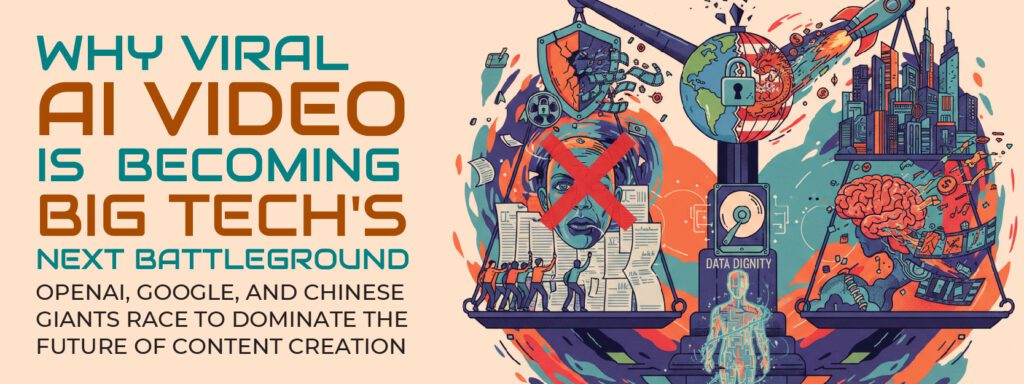
The race to dominate AI-generated video has become the most consequential technology battle since the smartphone wars. OpenAI’s Sora 2, Google’s Veo 3, and a fleet of Chinese competitors are now capable of producing cinema-quality footage from simple text prompts—and the implications extend far beyond Silicon Valley. Disney has invested $1 billion in OpenAI for exclusive Sora licensing. Hollywood studios are filing lawsuits over copyright infringement. Social media feeds are flooding with synthetic content that viewers struggle to distinguish from reality. The AI video generator market, valued at approximately $717 million in 2025, is projected to exceed $2.5 billion by 2032, growing at 20% annually. But the real prize isn’t market share—it’s control over the future of visual storytelling itself.
The Cinematic Singularity Arrives
Industry observers are calling early 2026 the “Cinematic Singularity”—the moment when AI-generated video became indistinguishable from high-end professional cinematography. OpenAI’s Sora 2, released in late 2025, represents the clearest evidence of this shift. The model doesn’t merely predict pixels; it simulates underlying physics, maintaining what OpenAI calls “World-State Persistence” across multiple shots. A character’s wardrobe, scars, and background props remain identical across different camera angles and cuts, effectively eliminating the visual drift that previously broke immersion. Google’s Veo 3 has taken a different approach, focusing on pixel-perfect photorealism through a 3D Latent Diffusion architecture that treats time as a native dimension rather than a sequence of frames.
The technical capabilities now available are staggering. Veo 3 produces 4K resolution at 60 frames per second—the only major AI video generator capable of true broadcast-quality output. It generates synchronized dialogue, ambient sounds, and music in a single render, eliminating the need for post-production audio work. Sora 2’s “Cameo” feature allows users to insert their own faces into AI-generated scenes, while Runway’s Gen 4.5 has climbed to the top of the Video Arena benchmark, outperforming both Google and OpenAI on independent blind tests. These aren’t incremental improvements—they represent a fundamental transformation in what’s possible.
The Platform Wars Intensify
The competitive landscape has bifurcated into distinct strategic camps. OpenAI is positioning Sora as a social platform, launching a dedicated app with TikTok-like feeds designed to capture the next generation of content creators. Google’s Veo 3 targets professional Hollywood production, offering granular cinematic controls and integration with industry-standard editing suites. Runway, the 100-person startup that beat trillion-dollar companies on benchmarks, has carved out a niche among independent filmmakers. Meanwhile, Chinese competitors have achieved remarkable traction: Kuaishou’s Kling AI has amassed over 60 million users and generated $240 million in annualized revenue, while ByteDance’s Jimeng AI boasts 8.93 million monthly active users.
The pricing structures reveal each company’s strategic intent. OpenAI bundles Sora with ChatGPT subscriptions at $20 or $200 per month, betting on ecosystem lock-in. Google charges $0.15-0.40 per second of generated video through its API, targeting enterprise customers. Kling AI offers a free tier with 10-second watermarked videos and paid plans starting at just $8 monthly—undercutting Western competitors while building market share. ByteDance holds the first and third spots on Artificial Analysis’ benchmark rankings for text-to-video models, with Google claiming second and fourth, demonstrating that Chinese companies have emerged as genuine leaders rather than mere imitators.
Hollywood’s Existential Reckoning
The entertainment industry finds itself caught between opportunity and existential threat. In December 2025, Disney announced a landmark $1 billion partnership with OpenAI, paying for an equity stake while licensing Sora technology for short-form video on Disney+. The three-year exclusive deal allows users to create content featuring approximately 200 animated and live-action characters—Darth Vader isn’t just a character you watch anymore; it’s one you create with. The move represents Disney CEO Bob Iger’s attempt to co-opt two simultaneous threats: TikTok’s capture of younger audiences and AI’s disruption of traditional production economics.
Not all studios share Disney’s embrace. Disney and Universal have sued Midjourney over alleged intellectual property theft, while Warner Bros. filed a copyright infringement complaint this month. The Washington Post found that Sora can generate videos closely resembling Netflix shows, popular video games, and studio logos from basic prompts. SAG-AFTRA President Sean Astin has warned that the technology threatens to enable unauthorized digital resurrections and non-consensual content creation. The stock footage industry has already seen a 60% revenue decline for generic B-roll since early 2025. Studios face a stark choice: partner with AI companies on their terms or watch their IP get recreated anyway.
The Social Media Transformation
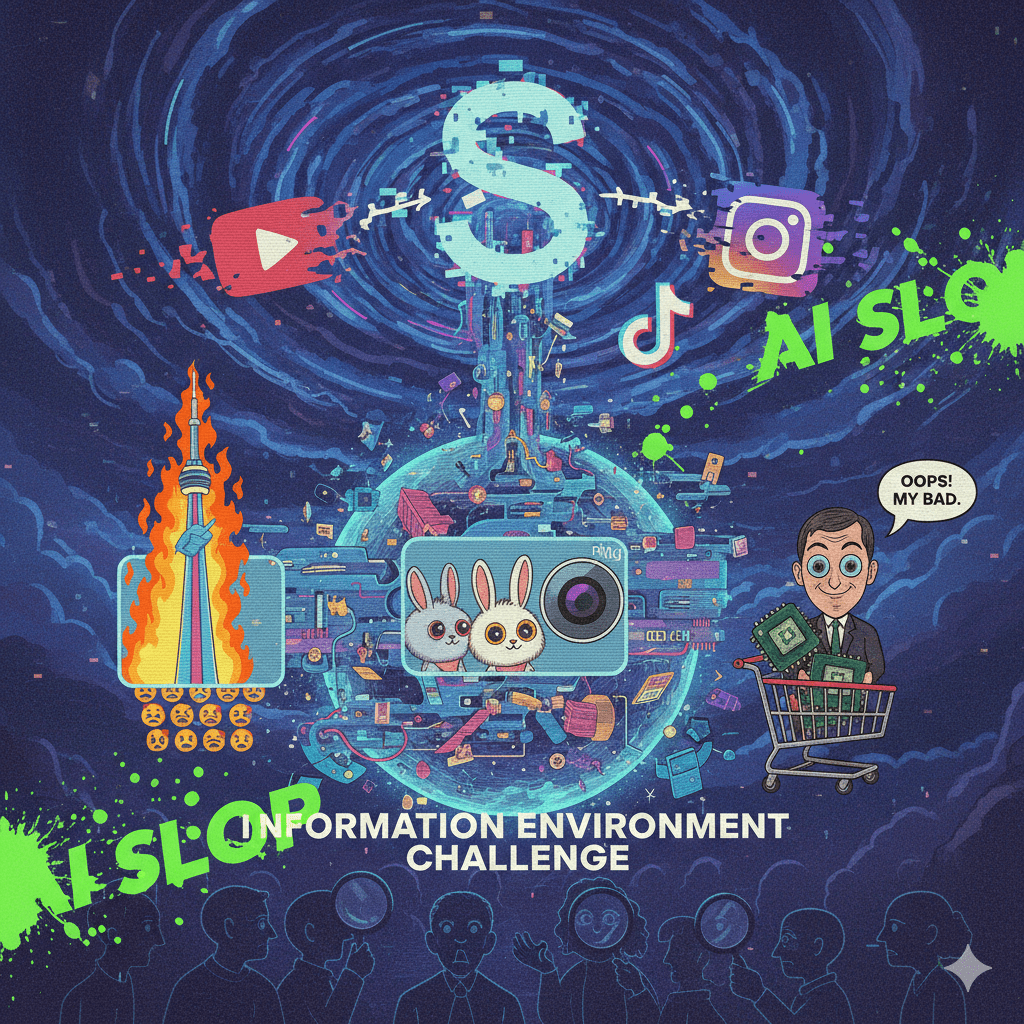
The integration of AI video into social platforms is reshaping how content flows across the internet. OpenAI’s Sora app launched in October 2025 with an explicit goal: capturing attention currently directed at TikTok, YouTube, and Instagram. Meta has responded with “Vibes,” a TikTok-like video feed within its AI app, while TikTok itself introduced AI Alive, a tool that transforms images into videos with simple commands. The result is a flood of synthetic content that professors studying AI’s societal impact describe as an “information environment” challenge—viewers increasingly cannot distinguish generated content from captured reality.
The phenomenon known as “AI slop” has exploded across social feeds. An AI-generated video of Canada’s CN Tower on fire went viral on Facebook, fooling viewers into thinking it depicted a real disaster. Videos of bunnies appearing to be captured on Ring doorbells have racked up 200 million TikTok views despite being entirely synthetic. NPR reports that Sora has “lowered the bar for slop to zero,” enabling anyone to create fake surveillance footage, fake local news interviews, or fake videos of public figures committing fictional crimes. OpenAI CEO Sam Altman himself became the subject of a viral deepfake showing him shoplifting computer chips from a Target store—an inside joke created by an OpenAI employee using the Cameo feature.
The Economics of Zero-Cost Pixels
The business implications extend far beyond entertainment. The broader AI video market was valued at $3.86 billion in 2024 and is projected to reach $42.29 billion by 2033, growing at a compound annual rate of 32.2%. Approximately 40% of video content on major social media platforms is now AI-generated. Some 69% of Fortune 500 companies use AI-generated videos for brand storytelling and marketing, while 62% of marketers report that text-to-video platforms have cut their content creation time by more than half. The cost-per-pixel is approaching zero, enabling what industry analysts call “solo studios”—individual creators producing cinematic-quality content that would have previously required $500,000 budgets and crews of fifty.
China’s Kuaishou exemplifies the commercial potential. Kling AI generated over 150 million yuan ($20.8 million) in Q1 2025 revenue alone, with annual run rate reaching $240 million. The platform has attracted more than 10,000 corporate customers adopting AI video for marketing, e-commerce, and entertainment production. UBS Securities analyst Wei Xiong believes AI video generation has potential to reshape the entire content industry by enhancing production efficiency, lowering barriers to creation, and unlocking new monetization models. The average cost per minute of AI video generation has dropped 65% from 2024 to 2025, with real-time generation—sub-two-second latency from prompt to video—already in closed beta at several Chinese labs.
Safety, Copyright, and the Trust Crisis
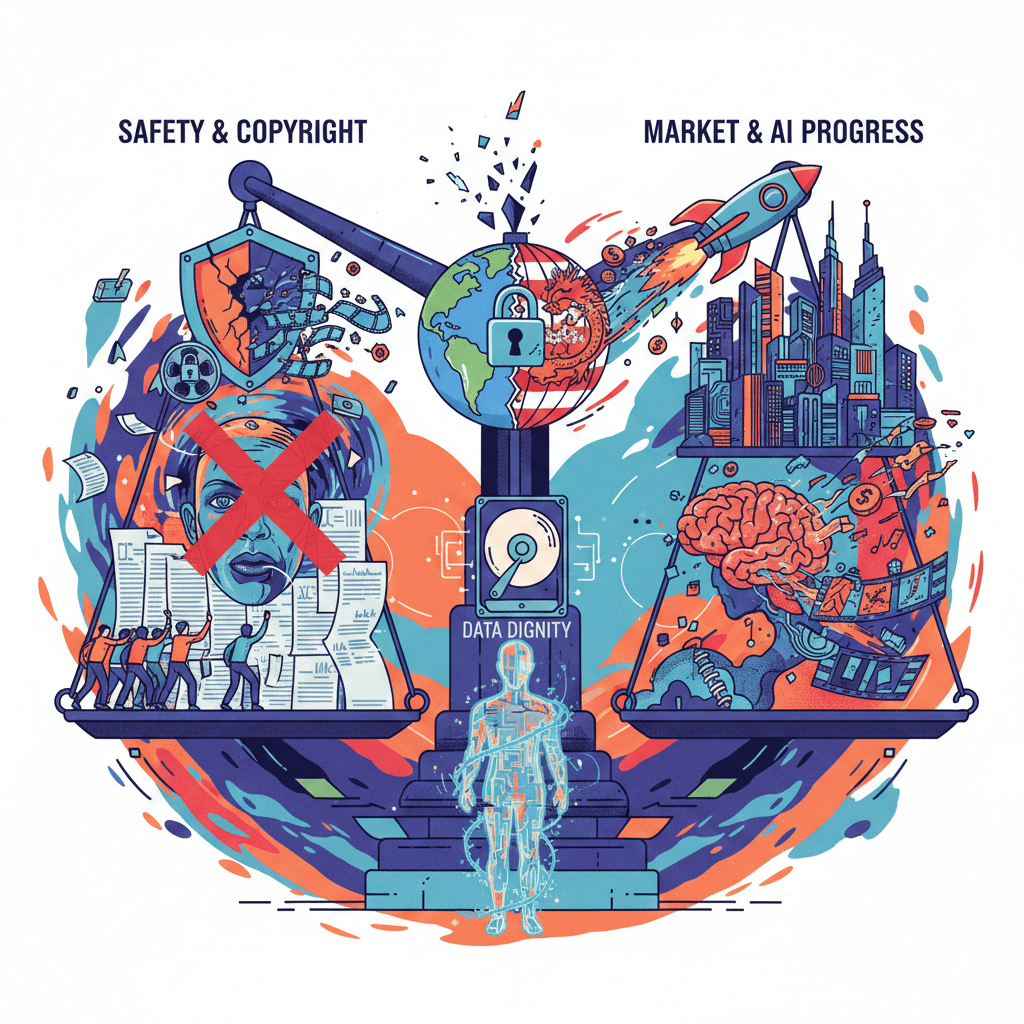
The rush to market has outpaced safety guardrails. OpenAI has implemented “Red Teaming 2.0” protocols requiring mandatory phone verification and C2PA metadata tagging to combat deepfakes. Sora-generated videos embed invisible watermarks denoting their AI origin, though tech publication 404 Media demonstrated these watermarks can be relatively easily removed. Copyright owners such as television and movie studios must opt out of having their work appear in Sora’s social feed—a policy critics describe as shifting the burden of protection onto rights holders. More than 400 directors, actors, and stars signed an open letter in March criticizing Google and OpenAI for asking the Trump administration to protect their right to train on copyrighted material.
The broader trend is moving toward “verified-origin” media, where the absence of a digital watermark or cryptographic signature is becoming a red flag for increasingly skeptical audiences. The Motion Picture Association has warned that videos infringing intellectual property will be aggressively pursued. Yet enforcement remains challenging: OpenAI argues that training AI models on copyrighted material constitutes fair use, framing the legal question as a matter of national security and American competitiveness against China. The 2024-2025 Hollywood strikes were only the beginning; by 2026, the focus has shifted toward “data dignity” and the fundamental question of who owns digital likenesses.
The Road Ahead
The next frontier is already visible. Several labs are targeting 5-10 minute coherent clips by Q2 2026, with native multi-speaker dialogue, consistent character appearance across entire scenes, and physics that respect the laws of reality. Runway has teased “Gen 4 Motion Worlds,” allowing users to build persistent 3D environments they can navigate and film from any angle—game-engine-level control generated on the fly. Real-time generation is moving from lab prototype to consumer product; by mid-2026, industry observers expect tools good enough for TikTok creators to go fully live with AI-generated content. The race toward full-length movies has shifted from “impossible” to “when,” with indie directors already experimenting with hybrid workflows where AI generates rough assemblies and humans handle emotional nuance.
The stakes could hardly be higher. Experts predict that by late 2026, we will see the first “generative video games” where environments are not pre-rendered but generated on-the-fly based on player input. The integration of spatial audio and haptic feedback may produce the first truly immersive VR experiences created entirely by AI. Yet the environmental and computational costs remain substantial—training and serving video models requires an order of magnitude more energy than text-based large language models. The industry is making a massive bet that the creative applications will justify the infrastructure investment. Whether that bet pays off will determine not just which companies dominate, but how humanity creates and consumes visual media for generations to come.
Author: Reshma Sultana Muskan