The global economy stands at a point where the inclusion of women in leadership positions is no longer merely a matter of equity but rather represents a fundamental economic imperative. Extensive research demonstrates that women’s leadership drives innovation, enhances financial performance, and creates more resilient organizations. From multinational corporations to local enterprises in Bangladesh, the transformative impact of half of the global population at the helm is reshaping how we understand business success and economic growth.
Organizations with women in leadership positions consistently demonstrate superior financial performance. McKinsey’s research spanning multiple years reveals that companies in the top quartile for gender diversity on executive teams are 25% more likely to experience above-average profitability compared to those in the bottom quartile. This correlation strengthens year after year, suggesting that as markets become more complex, the diverse perspectives women bring to decision-making become increasingly valuable.
The mechanisms behind this performance boost are multifaceted. Women leaders often bring different approaches to risk assessment, stakeholder engagement, and long-term strategic planning. Research published in the Harvard Business Review indicates that women executives tend to adopt more participative decision-making styles, which can lead to more thoroughly vetted strategies and higher employee engagement. Additionally, organizations with women in leadership positions typically demonstrate better corporate governance, reduced instances of fraud, and more robust ethical frameworks.
Innovation and Market Understanding
Women’s leadership catalyzes innovation by expanding the range of perspectives informing product development and market strategies. When women occupy decision-making roles, companies are better positioned to understand and serve diverse customer bases. This is particularly crucial given that from groceries to textiles, women control or influence the majority of consumer purchasing decisions globally. A compelling example also comes from the technology sector, where companies like Microsoft have found that diverse leadership teams develop more inclusive products. When the company increased gender diversity in its AI development teams, it identified and corrected gender and racial biases in its algorithms that homogeneous teams had overlooked, thus preventing potential reputational damage and ensuring broader market appeal.
In the financial services industry, women-led firms have demonstrated notably different investment patterns. Research from the Peterson Institute for International Economics found that firms with greater gender diversity in leadership allocate capital more efficiently and demonstrate greater sensitivity to environmental, social, and governance factors, which are increasingly important considerations for modern investors.
Bangladesh Industry Insights and FLFP
Bangladesh presents a fascinating case study in women’s economic leadership within a developing economy context. The country’s remarkable economic transformation over recent decades has been intrinsically linked to women’s participation in the workforce, particularly in the ready-made garment sector, which employs approximately four million workers, roughly 80% of whom are women. As of 2023, the Bangladesh Bureau of Statistics reported Female Labour Force Participation Rate to be over 40%. At the entrepreneurial level, Bangladeshi women have demonstrated exceptional leadership capability. The microfinance revolution pioneered by institutions like Grameen Bank revealed that women borrowers maintained repayment rates exceeding 95%, demonstrating financial discipline and business acumen. This success catalyzed a broader recognition of women’s entrepreneurial potential, leading to increased access to capital and business development resources.
In the banking sector, Bangladesh has witnessed growing numbers of women in senior positions. BRAC Bank’s SME division, which serves small and medium enterprises, has found that loan officers who are women often achieve better portfolio quality when serving women entrepreneurs, suggesting that representative leadership creates more effective business relationships and outcomes. The technology sector in Bangladesh is also experiencing a gender leadership evolution
The economic impact of women’s leadership extends far beyond individual companies. When women earn income and occupy positions of economic power, they typically reinvest a higher proportion of their earnings in their families’ health, nutrition, and education compared to men, closing gender gaps in labor force participation and entrepreneurship could increase global GDP by up to 20%. In Bangladesh, women’s economic participation has been credited with contributing to significant improvements in child health outcomes, increased school enrollment rates, and declining fertility rates. All of these factors support broader economic development. Women in leadership positions serve as visible role models, encouraging the next generation of girls to pursue education and career ambitions.
Women’s Leadership in National Governance
Women heads of state and government have demonstrated distinctive leadership strengths that often translate into measurable national outcomes. Research examining COVID-19 responses found that countries led by women, including New Zealand under Jacinda Ardern, Germany under Angela Merkel, and Taiwan under Tsai Ing-wen, achieved significantly lower death rates and infection rates during the pandemic’s early phases. These leaders were noted for their decisive action, transparent communication, and science-based decision-making. Beyond crisis management, women-led governments have shown particular strength in social policy innovation. Rwanda, under significant female parliamentary representation (currently over 60%), has achieved remarkable economic growth while implementing progressive policies on education and healthcare. Finland’s government, which in recent years featured a coalition led by five women party leaders, maintained some of the world’s highest rankings in education, gender equality, and quality of life indicators. Iceland, which has had multiple women prime ministers, consistently ranks as the world’s most gender-equal country while maintaining robust economic performance.
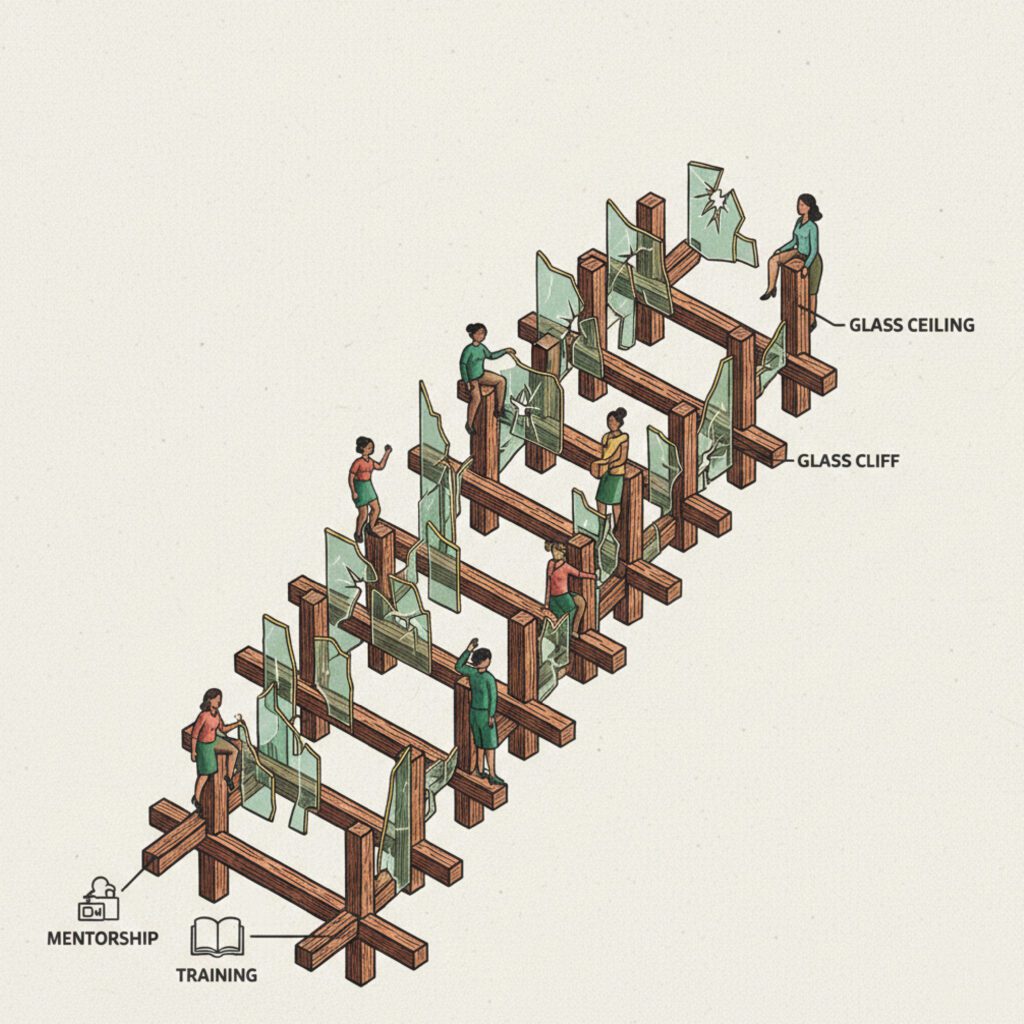
Unfortunately, despite progress and a plethora of evidence, women leaders worldwide continue to face what researchers term the “glass ceiling” and “glass cliff” phenomena: barriers to reaching top positions and being appointed to leadership roles primarily during times of crisis when the risk of failure is highest. In Bangladesh specifically, cultural expectations around family responsibilities, limited access to professional networks, far-right political and religious stances, and unconscious bias in hiring and promotion decisions continue to constrain women’s advancement.
On a brighter note, intentional interventions can yield measurable results. Companies implementing structured mentorship programs, transparent promotion criteria, and flexible work arrangements report improved retention and advancement of women leaders. Organizations including the Bangladesh Garment Manufacturers and Exporters Association (BGMEA), in collaboration with international development partners, have developed training programs to prepare women workers for supervisory and management roles, creating a pipeline of qualified women leaders in the industry. However, the evidence is unequivocal: women’s leadership transforms business performance and drives economic growth. From boardrooms to garment factories, organizations that embrace gender diversity in leadership positions position themselves for greater innovation, improved financial returns, and enhanced resilience. For Bangladesh, a country that has achieved remarkable economic progress in recent decades, continuing to expand opportunities for women’s leadership represents not just a moral imperative but a strategic economic priority. As barriers continue to fall and more women assume leadership roles, the resulting economic dynamism promises benefits that will be felt across families, communities, and nations for generations to come.