
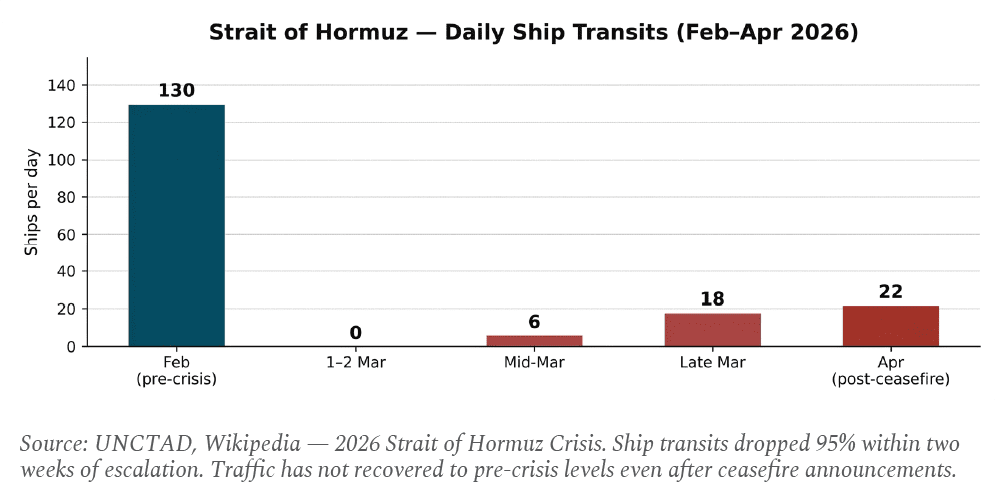
On 1 March 2026, for the first time in modern commercial shipping history, zero vessels transited the Strait of Hormuz. Not a reduction. Not a slowdown. Zero. The day before, 130 ships had passed through the 21-mile passage between Iran and Oman, carrying crude oil, liquefied natural gas, fertilisers, and cargo of every kind. Within 72 hours of military escalation in the region, that traffic had collapsed entirely.
 The conflict that caused it is context for this piece, not its subject. What matters for business leaders, supply chain managers, and policymakers is what happened next: a cascading systems failure across global shipping, energy markets, commodity supply chains, and trade finance that is, as of 27 April 2026, still unfolding.
The Strait did not need to close permanently to break global trade. It needed only to become unreliable. In the economics of global commerce, unreliability at this scale is indistinguishable from closure. This is the story of how that happened, what it did to global supply chains and business, and what it means for Bangladesh — one of the most exposed economies on earth to precisely this kind of disruption.
The insurance market moved first
The commercial closure of the Strait preceded the military one — and that sequence is what most observers missed. In the days before the February strikes, war-risk insurance premiums for Hormuz transits began rising, from 0.125% of vessel value per transit to between 0.2% and 0.4%. For a very large crude carrier, that meant an additional quarter of a million dollars per voyage. On 5 March, protection and indemnity war risk cover was removed entirely by major maritime insurers. At that point, the Strait became commercially impassable regardless of its physical status.
Without war-risk insurance, no commercial operator moves a vessel through a conflict zone. The liability exposure falls entirely on the shipowner. No shipowner accepts that for a cargo run. So the Strait became economically closed before Iran issued a single official declaration. Maersk, CMA CGM, and Hapag-Lloyd suspended all new bookings to and from the Upper Gulf with immediate effect — the UAE, Bahrain, Qatar, Iraq, Kuwait, and Saudi Arabia’s Dammam and Jubail, all in a single announcement.
Hapag-Lloyd formalised the new cost reality with a War Risk Surcharge of $1,500 per 20-foot container and $3,500 per reefer, applied to any booking from 2 March. CMA CGM introduced an Emergency Conflict Surcharge of $2,000 per 20-foot dry container. These surcharges applied not just to future bookings but to cargo already on water and not yet discharged. Shippers who had booked weeks earlier found their costs repriced mid-voyage.
The Red Sea closure compounded everything simultaneously. The Houthis in Yemen resumed attacks on commercial vessels, forcing Suez Canal traffic to reroute around Africa’s Cape of Good Hope — adding 14 to 25 days to Asia-Europe transit times. For the first time in the modern era, both the Suez Canal and the Strait of Hormuz were non-operational for commercial shipping at the same time. Every major alternative route was under stress at once.
What a chokepoint carries — and what happens when it stops
The Strait of Hormuz is the world’s most consequential piece of maritime infrastructure. Before the crisis, roughly 20% of global seaborne oil and 20% of global LNG passed through it daily. Looking at the disruption sector by sector reveals how widely and quickly the impact spread.
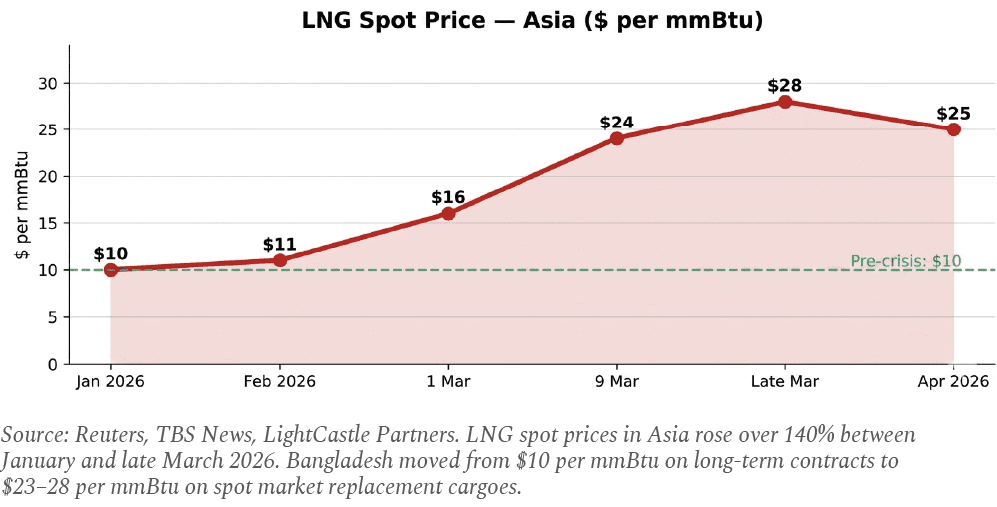 Energy was the first and most immediate shock. Brent crude rose above $90 per barrel within days and reached $119.50 on 9 March — the highest since mid-2022. QatarEnergy, the world’s largest LNG exporter, declared Force Majeure on 3 March and announced it would shut down gas liquefaction as tankers could not leave the Gulf. Restarting liquefaction, once shut, takes weeks. The announcement removed a meaningful share of global LNG supply from the market at a stroke.
Fertiliser followed. Up to one third of global trade in fertiliser raw materials — ammonia, nitrogen, urea — passes through the Strait. The disruption arrived at the worst possible time: the spring planting season across Asia. UN agencies warned that 9.1 million additional people in Asia faced acute food insecurity if disruption persisted. Iran agreed on 27 March to allow humanitarian and fertiliser shipments specifically in response to the agricultural emergency.
 Metals were hit next. The Middle East is a major aluminium producer; around 80% of its output trades through the Strait. The USA, Turkey, and Japan — together accounting for 35% of primary aluminium imports from the region — faced immediate supply constraints. Aviation took a parallel blow: roughly 20% of worldwide aviation cargo capacity was affected by regional airspace closures, with key freight hubs in Dubai and Doha operating at reduced capacity. Jet fuel prices surged globally, hitting approximately 25% of airline operating costs.
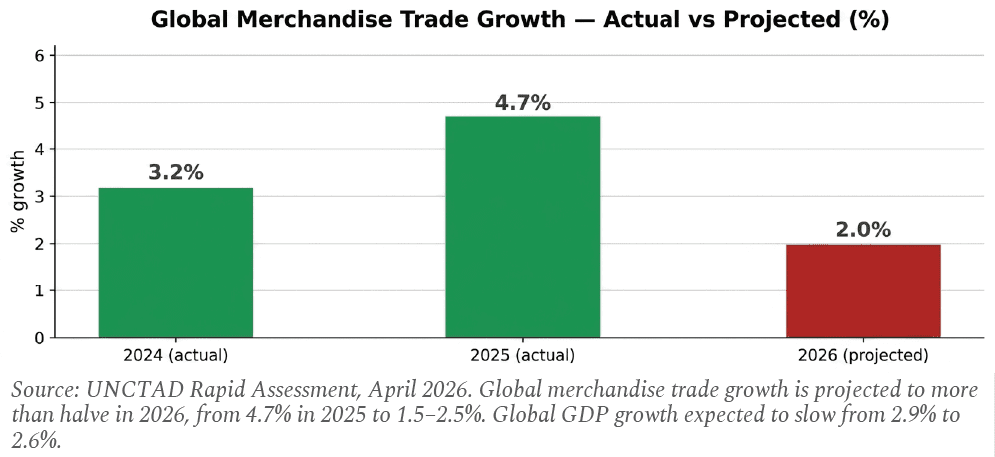
For businesses across manufacturing, logistics, and retail, the disruption ran through three simultaneous channels. The cost channel: higher freight rates, insurance surcharges, and bunker fuel feeding into every transported input and output. Spot rates from China to north Europe were already up 48% versus pre-Red Sea crisis levels; to the Mediterranean, up 79%. The time channel: Cape of Good Hope rerouting added 14 to 25 days per voyage, port congestion at Indian transshipment hubs pushed arrival delays to 40–49 days at peak, and more vessel capacity was required to move the same freight at premium prices. The uncertainty channel — the hardest to quantify but most damaging to business decision-making — was that every layer of contingency was compromised simultaneously. Ocean routes were disrupted. Air freight through Gulf hubs was disrupted. Inventory buffers that worked in a stable world were insufficient for this one.
Even ceasefire announcements of April 2026 have not restored normal traffic. As of 27 April, none of the world’s major shipping operators have resumed full Hormuz bookings. Approximately 500,000 containers remain stranded. Around 20,000 seafarers cannot complete their voyages. The Cape of Good Hope routing is now the default assumption for Asia-Europe commodity flows — not a temporary workaround but a new baseline. The logistics architecture that existed before February 2026 has not returned.
Bangladesh: 95% exposed, caught at every pressure point
Bangladesh imports approximately 95% of its energy. Around 80% of its crude oil, 65% of its LNG, and more than half of its LPG passes through the Strait of Hormuz. It exports more than $48 billion worth of goods annually — over 80% garments — to markets in Europe and North America reached primarily through the Suez Canal and Red Sea routes. When both corridors were disrupted simultaneously, Bangladesh was hit from both sides: as an energy importer and as an export economy.
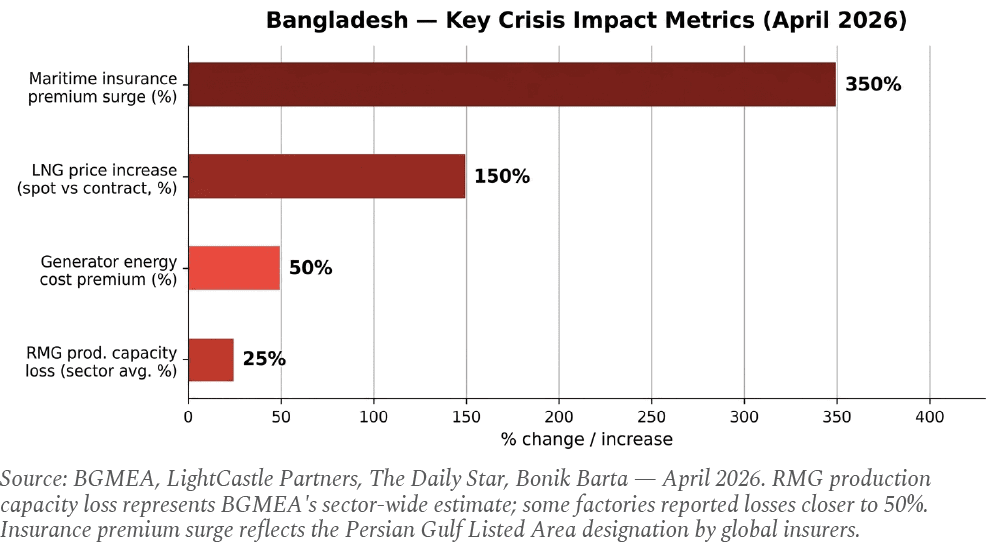 The energy shock arrived fast. QatarEnergy’s Force Majeure declaration on 3 March removed one of Bangladesh’s three long-term LNG suppliers overnight. Bangladesh was scheduled to receive 115 LNG cargoes in 2026. Officials projected losing 40 of them. Replacement LNG on the spot market jumped from approximately $10 per mmBtu before the crisis to $23–28 per mmBtu — a 130–180% increase in replacement cost.
Downstream consequences moved equally fast. Gas supply to the power sector dropped from 870 million cubic feet per day to 820 mmcfd. Power generation fell short of demand by around 3,000 megawatts at peak. Four of Bangladesh’s five state-run urea fertiliser factories shut down for at least 15 days — in the middle of the Boro rice season, when paddies require consistent irrigation and fertilisation. The Dhaka Stock Exchange DSEX dropped from 5,600 to 5,325 between late February and early March.
Source: BGMEA, LightCastle Partners, The Daily Star, Bonik Barta — April 2026. RMG production capacity loss represents BGMEA’s sector-wide estimate; some factories reported losses closer to 50%. Insurance premium surge reflects the Persian Gulf Listed Area designation by global insurers.
For the garment sector specifically, the crisis was a compound shock. Load shedding of two to three hours during a typical ten-hour workday reduced factory production capacity by 20 to 30% across the sector. Some factories reported losses closer to 50%. Factories running diesel generators paid 40 to 60% more per unit of energy than grid power. Dhaka-Chattogram truck fares rose from Tk 38,000 to Tk 50,000 — a 31% increase — as fuel rationing created scarcity in the domestic transport sector. Maersk’s suspension of bookings between the Indian subcontinent and the Upper Gulf cut a key shipping corridor for Bangladesh’s garment exporters, removing options for air cargo through Gulf transit hubs at precisely the moment ocean routes were also disrupted.
“After Trump’s tariffs, there was a chance that inflation in international markets might ease. But the Middle East war has upended all assumptions. With the Strait of Hormuz now verging on closure, the country faces an acute diesel shortage and that’s hampering production.”
— Mahmud Hasan Khan, President, BGMEA, April 2026
Western buyers added demand-side pressure. A senior official of a leading European buying house told The Daily Star that 8 to 10% of garment work orders would be cut for the next season, as retailers held unsold winter merchandise and freight cost uncertainty made forward ordering more difficult. Bangladesh’s merchandise exports had already contracted 4.85% in the first nine months of FY2025–26. Exports to Germany dropped 13.54%. Exports to the US fell 1.10%. Maritime insurance premium surges of 300 to 400% transmitted directly into freight costs for every container shipped or received. Shipping expenses rose by $500 to $4,000 per container depending on route and carrier. Every $10 increase in global oil prices adds $1 billion to Bangladesh’s annual import bill, according to estimates presented at a DCCI roundtable in April.
What the crisis exposed — and what policy cannot ignore
Governments across the region managed the immediate crisis through fuel rationing, emergency spot purchases, conservation mandates, and industry prioritisation. Bangladesh directed shopping centres to close by 8pm. Universities moved online early ahead of Eid. The government prioritised gas supply to the power sector and households over industrial applications. Petrobangla requested additional subsidies to cover the gap between international spot prices and domestic retail rates. Companies like Meghna Group began sourcing LPG from Vietnam, Taiwan, Malaysia, and China as emergency alternatives.
These responses managed the crisis. They did not address its cause. Bangladesh’s vulnerability to the Hormuz disruption is not bad luck. It is the predictable outcome of an energy strategy built almost entirely on imported hydrocarbons routed through a single geopolitical chokepoint, with no significant strategic reserves, limited domestic production capacity, and an underdeveloped renewable energy base. The crisis did not create these vulnerabilities. It revealed them.
Domestic natural gas production has been declining for years due to underinvestment in exploration. To fill the gap, Bangladesh began importing LNG from the Middle East in 2018, increasing dependence on the very supply routes now disrupted. Renewable energy — solar, wind, and hydro combined — accounts for roughly 1% of total power generation. Strategic petroleum reserves are minimal. When the Strait became unreliable, Bangladesh had almost no buffer.
The policy conversation now open spans three areas. First, energy diversification: accelerating solar and renewable capacity to reduce the percentage of power generation dependent on imported gas. Second, supply route diversification: building LNG supplier relationships outside the Gulf corridor, including Australia, the US, and Southeast Asian producers. Third, strategic reserves: holding sufficient buffer stocks to absorb the first weeks of a disruption without immediate rationing. All three require long lead times and upfront investment. All three were identified as priorities before February 2026. None had been acted on at sufficient scale.
For the RMG sector, the crisis reinforces the case for supply chain resilience investment the sector has been deferring. Reducing lead times by developing local man-made fibre production would reduce dependence on imported fabric through vulnerable sea routes. Diversifying freight routing assumptions, maintaining carrier relationships outside the Gulf-dependent network, and building inventory buffers appropriate for a world where shipping disruptions are no longer rare events — these are not crisis responses. They are normal operating requirements for an export sector in a geopolitically volatile world.
The chokepoint and the lesson
The 2026 Strait of Hormuz disruption will be studied for years as one of the most instructive supply chain events of the modern era — not because of its causes, but because of what it revealed about the assumptions baked into global trade architecture. For decades, the efficiency of global supply chains was built on the premise that major maritime chokepoints were stable. Logistics networks were optimised for that stability. Inventory buffers were reduced. Just-in-time delivery became the operational standard. The cost savings were real and large.
The hidden cost was fragility. When the Strait became unreliable — not closed, not destroyed, simply unreliable — that fragility became immediately visible. Ships could not get insurance. Containers could not get bookings. Factories could not get fuel. Farmers could not get fertiliser. None of the actors in that chain had prepared for a world where the chokepoint was genuinely unavailable, because the economic incentive had always been to assume it would not be.
As of 27 April 2026, a US-Iran ceasefire is in effect and has been extended. Ship traffic through the Strait remains far below pre-crisis levels. Insurance markets have not normalised. The Cape of Good Hope routing has not reversed. The global trade system is running at a structurally higher cost than it was six months ago.
For businesses and policymakers in Bangladesh and across the developing world, the more useful question may not be when the Strait normalises — but what it would take to be less exposed to the answer.
Sources: UNCTAD — Strait of Hormuz Disruptions: Implications for Global Trade and Development (Mar 2026) · UNCTAD — Hormuz Disruption Deepens Global Economic Strain (Apr 2026) · BCG — The Hormuz Strait: Which Sectors and Regions Are Impacted Most? (Apr 2026) · ISM — The Impacts of the Iran Attack on Supply Chains (Mar 2026) · Xeneta / Peter Sand — Freight Rate Analysis (Mar 2026) · The Daily Star — RMG Exports Brace for a Gathering Storm (Apr 2026) · The Daily Star — How Garment Makers Can Manage the Middle East Logistics Shock (Mar 2026) · Bonik Barta — Energy Crunch Cuts RMG Output 20–30% (Apr 2026) · LightCastle Partners — What Hormuz Strait Closure Means for Bangladesh (Mar 2026) · TBS News — Oil Crisis: Lessons from Global Crises and Bangladesh’s Blueprint (Apr 2026) · BSS News — Power Crisis to Ease by May (Apr 2026) · Bangladesh Textile Journal — Hormuz Disruption Raises Alarm (Apr 2026) · Wikipedia — 2026 Strait of Hormuz Crisis (updated Apr 2026) · IEA — Responding to the Largest Supply Disruption in History (2026)


