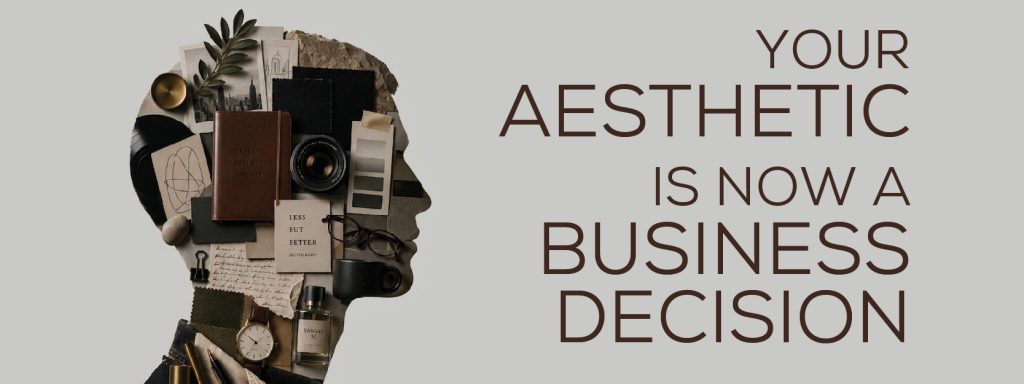
How the visual language you use to express who you are — across your home, wardrobe, desk, and Instagram — became a driver of purchasing decisions, brand loyalty, and career positioning. Aesthetics, it turns out, were never just decoration.
Think about the last time you walked into someone’s office and immediately formed an opinion about them. Not from anything they said — from the objects on the desk. The books arranged by colour or spine-out. The vintage film poster or the corporate motivational print. The plant that is clearly thriving or the wilting one that suggests a different kind of personality. The coffee cup with the slogan. You read all of that in approximately four seconds, and you drew conclusions that would have taken a thirty-minute conversation to reach through words alone.
That is how aesthetic identity has always worked. What is new in 2026 is that people are doing it deliberately — with the same intentionality that previous generations might have brought to a CV or a LinkedIn profile. The visual language someone uses to express who they are, across their home, wardrobe, social feed, and workspace, has become a form of communication that is in some contexts more trusted and more revealing than anything they say about themselves. And as that has become understood, the aesthetic has moved from personal preference into personal strategy.
| 67% of Pinterest’s 2026 trends are driven by Gen Z. Pinterest trends now evolve 4.4x faster than they did seven years ago.
Pinterest Predicts 2026 Report — based on the platform’s 600 million monthly users. The report has been 88% accurate over six years. The finding is not about Gen Z driving trends for everyone else. It is about a generation that has grown up thinking about visual identity with a precision and intentionality that older generations did not develop until much later, if at all. |
Pinterest’s annual trend forecast, which draws on the search behaviour of 600 million monthly users, has tracked this shift with unusual granularity. The platform’s 2026 report identifies three underlying currents running beneath this year’s most significant aesthetic movements: nostalgia as reclamation, identity curation, and grounded escapism. Each of them is worth understanding not as a design trend but as a statement about what people are actually trying to communicate about themselves and to themselves through the visual choices they make.
|
Nostalgia as Reclamation The past revisited on your own terms — gummy aesthetics, vintage finds, retro foods reinterpreted. Not copying the original. Owning a feeling it gave you. |
Identity Curation Selecting what to show rather than following what is trending. 42% of consumers say they only participate in trends that actually suit them. |
Grounded Escapism Retreat without detachment. Aesthetics that soothe rather than stimulate — calm blues, natural textures, folklore landscapes, cosmic quietude. |
The three cultural currents beneath Pinterest’s 2026 trend forecast. Each represents a distinct emotional logic — what people want their aesthetic to say about who they are.
Curation, not imitation
The identity curation current is the most consequential shift in how people relate to trends, and it represents a genuine break from how aesthetic culture has worked for most of the past two decades. The defining logic of social media aesthetics, from 2010 to roughly 2022, was imitation: find what is popular, replicate it, signal that you are current. The defining logic of 2026 is selection: find what is actually yours, curate it deliberately, signal that you know the difference between what is trending and what is you.
Pinterest’s data makes this specific. Nearly four in ten Gen Z users say they look to curate personal identities rather than copy aesthetics from the posts they save and search. Forty-two percent of global respondents say they only participate in trends that suit them — a number that would have seemed implausibly high as recently as five years ago, when the pressure to be current was considerably more powerful than the pressure to be coherent. What changed was the cultural cost of looking like everyone else, which rose as the tools for looking like everyone else became accessible to everyone. When the same six Spotify-playlist-cover aesthetics appeared across every living room on Instagram, the signal value of those aesthetics collapsed. Being distinctive became more valuable than being on trend, and curation became the tool for achieving it.
Ayumi Nakajima, senior director of content partnerships at Pinterest APAC, described the shift in terms that apply well beyond the platform: Gen Z is quietly leading a cultural reset to find their own space amid ambient chaos. They are building a new rhythm and moving away from the doom scrolling seen on other platforms, choosing instead to search with intention. The searching with intention observation is key. An aesthetic built through intentional search is different in kind from one assembled through passive scroll. It carries more of the person.
Being distinctive became more valuable than being on trend. Curation became the tool for achieving it — and what began as personal taste became, slowly, a form of communication.
Why nostalgia is not what it used to be
The nostalgia as reclamation theme is equally interesting, and equally misunderstood if read as simple retro enthusiasm. The gummy aesthetic — rubbery textures, jelly finishes, squishy everything — is trending because it references childhood tactility rather than childhood imagery. The vintage fashion movement is growing not because people want to dress like the past but because buying vintage is a way of opting out of fast fashion’s production cycle while maintaining a distinctive visual identity. The resurgence of handwriting, pen pals, and analogue habits among Gen Z is not about rejecting technology; it is about reclaiming a kind of sensory and temporal experience that digital life does not provide.
In each case, the aesthetic choice is doing several things simultaneously. It is communicating a set of values — sustainability, intentionality, the prioritisation of texture and feeling over speed and novelty. It is signalling group membership without requiring explicit statement. And it is performing an act of identity differentiation in a visual environment where differentiation has become the primary currency. The nostalgia is a vehicle for all of this, not the point of it.
The commercial implications are considerable. Brands that understand this are finding that inviting consumers to remix ideas — to take an aesthetic reference and make it their own — generates more engagement and more loyalty than campaigns that present a complete visual world for passive adoption. The one-size-fits-all campaign is losing ground not because it fails to reach people but because it fails to give them anything to curate. The most effective brand aesthetics in 2026 are the ones that provide raw material for someone else’s identity, rather than a finished product to be consumed whole.
The aesthetic as career asset
Where this becomes most surprising — and most practically relevant — is in the professional context. Aesthetic identity has moved into career positioning in ways that would have seemed eccentric a decade ago. The visual coherence of someone’s LinkedIn profile, the way they present themselves in video calls, the objects visible in their background, the design of their personal website if they have one — all of these are now read as signals of taste, intentionality, and cultural literacy in ways that amplify or undermine the professional content they accompany.
This is particularly true in industries where creative credibility matters — design, communications, marketing, media, fashion, architecture — but it is spreading into sectors where aesthetic sensibility was previously considered irrelevant. A consultant whose pitch deck is beautiful is communicating something about their attention to detail and their understanding of their audience that a consultant whose deck is functional but graceless is not. A manager whose workspace suggests considered taste is communicating something about how they process information and make decisions. None of this is fair, in the sense that it advantages people with cultural capital and disadvantages those without it. But it is real, and it is becoming more rather than less pronounced.
The practical implication — for professionals at any stage and in any industry — is that the aesthetic choices people have always made are now worth making consciously. Not performing an identity that is not yours: that reads as obviously constructed and produces the opposite of the intended effect. But understanding that the visual language you use to present yourself is being read by others as a signal, and choosing that language with the same deliberateness that you would bring to the words you use in a cover letter or an interview.
There is something both liberating and slightly exhausting about this. The liberation is in the recognition that taste is not shallow — that the objects you choose to surround yourself with, the way you dress when nobody is watching, the colour palette of your home, and the references you reach for when you need to feel like yourself are meaningful expressions of who you are rather than trivial consumer choices. The exhaustion is in the awareness that this is now known, and that the space for unconscious aesthetic drift has shrunk accordingly.
The generation that grew up on Pinterest did not invent the idea that how you present yourself communicates who you are. They inherited it, the way every generation inherits it, from the one before. What they did was take it seriously enough — and acquire the tools for executing it precisely enough — to turn it from an instinct into a practice. The aesthetic was always a business decision. It just took social media, a global pandemic, and a generation raised on visual platforms to make that explicit.