
Ask a chief marketing officer a simple question and watch them squirm: of all the money you spent on advertising last year, which half actually worked? For most of the past decade, the honest answer has been a shrug dressed up as a dashboard. The numbers looked precise. They were mostly fiction.
The reason is that the tools marketers trusted to answer that question have quietly stopped working. Privacy rules, browser changes, and walled gardens have erased somewhere between 30 and 40 percent of the conversions advertisers used to be able to track. The customer journey that once looked like a clean line from ad to click to purchase now looks like a spiderweb, and large parts of it are simply invisible.
So, how do modern advertisers measure what is working? Not with one tool, but with three, used together. The industry has spent the cookie’s long, messy decline assembling a new measurement stack, and by 2026, it has settled into a recognisable shape.
THE END OF THE LAST CLICK
For most of the 2010s, measurement meant attribution, and attribution meant the last click. You placed a pixel, followed the trail of cookies a user left behind, and handed full credit to whatever they touched last before buying. It was simple, it was deterministic, and it depended on being able to follow individuals across the web. That ability is gone.
Apple’s App Tracking Transparency let users switch off tracking, and most did. Safari and Firefox now block third-party scripts by default. The cookie’s own death turned out messier than anyone planned: Google, after years of promising to kill third-party cookies in Chrome, reversed course in 2025 and said it would keep them, then wound down its Privacy Sandbox replacement entirely. The cookie did not die on schedule. The industry moved on without it anyway.
What broke most clearly was multi-touch attribution, the model that tried to assign fractional credit across every touchpoint. Its coverage collapsed from above 90 percent to somewhere between 30 and 60 percent. Worse, the data it still produced was misleading in a specific and expensive way. Because attribution credited the channels it could see best rather than the channels that actually drove sales, marketers who optimised toward it were steering blind. In controlled holdout tests run in 2023 and 2024, several large advertisers found that attribution-optimised budgets underperformed a simple flat allocation by 15 to 30 percent on incremental revenue. They were not just measuring badly. They were spending worse because of it.
The paradox is real. Surveys through 2025 found attribution ranked as the top measurement priority for a large majority of marketers, while only about a third felt prepared for the privacy-first world they were already living in. More numbers, less certainty.
TOOL ONE: THE STRATEGIST
The first tool in the new stack is the oldest. Marketing mix modeling, or MMM, is an econometric method that dates to the 1960s, and it has come back precisely because it never depended on tracking anyone. Instead of following individuals, MMM works from the top down, drawing on aggregate data alone: spend, sales, seasonality, price, even weather. From that it uses statistical inference to estimate how much each channel contributed to the total.
Because it needs no cookies and no user-level identity, MMM is privacy-proof by design. That makes it the natural home for the biggest question a marketer faces. Across everything, from television to search to retail media, where should the next dollar go? It is the planning layer, built for quarterly and annual budget decisions rather than daily ones.
The comeback is measurable. In a 2025 survey by EMARKETER and TransUnion, nearly half of US marketers said they would invest more in MMM over the coming year, and when asked which methodology they trusted most, MMM was the top answer. Its weakness is appetite. The models are hungry for data, demanding years of history broken down by time and geography to produce reliable estimates. Recent advances in machine learning have made them faster to build, which is part of why a sixty-year-old technique suddenly feels new.
TOOL TWO: THE TRUTH-TELLER
MMM tells you how channels relate to sales, but it cannot prove cause. For that, advertisers turn to the second tool: incrementality testing. The idea comes straight from clinical trials. Split your audience or your markets into two groups, show the ad to one and withhold it from the other, and measure the difference. Whatever lift appears in the exposed group but not the control is the genuine, incremental contribution of the advertising. Everything else would have happened anyway.
This is the layer that answers the question every other method dodges: did the ad actually cause the sale, or did it just take credit for a customer who was always going to buy? The experiments take two main forms. Randomised holdout tests withhold ads from a slice of an audience; Kroger’s retail media arm runs these against loyalty data covering roughly 95 percent of its transactions. Geo-based experiments switch ads off in some regions and leave them running in matched ones, which suits television, out-of-home, and retail media where individual holdouts are impractical.
The results can be striking, and they often contradict the dashboards. A Mondelēz test measured 2.41 dollars of incremental return for every dollar spent and a 14 percent lift in in-store sales across 116 locations. In geo-experiments on TikTok run by the measurement firm Haus, brands saw an additional 68 percent lift in their main metric during the window after the test ended, capturing the slow-building demand that instant-response attribution misses entirely. The cost of this honesty is built into the method. To run a clean test, you have to withhold ads from real customers and accept the revenue you forgo while you learn.
TOOL THREE: THE TACTICIAN
The third tool is attribution itself, demoted but not discarded. Stripped of its old role as the source of truth, attribution survives as the tactical layer, the thing that guides the daily, in-channel decisions; the other two tools are too slow to handle. Which creative is winning on Meta, which keyword group is pulling its weight on Google: these are questions attribution still answers well, because inside a single platform, the first-party data is rich enough to see most of the journey.
The repair job underneath it is server-side tracking. Rather than relying on a browser pixel that privacy settings increasingly block, advertisers collect conversion events on their own servers and pass them back to the platforms. The recovery is substantial. Teams moving from a pixel-only setup to server-side collection routinely recover 20 to 40 percent of the conversion signal they had been losing. It is unglamorous plumbing, and it is the foundation the rest of the stack sits on.
The one caution with platform-run measurement is structural. When Meta or Google reports the lift from its own ads, it is grading its own homework. The numbers are useful as direction, not gospel, which is exactly why the independent truth layer of incrementality matters.
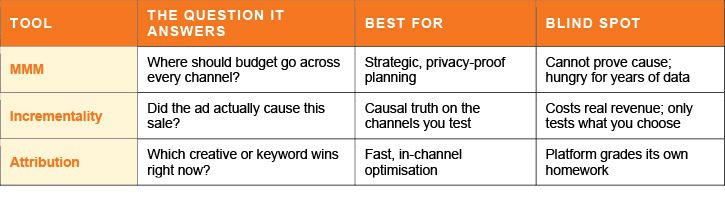
The mistake is to treat these as rival methodologies and pick one. They are three lenses on the same question, and each covers the others’ blind spots. MMM sees the whole portfolio but cannot prove the cause. Incrementality proves cause but only for what you choose to test. Attribution moves fast but sees only what the platform shows it. Used in concert, they triangulate toward something close to the truth.
In practice, the smartest programmes wire them together. MMM sets the strategic budget across channels. Incrementality validates the channels that matter most or look most uncertain, and feeds real causal estimates back into the model. Attribution handles the in-flight optimisation inside the channels that the other two have blessed. All three draw on the same foundation of clean, first-party event data, the substrate that makes any of it trustworthy. Without it, the model fits noise and the tests run on shaky baselines.
Nowhere is this pressure higher than in retail media, the fastest-growing corner of digital advertising, on track to top 69 billion dollars in the United States alone in 2026. The platforms sit on logged-in purchase data that makes closed-loop measurement possible, yet only about 15 percent of advertisers say they strongly trust the numbers they get back. Data clean rooms, where a brand matches its first-party data against a platform’s inside a privacy-safe environment, are the enterprise answer, though for most advertisers, they are a power tool to add once the basics are solid, not before.
The payoff for getting the architecture right is large. One regional bank that built unified measurement across its traditional, digital, and branch channels, optimising its messaging in near real time, doubled the incremental revenue it earned from new account openings. The order of assembly matters too. The cheapest first move, available to almost anyone, is fixing data collection with server-side tracking before spending on anything more sophisticated.
THE NEW DISCIPLINE
The deepest change is not technical. It is what marketers have to give up. The last-click dashboard offered a comforting illusion, a single number, updated daily, that seemed to say exactly what worked. The three-tool stack offers something less comfortable and more honest: no single source of truth, but a set of methods that check each other, run on different clocks, and answer different questions.
That asks something of the boardroom as much as the analytics team. It means trading the daily dashboard high-five for a blended, slower, more credible view of the whole system. The advertisers pulling ahead in 2026 made that trade. They assembled the three layers in the right order and learned to live with measurement that is approximate but real, rather than precise and wrong.
Author
HUMAYRA TASNIM