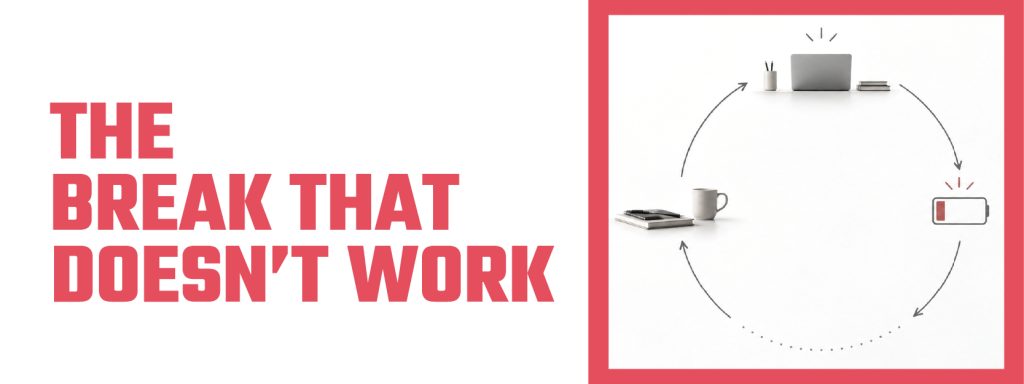
You finish something hard. Your brain has that pleasant scraped-out feeling, so you do what everyone does: you pick up your phone and scroll for five minutes. Then you put it down, turn back to the screen, and feel exactly as tired as you did before.
That is not your imagination. Researchers ran the experiment properly, with 308 employees and a pre-registered design published in Scientific Reports, and the result was unkind. Scrolling algorithmic video during a microbreak does replenish something, but not much, and it fails almost entirely on the one thing you wanted back. Fatigue stayed where it was. You detached from work without recovering from it, which turns out to be two different things.
Why nobody is measuring this
Consider what a modern office actually counts. Desk utilisation. Meeting room occupancy. Collaboration ratios. Headcount per square metre. Every one of those metrics measures activity, which means the building is optimised for the hours you spend doing things and completely silent on the hours that make doing things possible.
So recovery shows up in the accounts only as absence. Somebody was not at their desk. The idea that the not-being-at-the-desk might be productive infrastructure, in the same way a server room or a good chair is infrastructure, has not reached the floor plan.
What restoration actually needs
The science here is older and better established than the workplace conversation around it. Attention Restoration Theory, set out by Stephen Kaplan in 1995, separates two kinds of attention. Directed attention is the effortful sort you use to read a contract or debug a spreadsheet, and it depletes like a battery. Involuntary attention is what happens when something holds you without effort, and it does not deplete. Restoration is the process of letting the first recharge while the second does the work.
This is precisely why scrolling fails the test. An algorithmic feed is engineered to capture attention, not to release it, so the battery keeps draining while you believe you are resting.
Recovery researchers use a framework with an unlovely acronym and a useful structure, DRAMMA, which identifies six mechanisms: detachment, relaxation, autonomy, mastery, meaning and affiliation. Five minutes on your phone delivers roughly one of them. A five-minute walk outside, a conversation with someone you like, or a stretch of quiet delivers several.
Small things, unreasonably large effects
The encouraging part is how cheap the fix appears to be. Restoration studies keep arriving at the same slightly embarrassing conclusion: minor environmental resources produce disproportionate benefit. A coffee bar. A comfortable seat away from a screen. A window. Somewhere quiet enough to hear yourself think and private enough that nobody is watching you not work.
Nature helps most reliably. One frequently cited study found that employees with a view of greenery reported around 15 percent fewer headaches, 14 percent less eyestrain and 6 percent higher productivity than colleagues without one. Where greenery is not available, silence appears to do similar work, which is convenient in a city where a window mostly offers traffic.
Timing matters as much as setting. Microbreaks are most restorative at around five minutes and when they are frequent rather than long, so the ninety-minute lunch that feels virtuous is doing less for you than four short pauses spread across the afternoon.
The loop, and where it breaks
Think of the working day as a cycle: focus, then fatigue, then recovery, then focus again. Everything in office design is aimed at the first stage. Almost nothing is aimed at the third, and the third is what determines whether the first can happen twice.
When the recovery segment gets filled with stimulation rather than rest, the loop does not complete. You go from fatigue back to focus with nothing restored in between, which is the productivity equivalent of skipping the pit stop and wondering why the tyres are gone by the final lap.
What this means on Monday
None of this requires a refurbishment. It requires noticing that the pause is part of the work rather than a gap in it.
For an organisation, that means designating somewhere people can go that is not their desk and not a meeting room, and then not scheduling anything in it. For a manager, it means treating a colleague who has stepped outside for five minutes as someone doing their job rather than avoiding it. And for anyone reading this at a desk, it means the least effective thing you can do with your next break is the thing you were about to do with it.
Put the phone somewhere else. Walk to the end of the corridor and look at something further away than a screen. It sounds too simple to matter, which is roughly what the research keeps finding is the problem.
Sources: Attention Restoration Theory, Stephen Kaplan (1995), and Stress Recovery Theory, Roger Ulrich and colleagues (1991) · Pre-registered experimental study of social media microbreaks and employee resource recovery, 308 participants, Scientific Reports · Jiang et al. (2015), on nature views and workplace health outcomes · DRAMMA recovery framework · Research on restorative perceptions of office spaces, Building Engineering (2024) · Recent work introducing recovery ergonomics as a workplace design construct (2026).