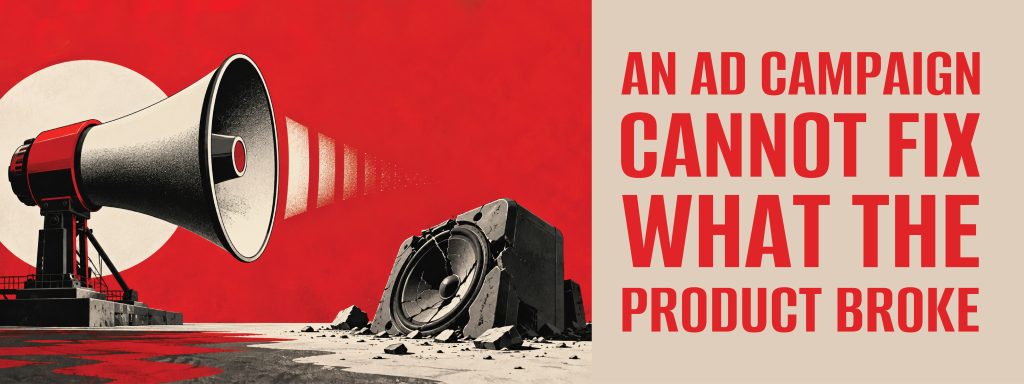
Every marketing department knows the moment. Something the company makes has stopped working as promised; customers are angry, and the pressure to be seen responding arrives from every direction. Retail partners want reassurance, sales teams want support, and the board wants action. A campaign is the fastest, most visible thing a company can approve. It is also, in most cases, the wrong first move.
The stakes of getting the order wrong have risen. A failure now spreads in hours through social feeds, review sites and group chats, and it stays searchable for years. AI assistants that summarise a brand draw on the same complaints. A company that responds with a glossy campaign while the problem persists does not just waste money. It creates a visible contradiction that customers are happy to point out.
The reason is simple once stated. Advertising works by making a promise and asking people to believe it. A product failure hands customers a different kind of evidence, one they hold in their own hands every day. When the speaker will not play or the order takes twenty minutes, no commercial can outrank what the customer just experienced. A campaign launched into that experience mostly reminds people of the gap between what the brand says and what it does.
Failure also changes who does the talking. In ordinary times a brand shapes much of its own message. Once the product breaks, customers become the main channel, through reviews, forums, comment threads and conversations with friends deciding what to buy. Money spent on media in that period largely buys a louder stage for the complaints.
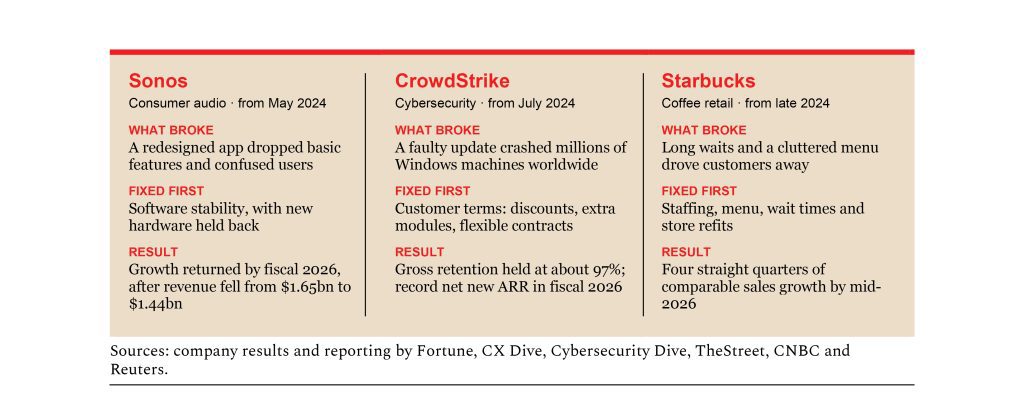
The recoveries of the past two years make the point from three very different industries.
 Go quiet and repair
Sonos is the plainest case. In May 2024 it replaced the app that runs its speakers with a redesign that removed features owners relied on, including the sleep timer and alarms. Shares fell about 40 percent, annual revenue slid from $1.65 billion to $1.44 billion and chief executive Patrick Spence, criticised for apologising too slowly, left in January 2025.
The failure also spoiled a launch the company had spent years preparing, the Ace headphones, which arrived while owners were still fighting the app. Sonos examined simply restoring the old version and concluded that engineering constraints made it impossible. There was no shortcut. The only way out was to repair the new software.
His successor, Tom Conrad, made software the entire agenda and held back new hardware for more than a year, reasoning that a launch into a customer base that still distrusted the app would only hand critics a fresh target. By mid-2025 executives reported rising social sentiment and falling support requests. Only after that, with the Amp Multi in January 2026, did the company restart launches, and it rebuilt its marketing around the system working again. By the fiscal third quarter of 2026, revenue was growing and the company had met its commitments for seven straight quarters.
Some of the most persuasive moments were updates rather than campaigns. In August 2025 a software release improved the sound of speakers people already owned, and owners noticed without being told, posting that the bass was fuller and the audio better overall. An update that makes a speaker bought years ago sound better does more for trust than an advertisement could.
Spend the recovery budget on customers
CrowdStrike faced something larger. On 19 July 2024, a faulty update to its Falcon security software crashed millions of Windows computers, disrupting airlines, hospitals and businesses around the world. For a company that sells protection, it was about the worst failure imaginable.
The reach was enormous. When the research firm ETR contacted 100 CrowdStrike customers on the day of the outage, 96 said they had been affected. Chief executive George Kurtz apologised publicly and repeatedly, and the company published its analysis of what had gone wrong in its testing process.
Its response put money into customers rather than media. The company offered what it called customer commitment packages, combining discounts, additional modules, extra subscription time and flexible payment terms. The packages carried a cost, about $25 million of lost new annual recurring revenue in the first full quarter, and sales cycles lengthened as buyers scrutinised deals. Yet gross retention stayed above 97 percent, down less than half a percentage point. Many customers who took the packages ended up using more of the platform, and by the fiscal year ending January 2026, CrowdStrike had added a record $1.01 billion in net new annual recurring revenue.
The lesson is less about generosity than about where persuasion happens. CrowdStrike’s customers were persuaded inside their own contracts and systems, by terms and service they could verify, rather than by claims made to them from outside.
Fix the experience you already sell
Starbucks shows that a product can break slowly. By 2024, long waits, a crowded menu and stretched staff had pushed away customers, and comparable sales fell for quarter after quarter. Brian Niccol, who arrived as chief executive that autumn, launched “Back to Starbucks” around the store itself: shorter waits, a simpler menu, more staff and refreshed cafes. The company passed 1,000 cafe “uplifts” at around $150,000 each and began paying baristas quarterly bonuses tied to customer experience targets.
Marketing played its part, and Niccol has credited renovations, menu changes and marketing together for the brand’s recovering image. The order still mattered. By its fiscal second quarter of 2026, US comparable sales were up 7.1 percent, led by more customer visits, and by the summer the chain had reported four straight quarters of growth. The fix was expensive: global operating margin fell to 12.9 percent from 15.8 percent two years earlier. That is the true price of recovery, and it shows up in the operating budget, not the media plan.
The confession needs a fix behind it
Admitting fault can help, but only when there is something new to point to. Domino’s showed this in 2009 and 2010, rebuilding its pizza recipe before running a campaign that aired customers’ harsh verdicts on the old one. Burger King followed a similar script this year, fixing parts of its menu and restaurants and then running advertising that conceded fast food had slipped. Its US comparable sales rose 5.8 percent in the first quarter.
Psychologists have long noted that owning a small flaw can make a person or a brand more likeable. The effect depends on what sits behind the admission. A confession backed by a repair reads as honesty. A confession about a problem that is still happening simply confirms the complaint.
Where advertising belongs in a recovery
None of this sidelines marketing. Communication has work to do from the first day, and speed matters. An early, candid acknowledgement buys patience and sets expectations, which is why Sonos’s slow apology became part of its problem. Once the product is genuinely better, advertising becomes valuable again, because it tells people who stopped paying attention that things have changed and shortens the time it takes for the reputation to catch up.
What advertising cannot do is start that clock. Before approving a recovery campaign, leaders can ask whether a customer who sees the ad and then uses the product today would find the claim true, and whether enough customers have already noticed the improvement for the advertising to confirm what they are hearing. If either answer is no, the money works harder on the product for a few more months.
That puts an unusual demand on marketing teams. In a crisis, their most valuable work may be internal: pressing for the fix, feeding customer complaints to the people who can resolve them, and protecting the budget for the moment when advertising will actually be believed. It is less visible than a campaign, and it matters more.
Trust also returns more slowly than revenue. Sonos was growing again in 2026, but its share price remained far below where it stood five years earlier. Starbucks had won back customers while investors waited for margins. Customers who lived through a failure remember it, and they forgive on the evidence of repeated good experiences. The campaign has its moment, but it comes after the product has done the persuading.
Author: Tanvir Ahmed