
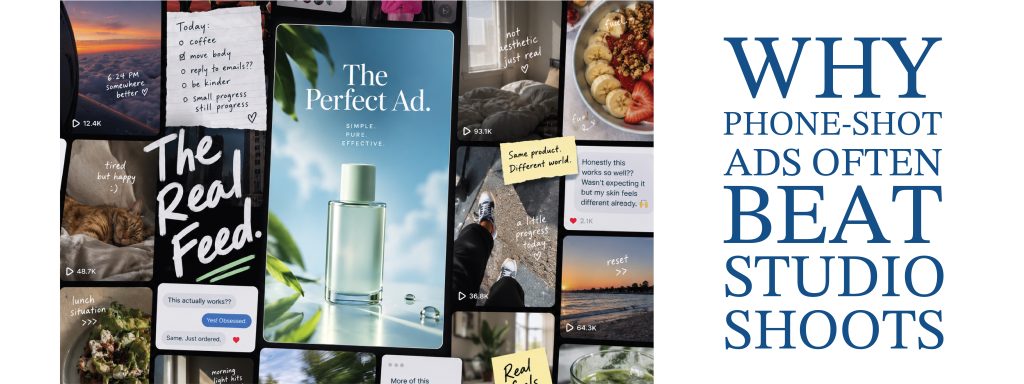
Picture two versions of the same ad. In the first, a crew of twelve fills a rented studio, the lights are the size of small suns and the model has smiled at the lens forty times. In the second, someone stands in a kitchen, holds a phone at arm’s length and says, “Okay, so I’ve been using this for three weeks.” On Reels and TikTok, the second one very often wins.
It happens often enough that marketers have a name for the style: lo-fi, or less kindly, ugly ads. Search Engine Land noted in April that many of the best-performing social ads now break the polished rules on purpose, with grainy phone footage, screenshots from a Notes app and green-screen reaction videos regularly beating studio-grade work.
The eye knows an ad when it sees one
Years of scrolling have trained people to spot advertising in a fraction of a second. Perfect lighting, a steady camera and a smooth voiceover all send the same signal: this is a commercial, keep moving. Phone footage sends a different one. It looks like something a friend, or someone worth following, might post, so the viewer gives it the two seconds a message needs to land. The shorthand in the industry is that lo-fi creative fits in to stand out.
The evidence has been building for years. In a 2019 study of ads in Facebook Stories, Meta found that self-recorded creative outperformed studio-shot creative on content views 84 percent of the time. More recently, the agency Brainlabs reviewed 46 Meta brand lift studies covering 225 campaigns. Polished brand creative did well at building awareness, but it took a real human voice in lo-fi, native-looking content to move purchase intent, delivering a 6 percent lift against an average of 4 percent across all creative types.
That split matters. The two styles are good at different jobs. The studio film tells people a brand exists and what it stands for. The phone video convinces someone that the product works for a person like them.
Why the rough version persuades
Part of the answer is the voice. Most phone-shot ads speak in the first person, as a user rather than a company, and a review from a user carries a credibility that a brand speaking about itself struggles to match. The imperfections help too. A real kitchen, an unmanicured hand or a pause while someone finds the right word all act as quiet proof that nothing was staged.
Then there is speed. One studio shoot can cost as much as dozens of phone videos, and social platforms reward variety because each creative tires quickly. A brand that can test twenty rough ideas learns far more than one that polishes two, and the winners can be spotted and scaled within days.
| WHEN THE STUDIO STILL EARNS ITS FEE
Lo-fi is a tool for the feed, not a rule for all advertising. Brand films built for television, cinema or a big launch still benefit from craft, and so do categories where the craft is the promise, such as luxury, fashion and premium cars. Products that need careful demonstration or a longer explanation can also suffer from a casual treatment. Some agencies find that polished creative works better with audiences who already know a brand, reinforcing trust rather than earning attention from scratch. |
Casual look, careful craft
The biggest misunderstanding about lo-fi is that it means low effort. The ads that win look casual but are built carefully. They hook the viewer in the first second or two, the audio is clear, the on-screen text is short enough to read and sits where the platform’s buttons will not cover it, and the ask at the end is obvious. A genuinely careless video with muddy sound and no clear message does not inherit any of the advantages. It is simply a bad ad.
There is also a shelf life to watch. Search Engine Land made the point that best practices are really an average of what worked for everyone over the past six months, and by the time a tactic becomes a rule, much of its edge is gone. If every brand in a category turns to shaky kitchen videos, the style becomes the new wallpaper, and the eye learns to skip it too.
Matching the look to the place
The phone did not win because it is cheap. It won because it looks like the medium. Television rewarded polish because television itself was polished, and a feed rewards what feels like the feed. The lasting lesson is less about cameras than about context. The best ads have always looked as if they belonged where they appeared, and on a phone screen in 2026, that often means looking as if someone just hit record.
Sources: Search Engine Land, “Why ugly ads outperform polished creative” (April 2026) · Brainlabs, analysis of 46 Meta brand lift studies across 225 campaigns (December 2025) · Meta, Facebook Stories creative study (2019), as reported in industry coverage.
Author: REDWAN ASHRAF


