Introduction
The concept of the metaverse, a seamlessly blended digital and physical reality, didn’t start in a lab or a business meeting; it began in the imagination. It was first conceived by writers and developers who envisioned a space where the digital and physical worlds would merge. The emergence of the metaverse will lead to a new set of regulations, tariffs, trade transactions, and business relationships that will function in both virtual and hybrid formats.
The metaverse represents a future vision of the internet; it encompasses a fully interoperable, decentralized network of digital environments that connect and interact with the physical realm. Currently, these digital environments lack interoperability. Nevertheless, numerous companies are beginning to make essential strides towards achieving this broader vision. As the metaverse is still in its nascent phase of development, this is the crucial moment to establish a strong foundation.
The Origin Story
Neal Stephenson is credited with inventing the word “metaverse” in his 1992 cyberpunk novel, Snow Crash. He used it to describe a detailed, virtual universe where avatars and the digital surroundings represented by people were just as immersive and elaborate as the real world. The name itself, combining “meta” (beyond) and “universe,” was a philosophical projection of the internet’s future. What started as science fiction has now begun to materialize.
An early, real-world prototype emerged in the early 2000s with Linden Labs’ unveiling of Second Life, a shared 3D virtual space where users could explore, interact with others, build things, and exchange virtual goods. This was definitely a watershed event regarding the evolution of the Metaverse, marking the first 3D environment where people could, in a sense, live, work, and play.
Economy
The metaverse has the capability to create a variety of global economic activities, leading to digital real estate, a wealth of distinctive retail experiences, and innovative models of product ownership. Utilizing advanced immersive technologies, it will enhance existing ones while also introducing new tools specific to companies’ digital environments.
According to the World Economic Forum, the metaverse will unlock opportunities for retailers, infiltrating every sector in the coming years and culminating in annual revenues estimated to be in excess of $1 trillion. Researchers concluded that the metaverse could boost global gross domestic product (GDP) by 2.8% ten years after its initial adoption. For instance, if the metaverse adoption started in 2022, it could add $3 trillion to the global economy by 2031.
Technology
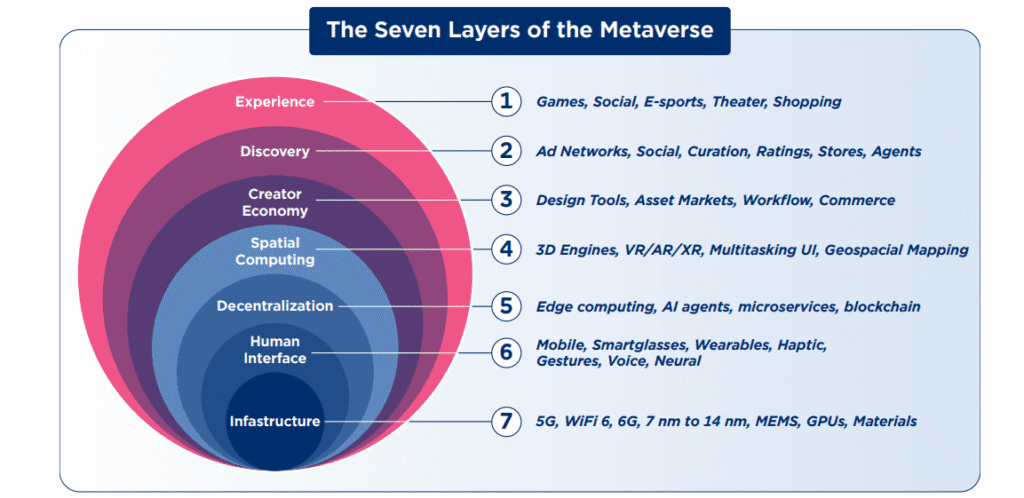
The metaverse can be described as an extensive, continuous, and immersive network of 3D virtual spaces enabled by a combination of technologies such as Augmented Reality (AR), Mixed Reality (MR), Virtual Reality (VR), extended Reality (XR), Artificial Intelligence (AI), and blockchain. The central concept revolves around establishing a persistent, interconnected, and interactive digital space that surpasses conventional online experiences.
The application of the metaverse as a sales avenue is evident. The opportunity for retail in the metaverse, once technological advancements improve, is to enhance online shopping, making it more interactive and beneficial. A platform that enables consumers to explore and discover more effectively than they currently do would bring online shopping closer to the experience available in physical stores. Various sectors, from fashion to local markets, stand to gain from the evolution of the metaverse.
Notable retailers like Bloomingdale’s have already made investments in the metaverse, driven by the belief that “Virtual showrooms in the metaverse represent the next evolution of the retail landscape, offering customers an engaging and immersive experience that links them to the brand and our store, while also giving us unique data insights into user preferences.”
Digital Evolution
Numerous consumer-oriented brands are experimenting with the metaverse to create customer experiences that seamlessly blend the physical and digital realms. Whether through unique digital collectibles or the launch of products that bridge the physical and digital worlds, companies such as Adidas, Coach, Coca-Cola, Dolce & Gabbana, Gucci, Nike, Starbucks, Taco Bell, and others are exploring innovative methods to enhance the current shopping experience. Digital twins will play a crucial role in unlocking the possibilities of these capabilities.
The vast range of metaverse experiences that brands can provide to consumers, associated with the purchase of a tangible item, presents a significant chance for engagement. While a GTIN serves as a class-level identifier for all products with similar physical attributes, there exists a more precise variant known as a Serialized Global Trade Item Number (SGTIN) that is unique to a specific instance or unit of a particular product globally. The serialization of products could enable businesses to develop more targeted, customizable, and unique experiences for customers. For instance, SharpEnd and Threedium collaborated with Puma to market sneakers that each had a unique identifier.
The Fusion of AR and VR
Regardless of whether it’s accessed through a browser, AR glasses, mobile applications, or a VR headset, the user interface for the metaverse is designed to be immersive. This sense of immersion is achieved when items and products within digital environments are depicted in a 3D space. Creating 3D models can be challenging; however, when it comes to engaging with the metaverse, the key difference between those who take action and those who merely fantasize is the ability to generate and deploy large-scale 3D representations of items.
If the metaverse is to become the next evolution of the internet, truly, it must be feasible to produce 3D models of physical objects en masse. The widespread use of 3D models in the metaverse by various businesses and industries can be more effectively realized through the implementation of standardized protocols. The Khronos Group is a standards organization dedicated to developing a cohesive, standardized approach for the creation, preservation, and application of 3D assets across today’s online landscape.
The core of the metaverse
Today, standards from GS1, such as Electronic Product Code Information Services (EPCIS), connect tangible product flows with digital data to provide comprehensive visibility throughout supply chains. The Global Data Synchronization Network (GDSN) enables any company, in any sector, to effortlessly share high-quality product information, thereby facilitating crucial data exchange. Through GDSN, trading partners can instantly access the latest and most complete information required throughout physical supply chains, a capability that can also be applied to digital supply chains. Today, interoperability in the physical realm is accomplished through these standards, which guarantee a steady flow of data accompanying a product on its journey.
This approach could serve as a framework for the movement of digital products, assets, and identifiers within the metaverse. Collaboration that benefits all parties is vital for establishing the digital ecosystem of the metaverse. Central to this is “interoperability defined as ‘the capability to integrate economies, avatars, and systems across platforms’’ which is frequently referred to as one of the key characteristics of the metaverse. As our physical and virtual environments increasingly blend, users will require a seamless and synchronized transition between various platforms, akin to our real-world experiences.” Both collaboration and standardization are the foundational elements needed to create an interoperable digital ecosystem.
Privacy and Security Concerns
In particular, these concerns can be categorized into four distinct groups: User data: A characteristic feature of the metaverse, as illustrated in Fig. While sensors are essential because they enhance user experiences, allowing individuals to fully immerse themselves in the metaverse, many users may not recognize or even be aware of the potential issues.
Two primary factors must be examined: the scenario itself and the avatars participating within it. Regarding the former, as a large number of users congregate on a metaverse platform (and there are currently limited alternative options), their interpretations of cultures, religions, and other societal elements will inevitably differ.
As a result, the scenario is unlikely to satisfy everyone’s expectations and could lead to misunderstandings among avatars. As for the latter, the influx of users will, unfortunately, include some malicious and unethical individuals who may engage in harassment, tracking, or even sexual misconduct targeting other avatars within the metaverse, similar to issues seen in online gaming.
Avatars are concerned about the unauthorized exploitation of their creations; for instance, if an avatar designs a unique outfit for themselves, they would likely not want to see it duplicated by others. At the same time, malicious users can disrupt goods transactions, thus avatars seek anonymity regarding their rights in these dealings. Consequently, it is vital to ensure the secure protection of both the goods themselves and the transactions that occur within the metaverse.
Future of Metaverse
“Metaverse isn’t a thing a company builds. It’s the next chapter of the internet overall.”
— Mark Zuckerberg
Effective commerce at scale relies on established standards. Currently, this is accomplished through GS1 Standards, while the metaverse will necessitate a comparable foundation for digital commerce in the future. The metaverse represents a logical progression of the internet, and we must recognize that this evolution is already in motion. Consumers are increasingly seeking to engage as active, immersive participants, prompting a transition from traditional 2D experiences to personalized 3D ones. Companies’ ability to meet this demand in a branded manner will become crucial, ultimately becoming a standard requirement for commerce within the metaverse.
As technology advances and both consumers and brands explore new engagement methods, brands need to adapt and broaden their use of standards. Those who neglect this will face expensive remediation and a struggle to catch up later. Just as standards facilitate today’s physical supply chain, they can also support the digital supply chain and the necessary interoperability to unlock future possibilities within the metaverse.
We are still years away from a Metaverse like the one shown in Ready Player One, and there are many technical obstacles to surmount to achieve a genuinely immersive digital universe that blends seamlessly with the real world. Additionally, unresolved moral and ethical dilemmas persist regarding the overall impact on society and whether it is advantageous for humans to spend their lives within a virtual realm. Will it take away essential aspects of our human nature? Will we still be able to feel empathy towards others if we find ourselves interacting only with replicas of existence?
Author: MD. Nadim Ahmed
M.A. in English Language Teaching
Jahangirnagar University
Email: nadim@bangladeshbrandforum.com