The Consensus Is Broken
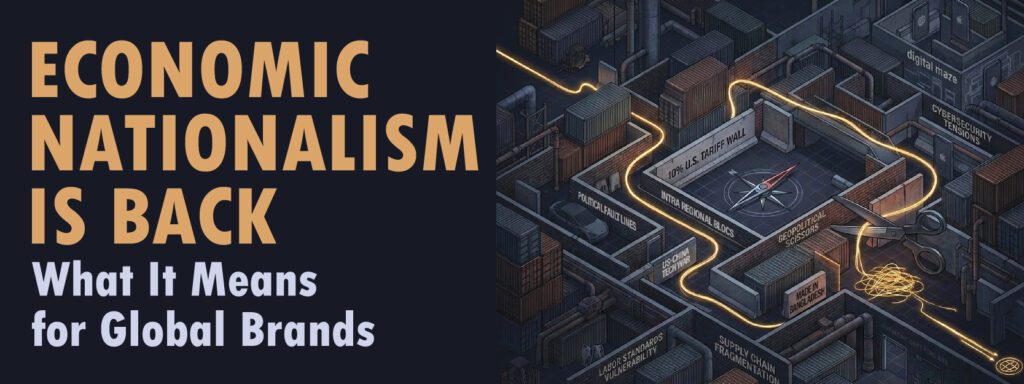
For thirty years, the big idea in global business was integration. Build where it’s cheapest. Sell where demand is highest. Let the market sort out the rest. And it worked — spectacularly, for a long time. Then came 2008, then COVID, then Ukraine, then the US-China tech war. Each crisis chipped away at the assumption that global supply chains were permanent infrastructure rather than a bet on geopolitical stability.
What we’re living through now isn’t a trade dispute or a political moment. It’s a structural reset. The United States has imposed tariffs ranging from 10% to 245% on imports from across the globe, framing trade deficits as national security threats. China has spent a decade building technological self-sufficiency while cultivating domestic champions to replace foreign brands. The EU has introduced carbon border levies and digital sovereignty regulations that carry real teeth. Even India — historically cautious about foreign investment — is using its ‘Vocal for Local’ policy to bend multinationals to its manufacturing agenda.
The WEF’s 2026 Trade Pulse Report puts a number on the shift: global trade growth is forecast at just 2.3%, with intra-regional blocs — ASEAN, GCC, Mercosur — gaining at the expense of the old multilateral model. For global brands, this isn’t background noise. It’s the new operating environment.
When Shopping Becomes Political
Here’s what makes this era different from past rounds of protectionism: governments aren’t acting alone. Consumers are joining in — and in some markets, they’re leading the charge.
In China, the nationalist turn in consumer behaviour has been building for years, but 2025 accelerated it dramatically. Foreign smartphone shipments collapsed by 49.6% in a single month, pushing Apple from first to fifth place in the world’s largest phone market, overtaken by Huawei, Xiaomi, Vivo, and Oppo. In Hong Kong, shoppers openly told journalists they were switching to Chinese brands out of national solidarity. The trade war didn’t start this trend — but it lit the afterburners.
The same dynamics surfaced in Europe, where anti-US sentiment following Trump’s tariff announcements triggered what analysts are calling a consumer earthquake. Tesla — once the aspirational EV of European progressives — shed 45% of its sales volume across the continent in the first five months of 2025. French sales fell nearly 37% year-on-year. Apps emerged to help shoppers identify and avoid American products. The French Wine and Spirits Exporters Federation forecast a 20% drop in US demand. An ECB-IMF working paper estimated that consumer boycotts doubled the economic damage of tariffs alone.
“In the age of economic nationalism, your CEO’s politics are your brand’s politics — whether you intended that or not.”
— BBF Global Business Desk
Three Brands, Three Lessons
Apple: Billions at Stake, No Easy Exit
Apple built one of history’s most elegant supply chains — and it is now one of history’s most expensive liabilities. With over 90% of iPhones assembled in China, the company’s annual tariff exposure hit an estimated $8.5 billion in 2025. Gross margins slipped to 34.5% in Q3 as Apple absorbed costs rather than pass them to consumers.
| CASE
STUDY Apple |
The $500B Pivot — and Why It’s Not Enough
Apple’s response has been bold: a $500 billion US investment plan over four years, a Texas server factory, 20,000 new hires, and the first-ever iPhone Pro models produced in India through a partnership with Tata Electronics. It’s also expanding in Vietnam. But manufacturing in India costs 5-8% more than in China, and replicating China’s supplier ecosystem takes years. Meanwhile, in China itself, Apple’s market share has fallen to 14.1% — fifth place — as nationalist sentiment and domestic brand quality close in from both sides. Apple is being squeezed at both ends of the world simultaneously. |
Tesla: What Happens When the CEO Becomes the Brand
Tesla’s story in Europe is a masterclass in a risk most brand strategists don’t have a framework for: the political identity of a brand’s founder bleeding into the brand itself. Elon Musk’s very public alignment with the Trump administration transformed, for many European buyers, what had been an aspirational EV purchase into a political statement — one they weren’t willing to make.
| CASE
STUDY Tesla |
When the Man Becomes the Message
A 45% drop in European volume. France down nearly 37%. Scandinavian markets — once Tesla strongholds — turning sharply away. None of this was driven by a flawed product or a pricing mistake. It was pure brand-political contamination. For any global brand with a high-profile, politically active leader, the Tesla lesson is this: in markets where the politics run hot, a founder’s positions can override every other brand investment you’ve made. |
Huawei: Sanctions as an Unlikely Launchpad
If Apple and Tesla are cautionary tales, Huawei is the counter-intuitive success story of the nationalist era. Sanctioned by the US from 2019, cut off from TSMC-manufactured chips, and largely expelled from Western 5G infrastructure projects, Huawei looked finished. It was not. By 2025, it was shipping the Mate XT — the world’s first tri-fold smartphone, priced at $2,800 — built on domestically developed chips through SMIC. State support, relentless R&D investment, and a consumer base that was primed to cheer the comeback made the difference. For global brands operating in China, the message is clear: Beijing can build alternatives, and Chinese consumers will buy them.
What Smart Brands Are Doing Differently
The brands navigating this era most successfully share a common instinct: they stopped thinking of economic nationalism as a policy headache and started treating it as a market signal.
That means making supply chains a brand story, not a cost line. Where something is made — and who benefits from its production — now carries emotional and political weight that no advertising campaign can manufacture. Apple’s India move isn’t just tariff management; it’s market positioning. Intel’s $100 billion Ohio semiconductor investment isn’t just domestic policy compliance; it’s a claim on American identity. The ‘Made in’ label is back, and it means something again.
It also means thinking hard about what ‘local’ actually looks like in each market. Not a flag on the packaging. Not a local-language ad campaign. Real investment — manufacturing capacity, local talent, supplier relationships that create genuine economic stakes for host communities. India’s PLI scheme is already pulling Apple, Samsung, and Foxconn in on exactly those terms. Countries that design their nationalist policies with investment incentives rather than just trade barriers will win the next round of corporate capital allocation.
And it means being honest about the pricing reality. Tariffs, localised supply chains, and reshoring all add cost. Yale Budget Lab found that the 2025 US tariff regime added around 0.7 percentage points to consumer inflation within six months. Brands face an unpleasant choice between absorbing the hit to margins or passing it to consumers who are already watching prices closely. There is no clean answer — only the discipline to make the trade-off consciously rather than by default.
What This Means for Bangladesh
For Bangladesh, the rise of economic nationalism is not an abstraction. It is a live operational reality with direct consequences for the garment industry that drives 84% of the country’s export earnings and employs more than four million people.
The risk is real. The EU’s Carbon Border Adjustment Mechanism will raise compliance costs for manufacturers supplying European buyers. The US tariff sweep, while focused on China today, has a logic that could extend further. But the opportunity is also real: brands fleeing Chinese manufacturing are actively looking for Bangladesh-scale alternatives with reliable infrastructure and cost competitiveness. That window will not stay open indefinitely.
The longer game, though, is brand equity. In a world where ‘Made in’ labels carry political and emotional weight, Bangladesh is still defined almost entirely by price. That will not be enough for the decade ahead. The companies — and the country — that invest now in building stories beyond price, in quality signals, in design, in sustainability credentials that European and American buyers will actually pay for, are the ones with the most to gain from the nationalist reshaping of global trade.
Adapt, or Become Irrelevant
Economic nationalism is not a phase. It is the new normal — and the evidence is piling up faster than most boardrooms are willing to process. The brands that will come out of this decade ahead are not the ones with the most optimised legacy supply chains. They’re the ones that moved quickly, localised genuinely, and built market positions that could survive political weather.
The playbook is already visible in the decisions being made right now: Apple betting $500 billion on American soil and Indian factories. Huawei turning sanctions into a competitive moat. Tesla learning the hard way that a brand is not insulated from its founder. India transforming nationalism into a foreign investment magnet. The thread running through all of it is not protectionism or openness. It’s adaptability. In the age of economic nationalism, global brands must learn to be local — or get ready to lose ground to those that do.
KEY SOURCES
WEF Trade Pulse Report 2026 · ACEA Registration Data 2025 · Eurostat EU Import Statistics 2024 · ECB-IMF Working Paper on Tariff-Boycott Impact 2025 · Yale Budget Lab — Effects of 2025 Tariffs · FinancialContent — Apple Gross Margin Analysis Q3 2025 · Rest of World — iPhone Sales China 2025 · AEI — Apple Supply Chain Analysis 2025 · Reshoring Initiative Annual Report 2024-25 · Pew Research — Consumer Reshoring Attitudes, Jan 2025 · CAICT via Reuters — Foreign Smartphone Market Share China 2025