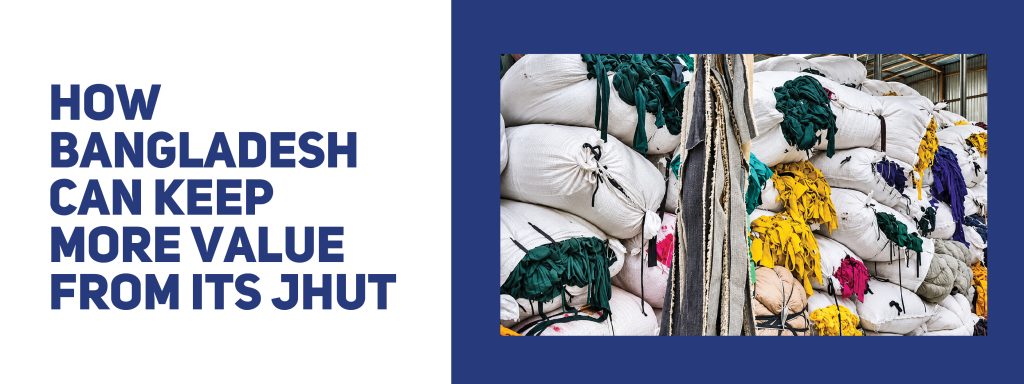
At the end of every shift in a Gazipur cutting room, the floor is covered in fabric. Strips of t-shirt jersey, triangles of denim and the curved pieces left over when a pattern is cut out of a roll all get swept up and stuffed into sacks. In the trade, this is jhut. By evening the sacks have been sold to a waste trader, and most of them are on their way to becoming something else.
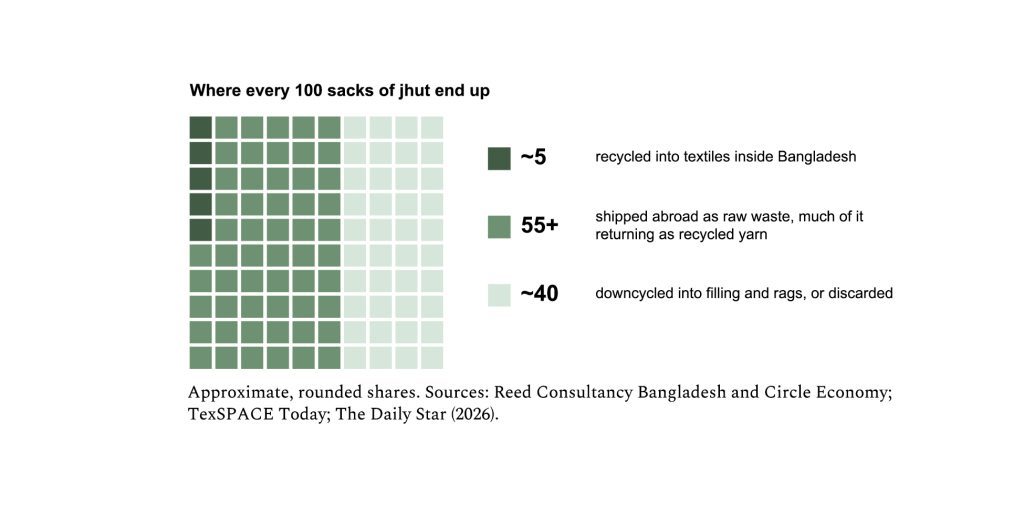
What they become, and where, is the interesting part. Estimates of the volume vary, but field research by Reed Consultancy Bangladesh and Circle Economy puts Bangladesh’s pre-consumer textile waste at between 400,000 and 577,000 tonnes a year, and BGMEA leaders now talk of nearly 600,000 tonnes. Much of it is high-quality cotton, which recyclers prize because it has never been worn or washed. Yet, by most estimates, less than 5 percent is recycled into new textiles inside Bangladesh. More than half leaves the country as raw waste.
None of this means the waste is worthless today. Gazipur has become the country’s largest hub for trading garment waste, and Textile Today describes the business as a multi-crore economy in its own right. The question is how much more value each sack could carry if it were spun into yarn before it left the country.
 A round trip with a price tag
Some of that exported jhut eventually comes home. Speaking at a seminar organised by the Ministry of Commerce and BGMEA in May, Vidiya Amrit Khan, a vice-president of BGMEA, described how a significant share of cutting waste goes to recyclers in India and Pakistan and returns to Bangladesh as recycled yarn. A local spinner then pays for the processing that happened abroad, and the margin travels with it.
How a sack of cutting waste can leave as scrap and return as yarn.
The numbers behind that round trip are large. A 2024 study by GIZ and H&M estimated that a stronger circular textile industry could add $4 billion to $5 billion a year to Bangladesh’s export earnings. Khan has put the wider opportunity at nearly $8 billion a year. The savings at home matter too. Bangladesh spent roughly $4.3 billion on cotton imports in 2022, and an analysis by TexSPACE Today estimates that recycling locally could save about $650 million a year in foreign exchange. Using about 250,000 tonnes of cotton waste could, by the same estimate, cut the country’s dependence on imported cotton by around 15 percent.
Why the sacks travel
The jhut leaves for practical reasons. Recycling cotton well depends on sorting it carefully by fibre and colour, because a recycler that knows exactly what is in the bale can skip dyeing and produce consistent yarn. Much of Bangladesh’s jhut is collected through an informal network of traders, which is efficient at moving volume but less suited to the paperwork that international buyers now want. Brands that sell “recycled” clothing need to prove where the fibre came from.
There is a technical reason too. Mechanically recycled cotton has shorter fibres than new cotton, so spinners usually blend it with virgin cotton or polyester to make a strong yarn. That takes specialised machinery and experience, which recyclers in larger hubs have spent years building.
Capacity is the other half of the story. Counts of Bangladesh’s recycling mills range from about two dozen to around 40, and TexSPACE Today estimates that together they process 18,000 to 24,000 tonnes of cotton-rich jhut a year. That is a solid base, but it is small next to the volume of waste available. Industry leaders say the next step is a clear national framework for treating factory offcuts as a tradable raw material, and the Commerce Ministry and BGMEA have begun working through the issue together, holding a joint seminar on it in May.
The mills that are already spinning
The encouraging part is that the industry is not starting from zero. Recycle Raw, founded in 2017 by Abdur Razzaque, has grown into one of the country’s largest waste-processing businesses, and he credits decent wages and basic labour standards with helping it keep workers. In Ashulia, Broadway Regenerated Fiber turns factory waste into new fibre. Its chief executive, Abdullah Rafi, says what the sector needs now is “more finance and collaboration among brands, suppliers, waste handlers and recyclers.”
Investors have taken notice. In late 2024 the Chinese firm Xingchen Textile signed a $35 million agreement with BEPZA to build a jhut recycling plant in the Mongla Export Processing Zone, with capacity for 20,000 tonnes of yarn and 12,000 tonnes of woven fabric a year. In June this year, Huaxin Textile proposed a $190 million recycled cotton and yarn project at the Payra port industrial zone, one of a group of Chinese investment proposals presented to the prime minister in Beijing.
Brands and lenders are also putting money in. Under the EU-funded SWITCH2CE programme, about 17 factories are running pilot projects on collecting, sorting and recycling waste, with H&M and Bestseller leading work on recycling and traceability. The pilots focus on the first step, which is sorting jhut by fibre and colour at the cutting table, before it ever reaches a trader’s sack. That simple change turns mixed scrap into a feedstock a spinner can plan around and a brand can trace. The European Investment Bank has also extended a €60 million loan to BRAC Bank for circular investments by smaller firms.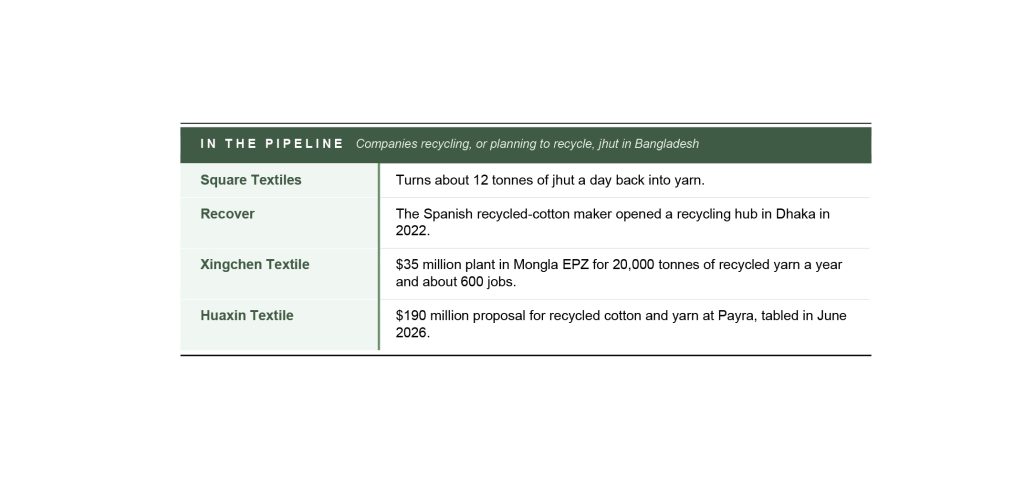 Why the timing favours Bangladesh
The push from buyers is getting stronger. The European Union, which takes nearly 60 percent of Bangladesh’s garment exports, is bringing in rules on product design and a Digital Product Passport that will ask brands to show what their clothes are made of and where the materials came from. Sheikh H M Mustafiz, a BGMEA director and managing director of Cute Dress Industry, named the EU Green Deal and the Digital Product Passport as the main forces pushing factories towards recycling. Recycled content backed by clear records is set to become a selling point. Michael Miller, the EU ambassador, told the May seminar that the bloc is “carefully assessing the request to negotiate a free trade agreement with Bangladesh,” and he linked circular practices to the country’s next stage as it graduates from least-developed country status.
The region shows what is possible. According to Fashion for Good, India recycles or reuses about 60 percent of its textile waste. Bangladesh has the same kind of raw material, and more of it sits right beside its own spinning mills.
Bringing the sorters along
The jhut trade already supports a large workforce. Field research cited in The Daily Star counts between 195,000 and 214,000 people and up to 22,000 informal enterprises in the business, and roughly 70 percent of sorters are women. These workers know the fabrics better than anyone, and as the trade formalises, they are a ready-made skilled base for the sorting that recyclers need. Building safer workplaces and fair pay into the new system will help Bangladesh offer buyers recycled fibre with a credible social story as well as an environmental one.
For now, most of the sacks swept up in Gazipur each evening still cross a border before they become yarn. The mills in Ashulia and the plants planned for Mongla and Payra suggest that this will change. As Nishat Tasnim of ICCCAD wrote in The Daily Star, the scrap on the cutting-room floor “is feedstock.” The more of it that becomes yarn here, the more of its value Bangladesh will keep.
Author: MOHAMMAD SIFAT