Every family has one. He is the cousin who has worn the same brand of sneakers since Class Eight, who will walk past three shops and a sale banner to find them, and who takes any suggestion of an alternative as a small personal insult. For years, marketers assumed this person was middle-aged. Loyalty, the thinking went, was something you grew into, like reading glasses or firm opinions about traffic. Young people sampled and switched and chased whatever their feed served up that week, and the faithful customer turned up somewhere around forty.
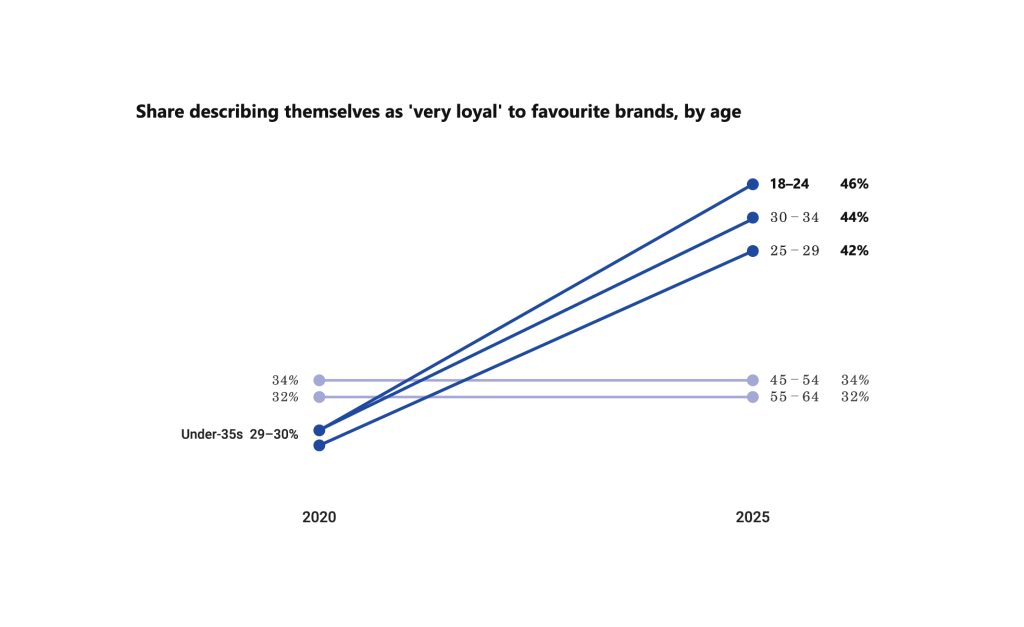
That picture has now been turned upside down, and by a very large sample. In September the US polling firm CivicScience published an analysis of more than one million American adults surveyed between January 2020 and January 2026. Over those six years, the share who describe themselves as very loyal to their favourite brands rose from 31 percent to 36 percent, reversing what the firm calls a decade-long decline. The more surprising part is where the growth came from. Among adults under 35, the increase ran at roughly three times the rate of the population as a whole. And while loyalty peaked among 45- to 54-year-olds in 2020, by December 2025 the most loyal age group in America was 18 to 24, at 46 percent.
John Dick, CivicScience’s founder and chief executive, said the old belief that consumers age into loyalty no longer holds. In his words, “it’s simply not true anymore.”
 The young caught up, then overtook
The age breakdown makes the shift easy to see. Between 2020 and 2025, the very loyal share among 18- to 24-year-olds jumped from 30 to 46 percent. People aged 25 to 29 went from 29 to 42, and those aged 30 to 34 from 30 to 44. Their parents, meanwhile, barely moved, with 45- to 54-year-olds holding at 34 percent and 55- to 64-year-olds at 32. Put simply, the generation brand managers spent a decade describing as restless now out-commits the generation they were working so hard to keep.
Loyalty grew fastest among the young while older groups stood still. Source: CivicScience, via EMARKETER.
The youngest loyalists also commit in a particular way. CivicScience found that 18- to 24-year-olds are the most category-exclusive consumers in its data, which means they tend to settle on one brand, or a small handful, in each category and stay put. That makes the stakes unusually high, because a brand that wins them early may shut rivals out for years. It also runs against the wider trend, since loyalty in general has become less exclusive. According to the study, 85 percent of respondents say they are loyal to several brands across at least a few categories.
Then why do they keep talking about price?
This is where the story gets awkward, because other surveys this year seem to describe a different generation altogether. In July, Rival Technologies asked 903 Gen Z consumers in the US and Canada what drives their loyalty. Price and value came first at 82 percent, with product quality close behind at 80. Alignment with personal values trailed at 36 percent, and influencer recommendations, the darling of many a marketing budget, finished last at 9 percent. A PayPal survey reported by YPulse in April went further. Seventy percent of Gen Z respondents called themselves loyal to brands they like, yet more than half admitted they would switch for a cheaper option or a better deal, and only 9 percent said they would never switch at all.
So which is it? Is this a generation of devotees, or a generation of bargain hunters who happen to own a loyalty card?
The answer lies in what each study measured. Rival and PayPal asked people what matters to them, and naturally price matters, since it matters to almost everyone buying almost anything. CivicScience asked a different question. Across 23 demographic groups, it looked at what explains the difference between the more loyal groups and the less loyal ones. On that test, emotional connection to brands accounted for as much as 90 percent of the variation. Service accounted for roughly half, while price and deals accounted for only 10 percent and quality for just 2.
Read side by side, the findings stop contradicting each other. Price works like an entry ticket, and a brand has to clear it before a young shopper will consider it at all. Every brand still in the running has cleared it, however, so price cannot explain why one of them ends up with a customer for life. Feeling does that work. It is a bit like the school friend who lived on your street. Being close made the friendship possible in the first place, but closeness is not the reason you still meet for tea fifteen years later.
Loyalty as a hedge against regret
Why would the youngest adults lean on brands harder than anyone else? One clue in the CivicScience data points away from sentiment and toward the household budget. Of the 160 attributes the firm tested, the strongest predictors of loyalty were attitudes rather than demographics, and one stood out in particular. People who follow markets and the economy closely were 19 percentage points more likely than average to call themselves very loyal.
That fits a pattern anyone on a tight budget will recognise. When money is short, a disappointing purchase hurts twice, first for the money spent and then for the replacement. A brand you already trust takes that risk off the table. YPulse’s 2026 Brand Loyalty Report reached a similar view, suggesting that the current wave of youthful loyalty may say as much about economic anxiety as it does about affection. Seen this way, buying the same shampoo every month works as a small insurance policy, although it is one that people tend to grow fond of.
Choice adds a second kind of pressure. Young shoppers face more options than any generation before them, and their feeds keep adding more. As a September report from the consultancies Radius Insights and ONE Strategy Studio pointed out, social media algorithms are not designed around repeat purchases, so every scroll brings a new label, a cheaper dupe or a creator’s latest find. Against all that noise, a brand you already trust saves you the trouble of deciding again. Loyalty, in that sense, is a shortcut through a very crowded shop.
The brands that made the cut
When Rival asked its respondents to name one brand they were loyal to and would recommend without hesitation, the answers spread widely. Even so, three names dominated. Apple, Nike and Costco, along with its Kirkland house label, were mentioned more often than the next nine brands put together.
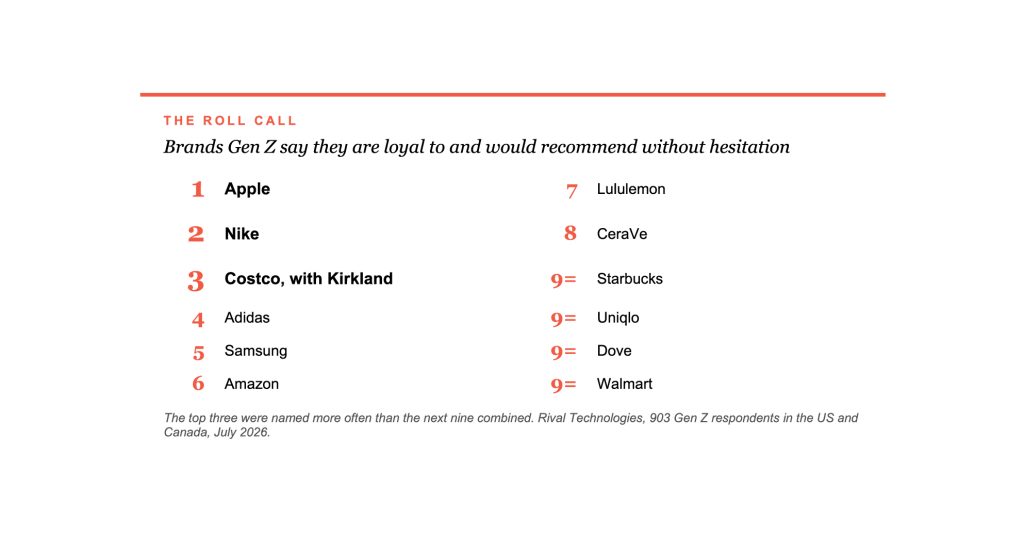
The list also says something about what this generation counts as emotional. A warehouse club whose own label sells batteries and paper towels sits in third place, ahead of Adidas and Samsung. That suggests reliability, repeated often enough, eventually turns into a feeling, which is exactly the bridge between Rival’s practical answers and CivicScience’s emotional ones.
Not everyone buys the loyal-generation story, and the sceptics have data too. The Radius and ONE report argues that Gen Z rotates through a portfolio of brands, starting from a need, checking for proof and treating the brand name as reassurance at the very end. It also found that 70 percent of Gen Z buy dupe products across categories, more than any other generation. Those findings, however, sit quite comfortably beside CivicScience’s. A young shopper can switch freely in categories she does not care about and still be fiercely exclusive in the two or three that mean something to her. The dupe buyer and the loyalist are often the same person, standing in different aisles.
Rival’s numbers also carry a warning for brands that expect the bond to look after itself. Only 11 percent of its respondents felt that brands understand them very well, and around two in three described their reaction to brand messaging as indifferent. Yet those who did feel understood were roughly nine times as likely to be unconditionally loyal as those who felt misunderstood, at 45 percent against 5.

Whatever you do, don’t say the word
The last finding in the CivicScience release is the most delicate, and for marketers perhaps the most useful. In an experiment, the firm asked some consumers about loyalty in neutral terms and asked others in explicitly identity-based terms, framing the brand as part of who they are. The second group was measurably less likely to describe themselves as very loyal.
The bond, it seems, survives best when nobody points at it. Young consumers will happily return to the same sneakers, the same phone and the same coffee order for years. Ask them to declare that a brand defines them, though, and many quietly step back. For brand teams fond of calling their customers a family or a tribe, that is an uncomfortable result. The emotion behind loyalty is real enough, but it grows slowly, through products that keep their promise and experiences that feel the same every time.
So the generation everyone wrote off turns out to be the one most willing to commit, provided it can do so on its own terms. The price has to be right before any conversation starts, and after that the feeling has to be earned rather than announced. The cousin with the sneakers never needed an advert to tell him who he was. He simply kept going back.
Author: TANVIR AHMED