
Remember when we used to draw urban scenery with skyscrapers and landmarks? A city bustling with people, cars, and buses with a few touches of greenery here and there? The modern city is largely composed of brick and asphalt, yet this very urbanisation has caused the planet to lose its environmental balance.
The Global Carbon Project reported that fossil fuel emissions peaked in 2025, indicating that global temperatures continue to rise. This directly contradicts the Paris Agreement 2015, which aimed at limiting global warming to a significant margin- below 2°C, relative to pre-industrial levels, yet in 2023 and 2024, heat records were broken across five continents. Addressing this rapid temperature increase has become an urgent issue, particularly in urban areas. As more than half of the population live in cities, an unprecedented number of people are at risk. At this critical stage the design of our cities can either amplify heat risks or provide sustainable protection.
THE GLOBAL COST OF HEAT
Extreme heat is one of the most severe climate-related hazards worldwide in recent years. According to the Lancet Countdown on Health and Climate Change, between 2012 and ,2021, heat-related mortality reached an estimated average of 546,000. The increased exposure to excessive heat levels has led to chronic heat stress, cardiovascular strain and neurological dysfunction. Report indicates an average 69% decrease in biodiversity since 1970.
In sectors such as agriculture, outdoor construction, and field services, high temperatures directly reduce labour productivity and output. Electricity demand increases with temperature, particularly in urban areas, where most infrastructure requires substantial energy. In most areas, each 1°C rise in temperature is associated with a significant increase in cooling demand; this puts grids to the test and increases the risk of blackouts during heat waves.
IS SMART COOLING A BETTER SOLUTION?
As mitigation efforts fall short, rising temperatures pose a significant challenge. According to researchers at the World Resources Institute, cities warm up faster because the concrete surfaces of most urban infrastructure absorb heat. In this context, smart cooling emerges as a more viable alternative to conventional energy-intensive air conditioning. Traditional cooling relies on energy-intensive components, which further contribute to global warming and increase energy consumption. Smartmart cooling is an urban-scale climate-adaptation measure that breaks the cycle by reducing energy use through critical structural changes that can lower heat exposure. It offers an adaptation pathway that aligns long-term climate resilience and energy sustainability.
RETHINKING URBANISATION WITH PRACTICAL STRATEGIES
Urbanisation has already caused many cities to lose their natural greenery, greatly reducing their seedy appeal. Large open spaces are very rare for reforestation or wetland establishment. But with better planning, urban design can incorporate cooling establishments.
Passive Building Design: Smart cooling involves proper orientation of structures to maximize solar gain; the application of shading devices, improved insulation, and the use of white paint are most effective solutions. Passive approaches have the ability to drop temperatures inside a home and usually postpone or even remove the necessity of mechanical air conditioning.
Cold and reflective surfaces: High-albedo roofs, façades, and pavements reflect solar radiation rather than absorb it. Cool roofs can lower surface temperatures outdoors and indoors by a certain degree. The Blue and Green Infrastructure: Cities are covered by trees, parks, green roofs, wetlands, and water bodies, which provide shading and evapotranspiration. Such green and blue infrastructure has the potential to lower air temperature and enhance air quality.
Urban Form that reacts to Climate, Airflow, and heat retention depends on variations in street orientation, building height, and the distance between structures. A lack of ventilation creates significant heat trapping. To promote nighttime coolness and minimize heat stress, pedestrian-level design, structural variations, adequate shading, and eco-friendly building materials should be implemented.
Data-driven, efficient planning using satellite imagery, sensors, and urban heat maps enables the identification of hotspots. In situations where mechanical cooling is necessary, high-efficiency appliances reduce energy consumption and waste heat compared with single air-conditioning units, including in heat risk assessment and planning approval, indicating that new developments will not contribute to urban heat.
GLOBAL EQUITY FOR BETTER RESULTS
Global equity is a central concern to achieving heat resilience. High-income countries are primary contributors, with disproportionately severe effects on low- and middle-income countries due to dense informal settlements and limited resources. Smart cooling and climate-responsive urban design must be included, prioritising vulnerable communities over elite urban development. International climate finance, technology transfer, and energy-efficient urban planning are essential to ensure that cities with limited resources can also participate in implementing smart cooling.
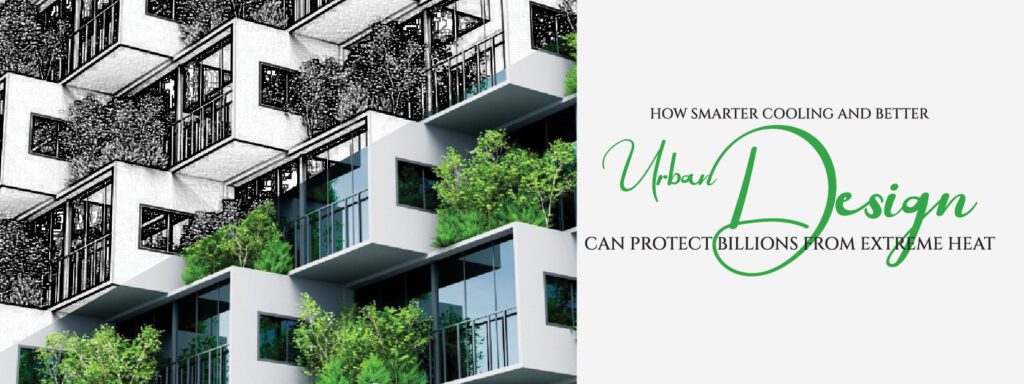
Bosco Verticale in Italy is one of the few eco-friendly buildings in the world. It demonstrates that smart cooling remains a relatively new concept, one whose implementation requires a strategic approach, as it’s feasible to rebuild cities. But further construction needs to take climate policies into consideration. It is the only way to protect the climate from degradation.
Author: Jarin Subah Turaba


