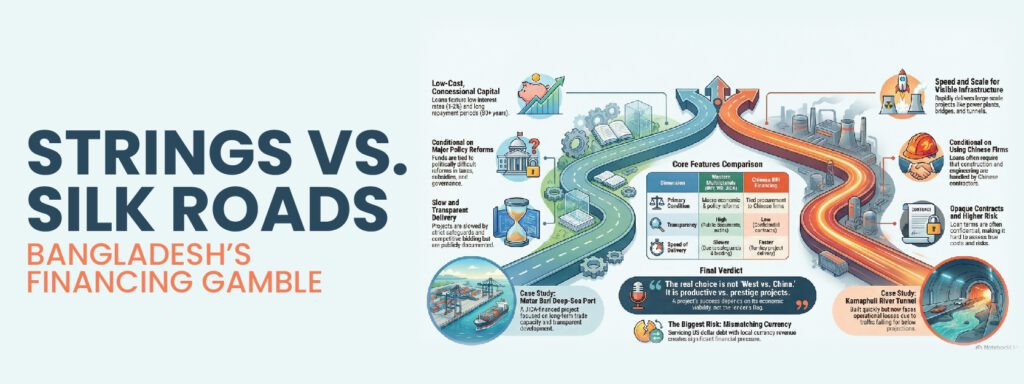
“Speed builds assets; patience builds resilience.”
Let’s start with a question: How Western conditional lending and China’s Belt and Road financing shape Bangladesh’s economy, sovereignty, and strategic future.
Introduction
Bangladesh stands at a financing crossroads. On one side are Western multilaterals, the IMF, World Bank, ADB, JICA offering low-cost loans with policy conditions. On the other is China’s Belt and Road Initiative (BRI) large, fast-moving infrastructure money with fewer macro conditions but more tied procurement. The choice is not only about money; it is about terms, transparency, speed, and strategic leverage. This article compares costs, conditions, risks, and benefits using recent debt data, project case studies, and program documents to explain what each path means for Bangladesh’s economy and autonomy.
Bangladesh’s Debt & Financing Snapshot
By global standards, Bangladesh’s public debt remains moderate, but recent external debt and servicing have risen, increasing the pressure on foreign exchange and the budget. In 2024, government debt stood around 26–27% of GDP, up from 24% the year before.
External debt reached about $104 billion by June 2024 (quarterly series), while other sources place outstanding external public debt in the $62–70 billion range depending on methodology and coverage.
Debt service is rising fast: foreign debt payments hit $3.36 billion in FY24, up 26%, with interest payments jumping 44% to $1.35 billion as grace periods end and market rates (SOFR) rise.
The IMF program (ECF/EFF/RSF) approved in January 2023 and augmented in June 2025 made $884 million under ECF/EFF and $453 million under RSF immediately available, while extending the program and raising total access.
Reserves have been rebuilding in 2025 after exchange-rate reforms, with recent gross measures around $31 billion and BPM6 measures around $26 billion; these figures fluctuate and are reported under two methodologies (gross vs. IMF-compliant).
Bottom line: Bangladesh is not in a classic debt crisis, but debt service, FX liquidity, and project selection now matter more than ever.
Western Financing: Terms, Conditions, and Delivery
Who and how: IMF programs support macro stabilization and reforms; the World Bank (IDA) and ADB provide concessional, long-maturity loans; JICA finances large power and port-linked projects with detailed feasibility and safeguards.
Typical terms:
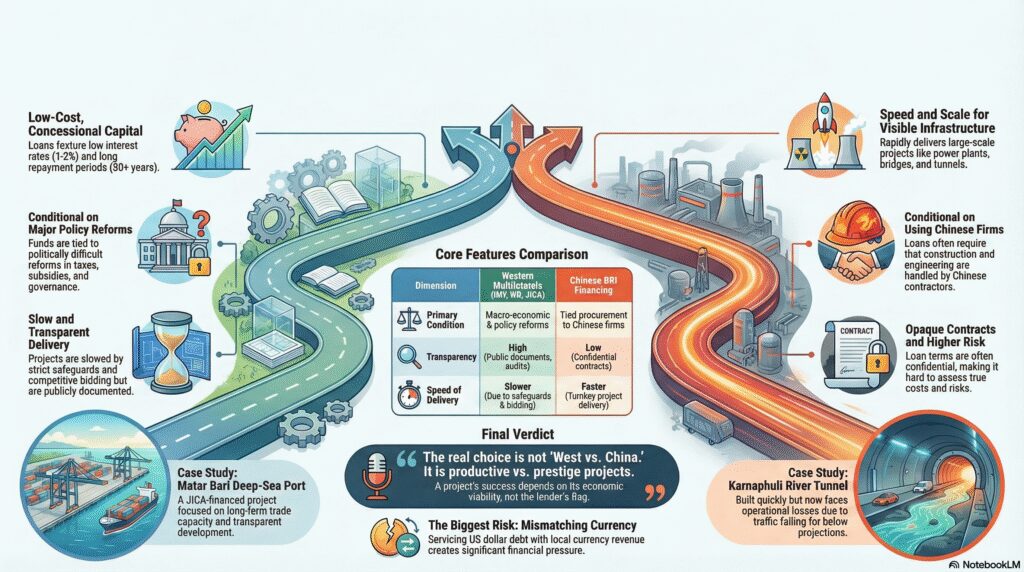
Interest rates are low (e.g., JICA tranches at 1.6% for works/equipment and 0.1% for consulting, 30-year maturity, 10-year grace).
Conditionality focuses on exchange-rate flexibility, tax reform, subsidy rationalization, and SOE governance.
Safeguards include environmental/social standards and competitive procurement.
Pros: Lower cost of capital, stronger transparency and safeguards, and capacity building.
Cons: Slow disbursement, politically tough reforms, and limited appetite for turnkey mega-infrastructure at speed.
Case to watch: Matar Bari Ultra-Supercritical (USC) Coal & Deep-Sea Port linkage—a JICA-financed baseload power project with port infrastructure and 400kV transmission, structured through multiple tranches since 2016–2025.
Chinese BRI Financing: Speed, Scale, and Strategic Logic
Who and how: Financing often comes via China Exim Bank or CDB, with EPC/turnkey contracts and tied procurement to Chinese contractors. Contracts can be opaque, with mixed concessional and commercial terms.
Typical terms (Bangladesh example): The Karnaphuli (Chattogram) Tunnel was financed with a government concessional loan and a preferential buyer’s credit at around 2% interest, 20-year maturity, 5-year grace, tied to a CCCC contract.
Pros: Speed and large ticket sizes, focusing on visible hard infrastructure (tunnels, ports, power plants).
Cons: Cost variability, contract opacity, higher reliance on foreign EPCs, and long-run O&M risks if demand or maintenance lags.
Bangladesh lens: Chinese EPCs are (partly) behind power capacity additions and assets like Karnaphuli Tunnel; but traffic and tolls have lagged projections, leading to operational losses and questions on timing and complementary projects.
“Debt Trap” vs. Development: What the Evidence Says
The “debt-trap diplomacy” narrative claims China lends to create dependence and seize strategic assets. Academic and policy analysis is mixed:
Rhodium Group’s review of 40 renegotiations found asset seizures rare; outcomes more often involve extensions, refinancing, or partial forgiveness.
Chatham House and other researchers argue many problematic projects reflect domestic governance and host-country politics, not a uniform Chinese strategy.
CSIS commentary flags opacity and debt risks, urging cooperation with IMF to improve transparency and sustainability.
Implication for Bangladesh: “Debt traps” are unlikely by design but possible by outcome if projects are poorly selected, overpriced, or underutilized, especially when revenues are in taka and debt service in dollars. Governance and project productivity matter more than the lender’s flag.
Side-by-Side: Costs, Conditions, and Outcomes
Interest & Maturity
Western multilaterals: Concessional rates (often 1–2%), long maturities, grace periods; best for macro stability and social-infrastructure or network upgrades.
Chinese BRI: Mixed; some concessional (close to 2%), others commercial; terms vary by project; procurement tied.
Conditionality
Western: Macro/structural reforms (FX, taxes, subsidies), governance and procurement standards.
Chinese: Few macro conditions but tied contracts; sometimes collateral/security clauses elsewhere; limited disclosure.
Speed & Execution
Western: Slower due to feasibility, safeguards, and competitive bidding.
Chinese: Faster EPC; aligned with political timelines for visible assets.
Transparency
Western: Public documentation, audits, and standards.
Chinese: Contracts often opaque, making risk assessment harder.
Local Industry & Skills
Western: Capacity building and competitive bidding can crowd in local firms and skills.
Chinese: Rapid build with Chinese contractors and imported inputs; O&M may be contracted to foreign firms for longer.
Geopolitical Leverage
Western: Influence via reform agendas and governance standards.
Chinese: Influence via strategic assets/corridors and supply chains.
FX Resilience
Western concessional reduces FX burden via low rates and long tenor; programs also aim to rebuild reserves.
Chinese mixed terms can heighten FX risk if project cash flows are domestic-currency only.
Snapshot: Western vs. Chinese Financing for Bangladesh
Bangladesh Case Studies
1) Karnaphuli River Tunnel (Chattogram) – Chinese financing/EPC
Financing & terms: China Exim Bank concessional loan + buyer’s credit, 2%, 20-year, 5-year grace, tied to CCCC.
 Delivery & outcome: Opened Oct 2023. Traffic and toll revenue far below projections; O&M costs exceed income, with losses projected around BDT 1.7–1.9 billion/year recently.
Implication: Without complementary industrial zones and Matar Bari port linkages, asset utilization lags, raising fiscal and FX pressures (as debt service begins).
2) Matar Bari Ultra-Supercritical (USC) Coal + Deep-Sea Port — JICA/Western
Terms: JICA tranches (e.g., VII) at 1.6%/0.1%, 30-year, 10-year grace; further ex-ante evaluations and safeguards.
Port progress: Contracts with Japanese firms signed in April 2025; first phase targets 2029 operations, enabling 16–18.5m draft vessels and sharply reducing shipping time/cost vs. Chattogram.
Risks: Delays and fund surrenders have occurred; project management and land acquisition remain critical.
3) Power sector IPPs & EPC – mixed Chinese participation
Observation: Capacity additions were significant, but utilization and capacity payments have generated fiscal stress, particularly when fuel imports and FX are tight. Comparative lessons from Pakistan’s CPEC power portfolio show how coal-heavy capacity can raise debt and environmental risks if demand and tariff structures lag.
4) Payra Port (context) – mixed financing history
Status & debate: Large investments (~Tk 14,000 crore) with limited revenue so far; heavy dredging costs and siltation concerns challenge viability, prompting calls to diversify ports but improve project rigor.
5) Padma Bridge (self-financed) – domestic financing signal
Context: After donors (led by World Bank) withdrew over corruption concerns, Bangladesh self-financed (approximately Tk 32,606 crore), using domestic borrowing and FX from local banks/reserves; toll revenues now service a Bangladesh Bank loan.
Trade-off: A governance milestone and national pride, but higher-cost domestic financing and FX usage reportedly tightened money and reserves during construction.
Debt Sustainability & Risk: What the Numbers Say
Public debt-to-GDP around 26–27% is moderate, yet external debt and servicing have risen. FX reserves have improved in 2025 under IMF-supported reforms, but still require careful management.
Stress channels:
FX depreciation and import bills (fuel, inputs) raise taka costs of dollar debts.
Export cycles (RMG demand) and remittance volatility affect reserves.
Rising market rates (SOFR, global financing) lift interest costs on non-concessional loans.
IMF program diagnostics emphasize tax mobilization, banking-sector repair, and full implementation of the new exchange-rate regime to sustain reserves and curb inflation.
Bottom line: Debt sustainability hinges on project productivity and FX-earning capacity (ports, logistics, export zones) rather than on whether the lender is Western or Chinese.
Possible Policy Choices: A Smart Middle Path
Balance the portfolio: Avoid overconcentration in any single creditor or instrument; blend concessional with carefully structured commercial loans.
Publish contracts and feasibility: Raise transparency to improve pricing and reduce governance risk; require independent demand studies.
Prioritize FX-earning, trade-boosting assets: Fast-track projects that cut logistics costs, deepen port capacity, and enable export diversification; Matarbari and corridor links should be sequenced with industrial zones and customs modernization.
Strengthen O&M and maintenance: Budget for life-cycle costs so assets like Karnaphuli do not become fiscal drains; align tolls and traffic management with realistic demand.
Hedge FX and refinance: Use currency diversification, long tenors, and refinancing windows to soften FX shocks; expand local capital markets in taka for domestic portions.
Stick to macro reforms: Keep tax reforms and banking clean-up on track to lower risk premiums and attract cheaper multilateral money.
Conclusion
For Bangladesh, the real choice is not “West vs. China.” It is cheap vs. costly debt, transparent vs. opaque contracts, and productive vs. prestige projects. Western financing brings concessional money and safeguards but demands reforms and patience. Chinese financing brings speed and scale but requires vigilant appraisal to ensure assets earn enough to service foreign-currency debt. The financing gamble will pay off if Bangladesh aligns funding with export competitiveness, FX resilience, and clean governance, no matter who writes the check.
Author: Abu Yousuf Abdullah