Coca-Cola is selling Crocs, Nike is co-branding with Kim Kardashian, and Louis Vuitton opened 2025 by reviving a twenty-year-old partnership. Behind the strange pairings sits a trade that has become one of the most dependable moves in marketing, with returns measured well enough that the strangeness now needs no defending.
On January 13 this year, Coca-Cola released a shoe. The product was an official Coca-Cola Croc, offered in regular and Diet liveries, sold as a limited drop through Crocs’ channels and gone in short order. Nothing about the release followed the logic of an ordinary licensing exercise. The shoe carried a collector’s price, launched with the countdown mechanics of a sneaker drop, and reached the trade press as a cultural event rather than a merchandising footnote. Because the run was small by design, selling out was the plan rather than the surprise, and the sell-out itself did the advertising — carrying both names to audiences that neither company could have reached with the same money in paid media.
The pairing was unusual only in its details. A day after the Croc drop, Starbucks launched the Cannon Ball, a limited drink built with MrBeast, whose YouTube audience exceeds 450 million subscribers. In February, Scrub Daddy released Mickey Mouse and Stitch editions of its sponges under a continuing Disney arrangement, and e.l.f. Beauty restocked a lip balm co-created with Liquid Death, a canned-water company, because the first run in 2024 had sold out in 45 minutes. Queue-it, the retail-technology firm that manages online drop traffic, called 2025 a record year for retail collaborations, and 2026 is running at the same pace. Seen from outside, this looks like a run of internet jokes. Seen from inside a marketing department, it looks like a machine that keeps paying out.
| $369.6 billion — global retail sales of licensed merchandise and services in 2024, according to Licensing International’s 2025 Global Licensing Industry Study. The consumer side of the trade is just as established: in Sprout Social’s Q2 2025 Pulse Survey, 64 percent of social users said a partnership with someone they like would make them buy more from a brand, and a 2025 study of Japanese and Korean fast-moving consumer goods found that co-branded products consistently earned higher loyalty scores than standard ones. |
Why the trade works — and why it works better now
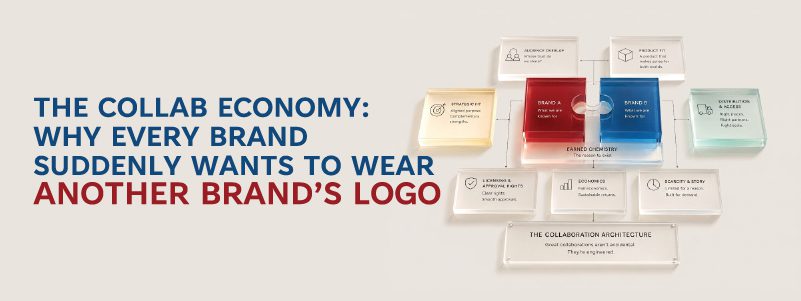
Every collaboration, once the novelty is peeled off, is the same transaction: each brand hands the other something it cannot buy at any sensible price, which is a different audience’s trust. Coca-Cola can buy reach among young collectors whenever it likes; what it cannot buy is the standing Crocs has earned with them, drop by drop and charm by charm, over years. Crocs, in return, borrows a century of affection for Coca-Cola that no footwear campaign could produce on its own. The exchange also explains why the products so often work as advertising in reverse. A branded Croc is a message the customer pays to carry, and paying is what makes the message believable.
A newer force has raised the stakes. Artificial intelligence has made ordinary marketing easy to imitate — a rival can now produce a similar advertisement, a similar visual, even a similar campaign idea in an afternoon — so the value is shifting toward the things that cannot be copied. A real product carrying the earned reputations of two brands is one of them. Software can mimic the look of a Coca-Cola Croc in seconds; it cannot mint the decades of trust that make people queue for one. Because imitation keeps getting cheaper, the un-copyable move keeps getting more valuable, and a collaboration is one of the few marketing formats whose scarcity is built in.
So why is the trade booming now rather than a decade ago? Partly because reaching a new audience through paid media grows more expensive every year, while a genuine surprise still earns its way across feeds for free. But there is a second reason, less discussed and more commercial: a limited drop is a cheap experiment. Two companies can test a product, a price and an audience with small volumes and borrowed anticipation, knowing that a flop will be filed under stunts and forgotten, while a hit earns promotion into the permanent range. Reese’s and Oreo ran that sequence to completion in September 2025, turning years of visible fan demand into a permanent Reese’s Oreo Cup once the limited editions had proved the appetite was real. The fans wrote the brief; the two companies merely split the risk of acting on it.
Dhaka’s open runway
Now bring the playbook home, because Bangladesh may be sitting on one of the format’s largest untapped opportunities. The foundations are already strong: local brands co-sponsor concerts and cricket, banks bundle offers with delivery platforms, and telecom operators fold partner deals into recharge menus, so the instinct for partnership clearly exists. What remains unclaimed is the format the global case files keep rewarding — the product-level collaboration, two established local brands making one thing together and selling it as a limited drop. A heritage biscuit with a streetwear label, a premium tea with a café chain, a classic confectionery on a sneaker: each of these is waiting for its first pair of movers, and whoever moves first inherits the entire novelty premium.
What would it take? Mostly machinery rather than money. The contract templates, royalty benchmarks and approval-rights playbooks that make these deals routine elsewhere are still being assembled in this market, and product partnerships need a broker — a role no local agency has yet built a practice around, which makes it an opening for agencies as much as for brands. The other ingredients are already in place: brands with decades of accumulated affection of the kind Coca-Cola traded on in January, a young consumer base fluent in drops and resale through the sneaker and gadget markets, and a social ecosystem that converts genuine surprise into national reach overnight at no media cost. A limited run also caps the downside by design, which makes the first experiment cheaper than a single television campaign — rare conditions, and they will not stay unclaimed for long.
The product is the headline; the audience swap is the business.
The playbook — what the scoreboard shows
Crowding has raised the bar. When a collaboration lands every week, the ones that compound can be told apart from the ones that evaporate, and eighteen months of case files make the differences specific enough to put in a table.
| PAIRING | LAUNCH | THE PRODUCT | THE RESULT |
| e.l.f. × Liquid Death | 2024 / Jan 2026 | Corpse Paint lip balm, co-made | Sold out in 45 minutes; restocked as a sequel |
| Reese’s × Oreo | Sept 2025 | Reese’s Oreo Cup | Promoted to the permanent range after fan demand |
| Urban Outfitters × Dunkin’, Nike, Chipotle | FY2026 | Rolling retail partnership program | Comparable sales up 12.5% in Q3 |
| Louis Vuitton × Murakami | Jan 2025 | Reissue of the 2000s collection, fronted by Zendaya | Double-digit brand growth that month |
| Coca-Cola × Crocs | Jan 2026 | Limited-edition clogs, two liveries | Sold through as a collector item |
| KitKat × Formula 1 | 2025–26 | Long-term global licensing deal | Full worldwide rollout this year |
| Nike × Skims | 2025–26 | NikeSKIMS, a standalone joint brand | US launch, global rollout planned |
Verified outcomes across the 2025–26 collaboration wave. Sources: company results and reporting by Sprout Social, Billboard and Avenue Z.
Read down the results column and the winning pattern is consistent. The pairings that worked shared audiences with something genuine in common, answered demand that already existed, and gave each side a capability the other lacked; the pairings that failed tended to be one brand renting another’s relevance and hoping proximity would pass for chemistry. The contract underneath is unglamorous but decisive. Most collaborations are licensing arrangements — one side lends the mark, the other manufactures and distributes, royalties flow back as a share of wholesale — yet the fights are rarely about the royalty rate. They are about approval rights, because each company is lending the other an asset built over decades, and a quality failure now travels in both directions at the speed of a screenshot. This is why the deals cluster among brands with strong identities and disciplined design teams, and why the sequel has become the surest sign of a good one: a pairing that returns for a second run is two companies agreeing, with money, that the association made them both stronger.
When the pairing stops paying
The clearest warning in the recent case files involves no scandal at all — only arithmetic. In March 2024, Krispy Kreme and McDonald’s announced one of the most ambitious brand partnerships in food retail: the doughnut maker would supply McDonald’s restaurants across the United States, more than doubling its distribution by the end of 2026. The rollout reached roughly 2,400 restaurants and the product, both sides agreed, was good. The economics were not. Delivering fresh doughnuts daily to thousands of locations proved punishingly expensive, and when the launch marketing faded, so did demand; sales per restaurant fell short of what the delivery runs cost. Fifteen months after the announcement, the companies jointly ended the deal, effective July 2, 2025, and Krispy Kreme booked $28.9 million in termination costs on top of $22.1 million in asset charges.
“Ultimately, efforts to bring our costs in line with unit demand were unsuccessful, making the partnership unsustainable for us.”
— Josh Charlesworth, Chief Executive Officer, Krispy Kreme, June 2025
Two beloved brands, a good product, and unit economics that never closed — the reminder that a collaboration is an operating model, not just a marketing idea.
The lesson generalises. Audience chemistry, which the doughnut deal had in abundance, cannot rescue unit economics, and a partnership deep enough to reshape distribution is deep enough to reshape the loss statement — McDonald’s own marketing chief, Alyssa Buetikofer, put the epitaph gently, noting the arrangement “needed to be a profitable business model for Krispy Kreme as well.” There is a second exposure every partner accepts, quieter but just as real: a trade in trust means each brand now shares the other’s headlines, good and bad, for the life of the deal and sometimes beyond it. And the third risk belongs to the format itself. Hollywood Branded, an entertainment-marketing agency that tracks the space, argues that most collaborations fail on their own terms because they are rushed, transactional logo swaps that audiences dismiss in a single scroll, and the arithmetic sides with the cynics: the format runs on surprise and scarcity, and a calendar in which every brand collaborates every quarter destroys both. The Coca-Cola Croc worked because Coca-Cola almost never does this; rarity was not a limitation of the campaign, rarity was the campaign.
Which is the note to end on, because it answers the question this article opened with. The collab economy is the market’s response to attention that can no longer be bought at a reasonable price — it can, however, be traded for, and the currency is the trust another brand has already earned. The trade rewards the patient and punishes the careless, it demands a real product and honest arithmetic underneath the fun, and it will look faintly ridiculous every time it is announced, right up until the moment it sells out. On the evidence of the past eighteen months, that moment is usually the following morning.