There was a time when business conversations in Bangladesh were largely about expansion.
New factories.
New markets.
New product categories.
New distribution footprints.
Boardroom discussions revolved around growth targets, market share gains, and investment opportunities. Many businesses experienced double-digit growth year after year, benefiting from a rapidly growing economy, a young consumer base, and increasing urbanization.
Today, the conversation has changed.
When I sit with fellow business leaders, entrepreneurs, or young managers, the discussions are no longer centered solely around growth. Instead, they revolve around sustainability, productivity, talent retention, digital transformation, cost optimization, and resilience.
The question is no longer, “How fast can we grow?”
The question is, “How prepared are we for what’s next?”
Leadership Reveals Itself During Difficult Times
Leadership is easy when the wind is behind you.
Its true character emerges when the winds change direction.
Over the past few years, Bangladeshi businesses have experienced a series of challenges. The pandemic disrupted supply chains. Foreign exchange volatility increased the cost of imports. Inflation affected consumer spending patterns. Energy shortages created operational uncertainty for manufacturers.
Yet some organizations emerged stronger.
I still remember speaking with a local manufacturing leader who refused to reduce workforce numbers during the peak of the pandemic despite severe business pressure. His reasoning was simple:
“Machines can be bought again. Trust cannot.”
That decision came at a cost.
But when business rebounded, employee loyalty, productivity, and organizational culture became competitive advantages that competitors struggled to replicate.
The lesson was clear.
During difficult times, people remember how leaders made them feel long after they forget quarterly results.
Bangladesh’s Next Competitive Advantage
For decades, Bangladesh’s success story has been built on resilience and hard work.
The Ready-Made Garments sector transformed the nation into one of the world’s largest apparel exporters. The pharmaceutical industry earned international recognition by exporting quality medicines to global markets. Mobile financial services changed how millions of people transact daily.
Yet the next chapter of growth may look very different.
The businesses that will lead the next decade are unlikely to win solely because they have larger factories or bigger distribution networks.
They will win because they are smarter.
Because they use data better.
Because they innovate faster.
Because they attract and retain better talent.
And because they can adapt more quickly than their competitors.
A striking example can already be seen in Bangladesh’s retail and consumer sectors. Companies that embraced digital commerce, data analytics, and customer engagement platforms years ago are now operating with greater agility than those that viewed technology as merely an IT function.
Technology is no longer a support function.
It is becoming a business strategy.
The AI Conversation We Need To Have
Artificial Intelligence has become the most discussed topic in executive meetings across the world.
Bangladesh is no exception.
Some leaders fear it.
Others are rushing to adopt it.
Most are still trying to understand it.
The reality is that AI will not replace leadership.
Nor will it replace human judgment.
What it will do is expose organizations that are slow to learn.
Imagine a sales manager who can analyze customer buying behavior in minutes instead of weeks. Imagine a manufacturing plant that predicts machine failures before they occur. Imagine healthcare providers improving patient experiences through intelligent decision support systems.
Those possibilities are no longer future scenarios.
They are already happening globally.
However, there is another side of the conversation that deserves equal attention.
Cybersecurity.
Data privacy.
Digital governance.
As organizations become smarter, risks become smarter too.
The challenge for leaders is not simply adopting technology.
It is adopting technology responsibly.
The Leadership Shift Happening Quietly
Perhaps the biggest transformation is not technological.
It is human.
A generation ago, leadership often meant authority.
The boss spoke.
Others listened.
Today’s workforce expects something different.
Young professionals entering organizations want more than salaries and designations. They seek purpose, growth opportunities, flexibility, and meaningful work.
Recently, a young executive asked me a question that stayed with me.
He did not ask about compensation.
He did not ask about promotion.
He asked:
“How will this role help me grow as a person?”
That single question reflects a broader shift taking place across workplaces.
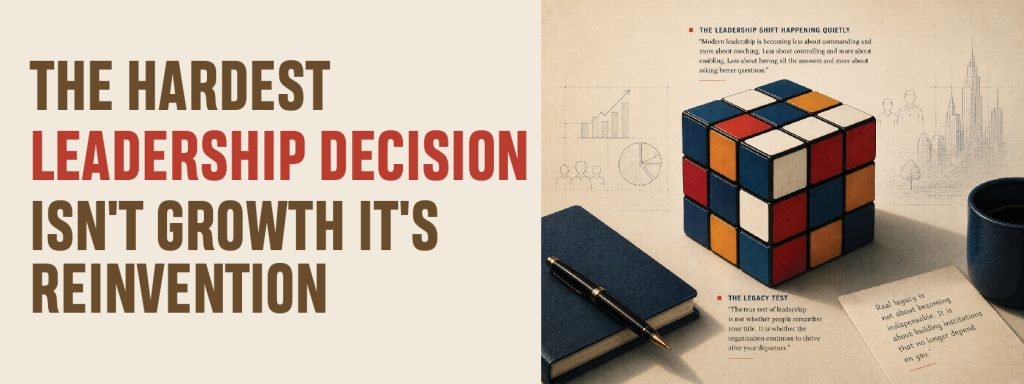
Modern leadership is becoming less about commanding and more about coaching.
Less about controlling and more about enabling.
Less about having all the answers and more about asking better questions.
Ironically, many experienced leaders eventually arrive at the same realization:
They wish they had listened more.
Building Organizations That Outlive Us
Every leader wants to leave a legacy.
The challenge is that many confuse legacy with visibility.
Real legacy is not about becoming indispensable.
It is about building institutions that no longer depend on you.
Some of Bangladesh’s most respected business groups have successfully transitioned from founder-led enterprises to professionally managed organizations. Those transitions were not successful because of charismatic individuals alone.
They succeeded because systems, culture, governance, and leadership pipelines were built deliberately over time.
The true test of leadership is not whether people remember your title.
It is whether the organization continues to thrive after your departure.
Because in the end, leadership is not about being the hero of the story.
It is about ensuring the story continues long after you have left the stage.
As Bangladesh moves toward its next phase of economic development, this may be the most important leadership challenge of all.
Not how to build bigger businesses.
But how to build stronger, smarter, and more enduring ones.
Author:

Towfique Hasan FCIM
Chief Business Development Officer
Akij Resource