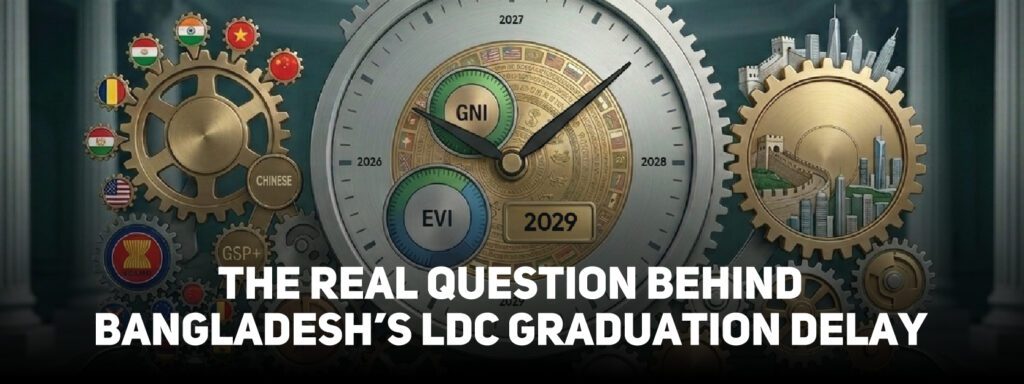
Bangladesh has again returned to a question it thought it had already answered: should it graduate from the UN’s Least Developed Country (LDC) category in 2026, or should it ask for more time? This debate is not new, but the politics around it are new. A new government has formally asked the United Nations to defer Bangladesh’s LDC graduation by three years, until 24 November 2029, and the UN system has agreed to assess that request.
The UN Committee for Development Policy (CDP) has acknowledged receipt of Bangladesh’s letter and will review whether the country is facing a “crisis due to unanticipated and beyond control factors,” before sending recommendations to ECOSOC and then to the UN General Assembly for a final decision. In plain words: Bangladesh is still on track to graduate, but it is trying to convince the UN that the last five years were so disrupted that graduation in 2026 would carry unusual risks.
This article argues that the real issue is not simply “graduate or delay.” The deeper issue is how Bangladesh manages the costs of graduation, especially trade rules, investment confidence, and reform pressure in a world where economic competition is also geopolitical competition.
1) What LDC Graduation Actually Means (Beyond the Celebration)
LDC graduation is often presented as a trophy: a sign that Bangladesh has improved income, health, and resilience. Technically, Bangladesh qualifies because it meets the graduation criteria, GNI per capita, Human Assets Index (HAI), and Economic Vulnerability Index (EVI) and has done so consistently.
But graduation is not just a label. It changes Bangladesh’s relationship with the global system in at least four ways:
- Trade preferences can decline over time (duty-free market access, relaxed rules of origin, etc.).
- Special treatment in global trade rules becomes harder to claim.
- Concessional finance and LDC-specific facilities may shrink or become less accessible.
- The country’s international image shifts from “supported developing economy” to “standard competitor.”
So, graduation is a transition from a protected lane to an open highway. And open highways reward those who are competitive and punish those who are not.
2) Why the New Government Asked for a Delay
Bangladesh’s letter to the CDP argues that the five-year preparatory period meant to prepare for post-LDC life was hit by overlapping shocks: Covid-19, global conflicts, tight global money conditions, and slow trade recovery; plus, domestic pressures like financial sector problems, political upheaval, and the cost of hosting displaced Myanmar nationals.
The government’s claim is simple: policy attention shifted to crisis management (inflation, reserves, stability) instead of long-term transition work. The UN’s CDP is now examining whether these shocks meet the threshold of a crisis “beyond control.”
This is where political economy matters. Governments are not neutral technocrats. They face pressure from groups that gain or lose from policy choices.
- Export sectors fear losing preferences.
- Reformers fear delay may reduce urgency.
- Investors fear uncertainty if policy signals are mixed.
A delay request is therefore not only economic, it is also a negotiation among domestic interests, and also a negotiation with global partners.
3) The Big Trade Fear: EU Market Access and the “Preference Cliff”
Bangladesh’s strongest economic worry is trade. The EU has been Bangladesh’s biggest export market, and garments dominate that relationship. The EU’s Everything but Arms (EBA) scheme allowed duty-free access for LDCs and supported Bangladesh’s garment success.
After graduation, this comfort does not last forever. The EU has indicated a transition period until November 2029, after which Bangladesh would need a new arrangement, such as GSP+ or face higher tariffs.
Here is the political economy core: tariffs are like a tax on exports. If Bangladesh faces a 9–12% tariff on apparel, it can lose price competitiveness against rivals. That threat is not abstract. Reports and analyses repeatedly warn that preference erosion can cost billions and pressure jobs, especially in garments
But there is a geopolitical layer too. GSP+ is not just trade; it is conditional trade. It requires strong performance on labor rights, human rights, environment, and governance commitments. So, Bangladesh’s “trade strategy” becomes linked to political reforms and credibility in global eyes.
In short: post-LDC trade is not only about exports; it is about the politics of standards.
4) The US Angle: Reciprocity, Tariffs, and Signaling
Bangladesh’s letter also raised concern about possible reciprocal tariffs from the United States and wider uncertainty in global trade rules. Even when the US does not offer the same LDC preference structure as the EU, the bigger issue is signaling: graduation can shift how partners treat Bangladesh from “special case” to “normal competitor.”
In geopolitics, perception matters. If Bangladesh delays graduation, some partners may interpret it as caution and realism; others may interpret it as lack of readiness. That is why the decision is not purely economic. It is also a reputation management strategy.
5) The Domestic Economy: Stability vs. Transformation
The government’s argument also highlights macroeconomic strains: pressure on reserves, inflation, investment slowdown, and reduced imports of capital machinery, an indicator often linked to future productive capacity.
This is a classic policy trade-off:
- Stabilization policies aim to control inflation, protect reserves, and keep the exchange rate and banking system from crisis.
- Structural transformation aims to diversify exports, raise productivity, and upgrade technology and skills.
When shocks hit, governments usually priorities stabilization first. Bangladesh’s letter basically says: “We had to spend the preparatory period fighting fires.”
The danger is that a country can remain stuck in stabilization mode and postpone transformation. Graduation then becomes risky because the economy remains concentrated particularly in garments and vulnerable to external shocks.
6) Pros of Delaying Graduation
More time to protect export competitiveness
A delay can provide time to adjust trade policy, strengthen compliance systems, and prepare for EU rules and possible tariff changes.
A buffer to stabilize the macroeconomy
If reserves are weak and inflation is high, a sudden trade cost shock after graduation could be harder to manage. More time can help rebuild buffers and confidence.
Time to implement the Smooth Transition Strategy
The UN’s Enhanced Monitoring Mechanism (EMM) invites countries to report progress and helps connect monitoring to support, including possible extensions in crisis situations. If the preparatory period truly did not work as intended, extending it can restore its purpose.
Political ownership under a new government
A new government may argue it needs time to “own” the transition strategy, build a coalition, and implement reforms with legitimacy.
7) Cons of Delaying Graduation
Credibility risk
A delay can be read as uncertainty. Investors and partners may ask: if Bangladesh qualifies, why hesitate? This can weaken confidence, especially when the country needs investment.
Reform procrastination
If benefits continue, powerful groups may resist difficult reforms. Extra time can become “extra comfort,” not “extra preparation.”
Opportunity cost
Graduation can strengthen Bangladesh’s international image and negotiating position as an emerging economy. Delaying can delay these benefits.
Structural problems don’t disappear
Export concentration, weak tax capacity, and financial sector issues require reforms. The calendar is not the problem; the capability is.
8) Similar Countries: What Precedent Says
Bangladesh’s request is not happening in a vacuum. The UN system has previously allowed deferrals or extensions aftershocks.
Nepal: Deferral after earthquake: Nepal also scheduled to graduate on 24 November 2026 had its graduation path delayed earlier, after the 2015 earthquake, when deferral was recommended at Nepal’s request. The UN can accept that a major shock changes readiness.
Samoa: Graduation pushed after the 2009 tsunami: – Samoa’s graduation was scheduled for 2010, but after the 2009 tsunami, the UN General Assembly extended the preparatory period; Samoa graduated in 2014.
the UN has treated disaster disruption as a valid reason for extra time.
Maldives: Graduation deferred after the 2004 tsunami: –
Maldives’ graduation was deferred after the 2004 tsunami and ultimately took effect in January 2011.
graduation timing can change even after eligibility
Vanuatu: A three-year extension after Cyclone Pam
Vanuatu received a three-year extension after Cyclone Pam (2015), pushing graduation to December 2020.
formal extensions are real tools, not theoretical options.
Kiribati & Tuvalu: eligible, but ECOSOC defers: – Kiribati and Tuvalu show another route: even when eligibility exists, ECOSOC can defer decisions due to high vulnerability. In 2024, UN documentation noted ECOSOC’s exceptional decision to defer graduation for vulnerable cases like Kiribati and Tuvalu.
“Meeting thresholds” is not always the end of the story; sustainable readiness matters.
These examples also show a key point: in many cases, deferrals were linked to clear shocks like tsunamis and cyclones. Bangladesh’s case is different because it is not one natural disaster it is a stack of global and domestic shocks. The UN will likely ask: is the combined effect comparable to a “crisis” level?
9) The Geopolitical Reality: Graduation in a World of Competing Blocs
Bangladesh’s graduation debate is happening when global trade is becoming more political: supply chains are being reorganized, standards are stricter, and market access is increasingly tied to governance and labor issues, especially in the EU context through GSP+ conditionality.
So, Bangladesh’s new exit plan must answer two geopolitical questions:
- How will Bangladesh keep market access while meeting stricter standards?
- How will Bangladesh negotiate with major powers while protecting its export jobs and investment needs?
If Bangladesh delays graduation but fails to use the time to build credibility, it will enter 2029 with the same problem only later. If it uses time well, it can enter 2029 stronger.
10) A Better Way to Frame the Choice: “Delay with Discipline”
If the UN grants Bangladesh’s request, the extra three years should not be treated as a holiday. It should be treated as a performance contract.
Here is what “delay with discipline” should look like:
- A) A trade roadmap for the EU transition deadline
Bangladesh should plan backwards from November 2029, when EU transition benefits are expected to end, and align domestic reforms to GSP+ or alternative arrangements.
- B) Productivity and diversification, not only incentives
Export incentives can help short-term, but long-term competitiveness comes from productivity: better logistics, skills, energy reliability, and technology upgrading.
- C) Financial sector reform as part of graduation readiness
If banking governance is weak, investment and long-term industrial upgrading suffer. A graduation plan without financial reform is incomplete.
- D) A credible national “transition dashboard”
The EMM system expects annual reporting and monitoring of progress on the smooth transition strategy. Bangladesh should publish measurable milestones to avoid reform drift.
Graduation Is Inevitable. Preparedness Is a Policy Choice
Bangladesh’s graduation is not being questioned by the UN on technical eligibility grounds. The real question is whether Bangladesh can persuade the UN that the shocks it faced justify a delay—and whether the country can convince its own citizens that extra time will produce real reforms, not extended dependency.
The strongest reason to delay is not fear; it is strategy. A delay can make sense if it is used to stabilise the economy, protect trade competitiveness, and complete the institutional upgrades needed for a post-preference world.
The strongest reason not to delay is also strategic: credibility and reform pressure matter. If a delay reduces urgency, Bangladesh could arrive at 2029 still unprepared—facing the same trade cliffs, but with less sympathy.
So, the real question is not “graduate or delay.” It is:
Will Bangladesh rewrite its LDC exit plan as a serious economic transformation project or as a political pause?
The new government has reopened an old question. The answer this time must be more than procedural. It must be strategic, measurable, and credible.
References
- The Business Standard. (2026, February 28). UN body agrees to assess Bangladesh’s request to delay LDC graduation by 3 years. https://www.tbsnews.net/economy/un-body-agrees-assess-bangladeshs-request-delay-ldc-graduation-3yrs-1372716
- The Daily Star. (2026, February 20). LDC graduation: Government asks UN for three-year deferment. https://www.thedailystar.net/news/bangladesh/news/ldc-graduation-government-asks-un-three-year-deferment-4110436
- UN DESA (Committee for Development Policy). (n.d.). CDP’s Enhanced Monitoring Mechanism for graduating and recently graduated countries. https://policy.desa.un.org/themes/least-developed-countries-category/cdps-enhanced-monitoring-mechanism-for-graduating-and
- Mirdha, R. U. (2025, December 5). EU’s GSP+: The lifeline Bangladesh must win before 2029. The Daily Star.
https://www.thedailystar.net/business/news/eus-gsp-lifeline-bangladesh-must-win-2029-4051411 - The Asian Age. (2025, May 11). Challenges for market access after LDC transition.
https://dailyasianage.com/news/337584/challenges-for-market-access-after-ldc-transitio - UN DESA – LDC Portal. (n.d.). Samoa graduation history.
https://www.un.org/ldcportal/content/samoa - Global Issues. (2011, March 17). Maldives seeks “smooth transition” for world’s poorest nations.
https://www.globalissues.org/news/2011/03/17/8919 - UN DESA – LDC Portal. (2020/2026 updates). Vanuatu graduation history & extension after Cyclone Pam. https://policy.desa.un.org/news/vanuatu-graduated-from-ldc-status
Author: Yousuf Abdullah Pavel