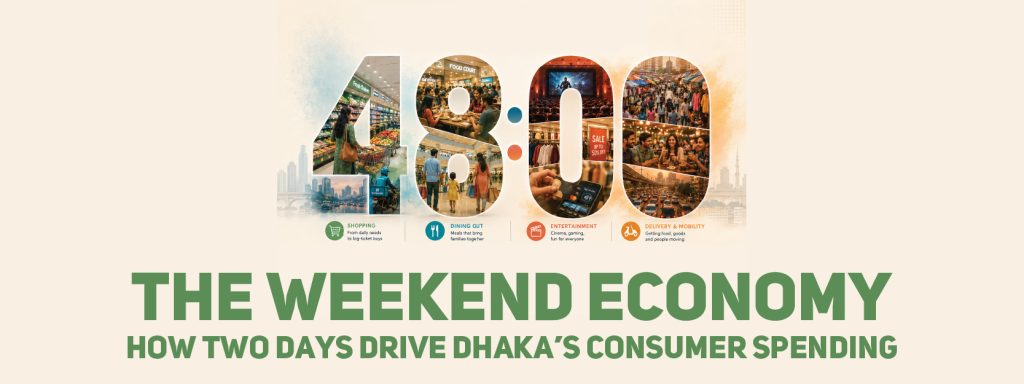
Dhaka runs a commercial week found in almost no other city: zoned, staggered, and packed into a Friday–Saturday surge. It is also the clearest window onto how the country really spends.
Walk through Dhaka on a Tuesday and again on a Friday and you might think you were in two different cities. On a weekday the shopping is mostly errand-driven, squeezed into the gaps of a six-day working week, and somewhere in the metropolis a whole cluster of shops sits shuttered for its assigned day off. Come Friday the rhythm changes completely. Families pour into the malls after prayers, the food courts fill, the Friday bazaars swell into all-day events, and a week’s worth of discretionary spending compresses into roughly forty-eight hours.
This is the weekend economy, and in Dhaka it runs on a logic found in almost no other city. Bangladesh’s official weekend is Friday and Saturday, but the capital’s commercial week is stranger and more interesting than a simple two-day pause. It is staggered, zoned, and unusually concentrated, and it offers one of the clearest windows onto how the country actually spends.
The zoned week
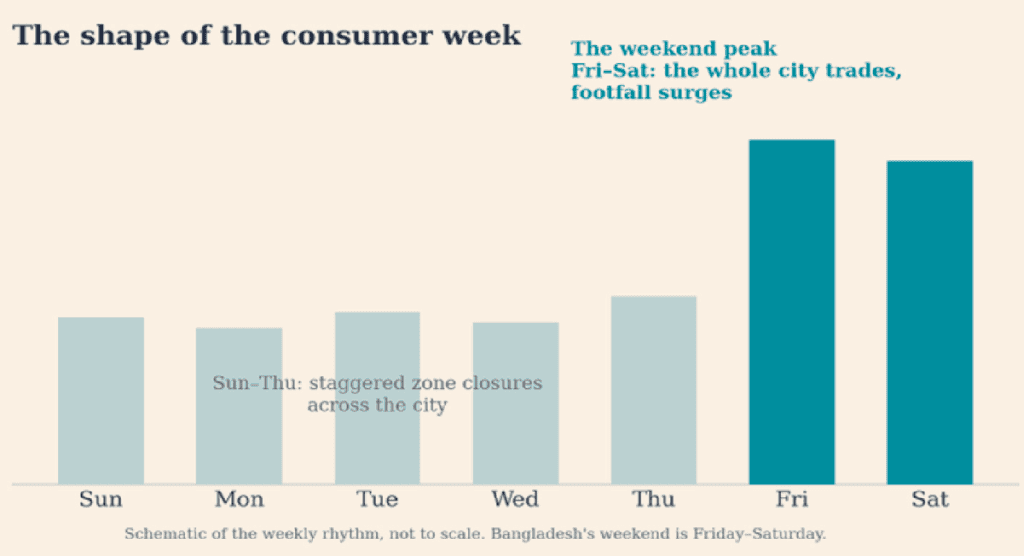
Start with the quirk that shapes everything. Since 2010, to ease the capital’s notorious traffic, the authorities have split Dhaka’s retail into seven zones, each assigned a different mandatory closing day during the week. The result is a rolling shutdown. On most weekdays one part of the city is dark while the rest trades on, and the next day the closure moves elsewhere. Dhaka, in effect, never fully closes and never fully rests.
The week bends toward two days: Friday and Saturday are when the whole city trades and footfall surges.
Against that staggered weekday backdrop, the real weekend stands out all the more sharply. Friday, the day of congregational prayers and the anchor of family life, is when the city comes out to spend, and Saturday extends the surge. The malls that run at a steady hum from Sunday to Thursday fill to capacity. This is when households do the shopping the working week leaves no room for: the family outing, the monthly provisioning, the big-ticket purchase that needs everyone present to decide. Six days of utilitarian errands give way to two days of consumption as leisure.
Where the money concentrates
The scale of that concentration is easy to underestimate. Dhaka alone is home to an estimated 25,000 foodservice outlets, and together with Chattogram it accounts for more than 60 percent of the entire sector’s turnover, according to the research firm Mordor Intelligence. The dominant format is the sit-down meal, and its peak is the weekend, when families and friend groups choose to eat out together rather than order in.
The anchor malls show the same pattern at scale. Bashundhara City, one of the country’s largest, draws around 200,000 visitors on a busy day into a complex that pairs hundreds of shops with a food court of roughly a hundred outlets. Jamuna Future Park, larger still, runs a food court of some 3,000 seats and more than forty fast-food brands. These are not really shopping centres in the old sense. They are weekend destinations, bundling retail, dining, cinema, and play into a single air-conditioned outing that can absorb an entire Friday.
9th Bangladesh’s projected rank among the world’s consumer markets by 2030, on the back of a middle class that grew from 19 to 34 million in five years. (Boston Consulting Group).
WHERE THE WEEKEND MONEY GOES
Dining & food courts Sit-down meals peak on weekends; Dhaka has an estimated 25,000 outlets
Malls & entertainment Bashundhara City draws ~200,000 visitors a day; cinema, play zones, food courts
Supermarkets Weekend family provisioning; Shwapno now serves ~143,000 customers a day
The Friday bazaar Motijheel’s second-hand market, likened to Bangkok’s Chatuchak
Delivery & ride-hailing Orders and movement concentrate on Fri–Sat; Foodpanda reaches all 64 districts
Sources: Mordor Intelligence; The Daily Star; company data, 2025–26.
Two weekends, two consumers
Look more closely and the Dhaka weekend is not one event but two, running in parallel for two different consumers.
The first is the mall weekend. For the city’s middle and upper-middle class, the air-conditioned mall is the default Friday outing, as much a refuge from heat and traffic as a shopping trip, and its pull is the experience as much as the merchandise: the food-court lunch, the cinema, the children’s play zone, the simple pleasure of a comfortable place to spend an afternoon.
The second is the bazaar weekend, and it belongs to a different crowd and a different mood. The Friday markets that spring up on the city’s off-days, most famously the sprawling one at Motijheel, deal in second-hand and discounted goods and run on browsing, bargaining, and discovery rather than fixed-price convenience. It is a treasure hunt as much as a transaction, an event people attend rather than a shop they visit.
People are not only buying products anymore.
— Kamruzzaman Kamal, Director (Marketing), PRAN-RFL Group
The two weekends rarely meet, but they point to the same underlying shift. Across the income spectrum, the weekend purchase is becoming less about pure utility and more about how the time is spent.
The squeeze
Concentrating a week’s discretionary spending into two days does not only create opportunity. It creates pressure, and in 2026 that pressure pulls in two directions at once.
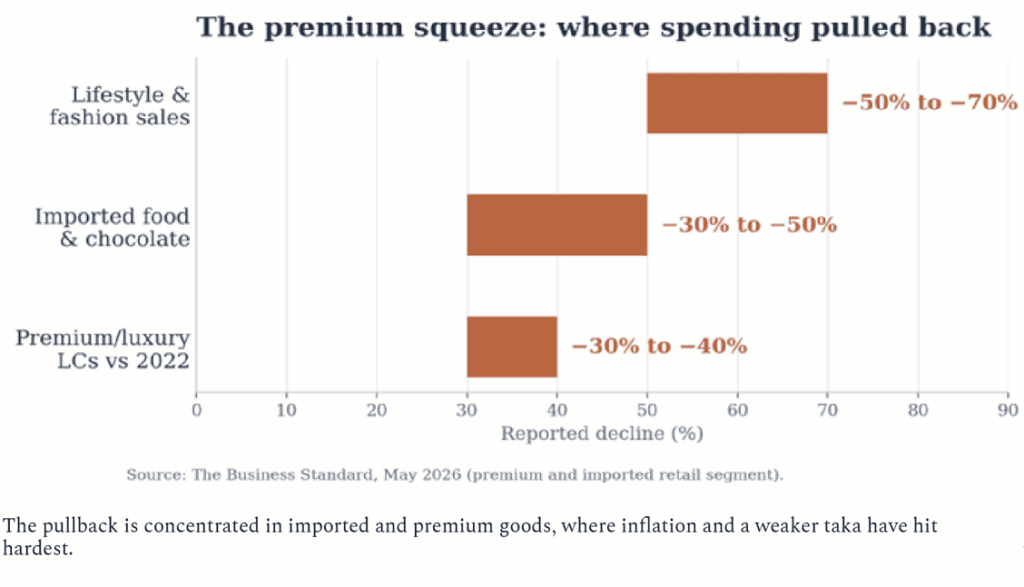
At the premium end, the weekend buy is shrinking. After nearly four years of inflation stuck above 8 percent, with wages failing to keep pace for fifty consecutive months, households have turned cautious with discretionary money. Retailers of imported and premium goods across Gulshan, Uttara, Dhanmondi, and Chattogram describe the same picture: thinning footfall, stockpiling up, and customers who once bought on impulse now visiting four or five shops for a single item, or leaving empty-handed. Sales of lifestyle and fashion products have fallen by half or more, imported food and chocolate by a third to a half, and the opening of letters of credit for luxury goods has dropped sharply against 2022 levels. The weekend browse is lengthening; the weekend buy is getting smaller.
The pullback is concentrated in imported and premium goods, where inflation and a weaker taka have hit hardest.
Yet another part of the weekend economy is booming at the same time. Organised retail and supermarkets are in the middle of a growth spurt, the sector expanding by around 20 percent a year as middle-class families shift their weekly provisioning toward the convenience and hygiene of modern stores. Shwapno, one of the country’s largest supermarket chain, now holds more than half the modern-retail market, runs around 900 outlets, and serves close to 143,000 customers a day, according to company figures, having roughly doubled its traffic in three years. PRAN-RFL’s retail brands together draw more than 160,000 shoppers a day across some 2,444 stores. Foreign money is moving in too: Indonesia’s Alfamart entered in late 2025 in a joint venture with Kazi Farms Group, with Japanese trading houses backing the expansion. One retail executive has called the moment an inflection point. The weekend economy, then, is slowing and accelerating at once, depending on which shelf you happen to be standing in front of.
The marketing blind spot
For all that the weekend dominates Bangladeshi consumption, brands treat it with surprising casualness. Media plans, promotions, and staffing are too often spread evenly across the week, as though a Tuesday afternoon and a Friday evening carried the same commercial weight. They do not.
Playing the weekend well means treating it as the main event it actually is. It means timing the biggest campaigns, offers, and product launches to land as families plan their Friday, not midweek when intent is low. It means sizing delivery capacity and store staffing to the two-day peak rather than a flat weekly average, because a fleet built for Tuesday will buckle on Friday night. And it means designing for the experience-led, convenience-seeking shopper that both the mall and the supermarket data describe, instead of assuming the weekend crowd is just a larger version of the weekday one. The brands that win the weekend build their whole rhythm around it.
Beyond Dhaka
The pattern is not confined to the capital, even if Dhaka shows it most vividly. Chattogram shares the same weekend concentration and, with Dhaka, makes up the bulk of the country’s organised consumer spending. In Sylhet, remittance wealth lends the weekend a particular intensity. And the infrastructure that serves it is spreading fast: food-delivery platforms now reach all 64 districts, and supermarket chains are pushing their franchise models into upazila towns that never had a modern store. As that reach extends, the two-day spending rhythm of the big cities is steadily becoming a national one.
Reading the week
There is a reason the weekend deserves more attention than it gets. More than any single sales figure, it is the truest barometer of the consumer economy’s health. When confidence is high, the malls and bazaars overflow and the baskets are full; when households are anxious, the browse lengthens and the spending thins, and the change is visible in a single Friday afternoon. Dhaka packs a week of commerce into two days, and in doing so it reveals, more honestly than any forecast, how the country feels about spending. For the brands paying attention, those forty-eight hours are the most valuable of the week.