Before I dive into this edition of the newsletter, I want to take a moment to express my sincere gratitude to everyone who has shown their support and evangelized my new book – The Vacuum Principle…
Over the past few weeks, I’ve had the privilege of traveling across the country for keynote speeches at various business communities and innovation forums related to the book.
Now, let’s get into the newsletter.
Observations of D2C Brands from a Strategist’s Lens
There’s been a remarkable wave of D2C brands attempting to redefine consumption in India. They typically begin with a focused niche—clean beauty, healthy snacking, personal care—and often succeed in building early traction. But somewhere around the ₹20-50 crore revenue mark, growth inevitably begins to plateau. Customer acquisition costs (CAC) rise dramatically. Retention weakens noticeably. Scaling becomes prohibitively expensive.
This isn’t random. It’s structural.
The India Stack Reality
Blume Ventures’ 3-tier India stack framework offers sharp insight here:
India 1: Affluent, metro-based, digitally native consumers. Early adopters with high purchasing power.
India 2: Urban and semi-urban middle-class consumers. Aspirational, price-conscious, and digitally aware.
India 3: Rural and small-town India. Largely offline, highly price-sensitive, and driven by access and affordability.
Most D2C brands are built for India 1 and, at best, parts of India 2. Why? These consumers are reachable via performance marketing and have the disposable income for premium offerings. But that’s a finite audience. Brands chasing scale within this layer soon find themselves boxed in.
Simple economics: too many D2C brands competing in the India 1 space, but the market size isn’t infinite. Limited demand is one constraint, lack of meaningful differentiation is another.
Evaluating the Indian D2C Segment Using Porter’s Five Forces
When you evaluate the Indian D2C segment through the lens of Porter’s Five Forces — that old but remarkably relevant mental model for assessing industry attractiveness — here’s what becomes crystal clear:
- High competitive rivalry: Dozens of brands with lookalike SKUs and similar brand stories are crowding the same digital shelves. Too many players chasing the same wallets.
- Low barriers to entry: White-label suppliers and Shopify have made launching almost frictionless, got a logo, and some capital? You’re in business tomorrow.
- High buyer power: Too many options with low switching costs means consumers dictate terms. One dissatisfaction, and they’re gone.
- High threat of substitution: Cheaper alternatives and legacy incumbents are always within reach. Premium positioning is constantly undermined.
- Low supplier power: A slight advantage, but insufficient to offset the other forces working against sustainable margins.
Porter would likely give this segment a poor attractiveness score. It explains why early traction often hits that brutal ₹20-50 crore ceiling. The fundamental economics don’t support a sustainable scale under these conditions.
Meanwhile, legacy players like HUL and P&G operate effortlessly across India 1, 2, and 3, which caters to all the price and value segments. They benefit from economies of scale, reach, trust, and pricing power. That’s where the true headroom lies.
Rethinking Growth: The D2C Grid
I’ve developed a simple 2×2 mental model based on two critical variables: Business model type (Volume-led vs Margin-led) and Consumer stack fit (India 1-2 vs India 3). This creates four strategic zones:
The D2C Growth Grid: 4 Strategic Zones
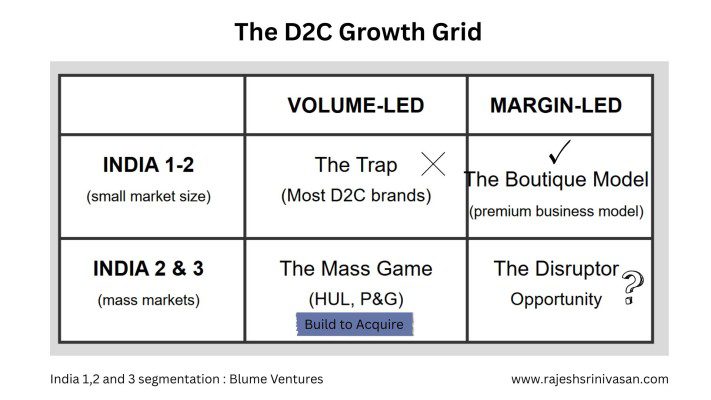
The Trap (India 1-2 x Volume-led): Where most D2C brands operate today. Low-margin growth, high CAC, and short runway. Sound familiar?
The Boutique Model (India 1-2 x Margin-led): High-margin, niche brands. Slower growth, but sustainable if built intentionally. Think specialty brands that know exactly who they serve.
The Mass Game (India 2 & 3 x Volume-led): Dominated by traditional FMCG giants. Built for scale, efficiency, and distribution moats that took decades to establish.
The Disruptor Opportunity (India 2, 3 x Margin-led): An under-explored, high-upside space for D2C challenger brands. A mix of conventional sales and distribution, along with innovative offerings.
The Disruptor Opportunity
This is where it gets interesting.
While India 3 is traditionally seen as a volume market, there’s a growing aspiration for better-quality products. It’s not about luxury—it’s about accessible upgrades. If a brand can deliver quality, trust, and value within the pricing constraints of this segment, it can unlock scale without chasing unprofitable growth.
But to play here, the D2C model must evolve:
- Product innovation around sachets, smaller SKUs, and relevant formats that respect both aspirations and constraints.
- Distribution innovation through kiranas, rural partnerships, or hybrid models that meet consumers where they are.
- Branding innovation that speaks in the language, culture, and context of Bharat, not Instagram. Authenticity matters.
This is hard work. It doesn’t follow the usual playbook of influencer marketing and D2C convenience. But it offers something very few markets do: the chance to build a truly large, meaningful consumer brand that doesn’t need to burn cash to grow.
The Strategic Question
As a D2C founder or strategist, it comes down to clarity. Are you building for a niche audience with deep pockets? Or are you designing for mass India, with operational muscle?
Volume game or margin game? Choose one.
Most D2C brands get stuck in the trap of high growth expectations and limited markets. The smart ones either stay boutique or embrace the harder, more ambitious path of disruption, or even build to acquire.
This last path—building with acquisition as the end goal—is increasingly viable. While D2C brands excel at innovation, digital marketing, and speed-to-market, they often lack the distribution network needed to truly scale. Conversely, traditional FMCG companies have extensive distribution capabilities but can be slow to innovate. This creates a complementary dynamic where strategic partnerships or acquisitions make perfect sense.
Author:
Rajesh Srinivasan
Founder, Mindful Marketing
Board Director, 4x Author, Keynote Speaker