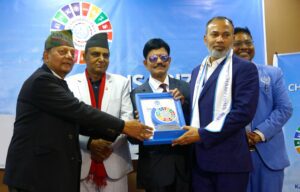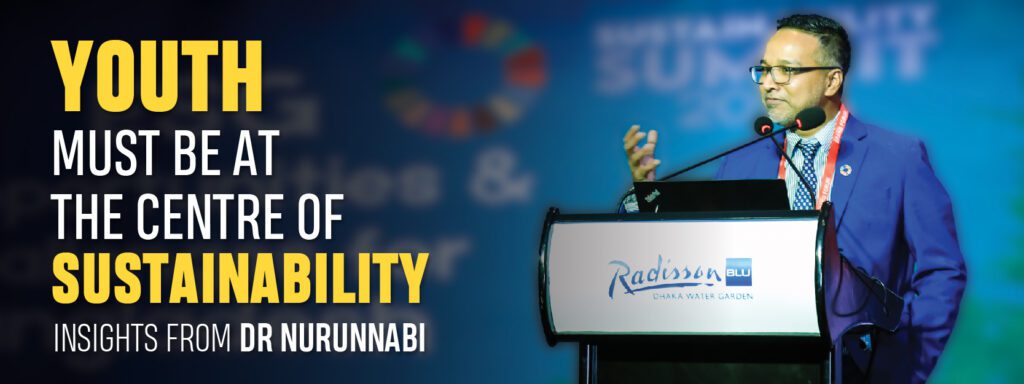
Professor Dr Mohammad Nurunnabi, UNESCO Chair in Education for Sustainable Development, Green Skills, and Climate Actions; Founding President & CEO, Global Oxford Impact Group, attended the Sustainability Summit 2025 as a keynote speaker. Following his session, the Bangladesh Brand Forum sat down with him for an exclusive conversation on sustainable development, education reform, and the role of youth in shaping the future.
BBF: From your perspective, which SDGs are most at risk of lagging in Bangladesh —and what policy interventions are urgently required to course-correct?
Dr Nurunnabi: Bangladesh faces many challenges, but so does the world at large—we are part of a global nexus of complexities. The first step for Bangladesh is raising awareness. Research shows awareness levels remain very low across the public sector, private sector, and youth community.
What we urgently need is a realistic roadmap—something we currently lack. Despite having over 40 ministries engaged in SDG compliance, many efforts are duplicated, with little integration. Better governance and coordination are vital. Equally important is celebrating success stories alongside challenges. With real data and examples, we can present Bangladesh’s achievements to the world, not just its struggles.
You have led initiatives such as the Financial Literacy for Women in Business programme under SDG 5. What lessons have you drawn, and how can such initiatives be scaled across South Asia?
Dr Nurunnabi: Two elements are critical. First, creating a professional ESG network that connects stakeholders across the private sector, academia, civil society, and government. Second, building a youth ESG network coordinated through schools and universities.
Bangladesh has enormous untapped potential, such as the National University, which has four million students—the largest in the world. These platforms can be leveraged to drive gender-focused economic empowerment.
In Saudi Arabia, for example, we hold monthly online engagement sessions across 57 countries. Bangladesh could adopt a similar model, ensuring ongoing, structured engagement rather than one-off annual events.
On gender equality, SDG 5 is making strides. UNESCO data shows that for every 100 male students in universities, there are now 113 females. This signals both progress and the need to rebalance policies in the long run.
As the UNESCO Chair for Education for Sustainable Development, which competencies are non-negotiable for future business and governance leaders?
Dr Nurunnabi: Globally, female students are now outperforming males in higher education. Yet access remains unequal—especially in Sub-Saharan Africa, where net enrolment is just 9%.
The real issue is that our curricula are outdated. Bangladesh’s last national education policy was in 2010—yet technology evolves every year. Employers today need AI specialists, green skills, and practical expertise. If a candidate with a six-month vocational qualification has the right skills, they are more employable than someone with a four-year degree lacking relevance.
Bangladesh, one of the most climate-vulnerable nations, has huge potential to create jobs in green skills and sustainable agriculture. But we need a clear plan and curriculum reform to make this a reality.
With Gen Z becoming more vocal and values-driven, how do you see young people shaping sustainability?
Dr Nurunnabi: I love speaking with young people—they are full of creativity and energy. But too often, society silences them. Policies are made for them, yet without their input. That must change.
Bangladesh’s youth recently demonstrated their power through movements such as the July Revolution. With over 50% of the population under 30, it is essential to bring them into every discussion—economic, political, and sustainability-related.
We must respect and engage young people, not dismiss them as “too young”. Policymakers should adapt to their learning styles, which are digital, mobile-first, and fast-paced. Beyond youth, we must also involve women and indigenous communities in shaping inclusive policies. Only then can we build a truly new Bangladesh.
What teaching models—traditional, digital, or hybrid—work best for embedding sustainability education globally?
Dr Nurunnabi: Progress has been slow in Bangladesh. But globally, there are lessons. For example, a recent UNESCO study across 19 MENA countries found disparity in sustainability education, yet also strong efforts to reform curricula.
For Bangladesh, the key is data honesty and transparency. Without accurate data, we cannot design effective curricula or policies. Sustainability must be embedded across the entire education ecosystem—from schools to universities—so that each stage builds understanding.
Context matters too. What works in Saudi Arabia or California may not be suitable for Bangladesh. We must develop context-specific skills aligned to our needs—particularly in climate resilience, agriculture, and technology. We must also collaborate globally, learning from other regions while tailoring solutions to our unique reality.