For most factories, gas is something that is noticed only when the pressure drops. Across Bangladesh, that has become an increasingly common problem. National media flags Bangladesh’s deepening energy crisis from LNG supply disruptions to critically low gas pressure in major industrial belts. Industry representatives warn of falling production, rising operating costs, and growing risks to investment and employment.
Disruptions in LNG supply and declining gas pressure have left many industries struggling to keep production running at full capacity. For manufacturers, particularly those, who dependent on gas-fired kilns, the consequences go beyond a temporary slowdown. Lower pressure can mean lower production, higher costs, and, in some cases, concerns over product quality.
For a ceramic manufacturer, the problem is particularly unforgiving. A kiln cannot simply be switched off and restarted like an ordinary machine. The firing process demands consistency; fluctuations in gas supply can affect production, efficiency, and ultimately the quality of the finished tile. Yet, several hundred kilometers away from the industrial congestion of Dhaka, Narayanganj, and Gazipur, a different industrial story is unfolding.
In Bhola, Sheltech Ceramics has built its manufacturing operation around access to natural gas, a factor that has become increasingly important as the crisis deepens.
The location was chosen with those realities in mind. When Sheltech entered the ceramics business, the company was already looking beyond the immediate economics of setting up a factory. Bhola offered access to natural gas, land for expansion, and river-based transportation. At a time when manufacturers elsewhere were struggling with gas connections and pressure, the location offered a structural advantage.
Today, the Bhola facility spans 67 acres and has a production capacity of more than 450,000 square feet of wall and floor tiles a day. The company describes the site as strategically positioned to leverage the district’s natural gas resources.
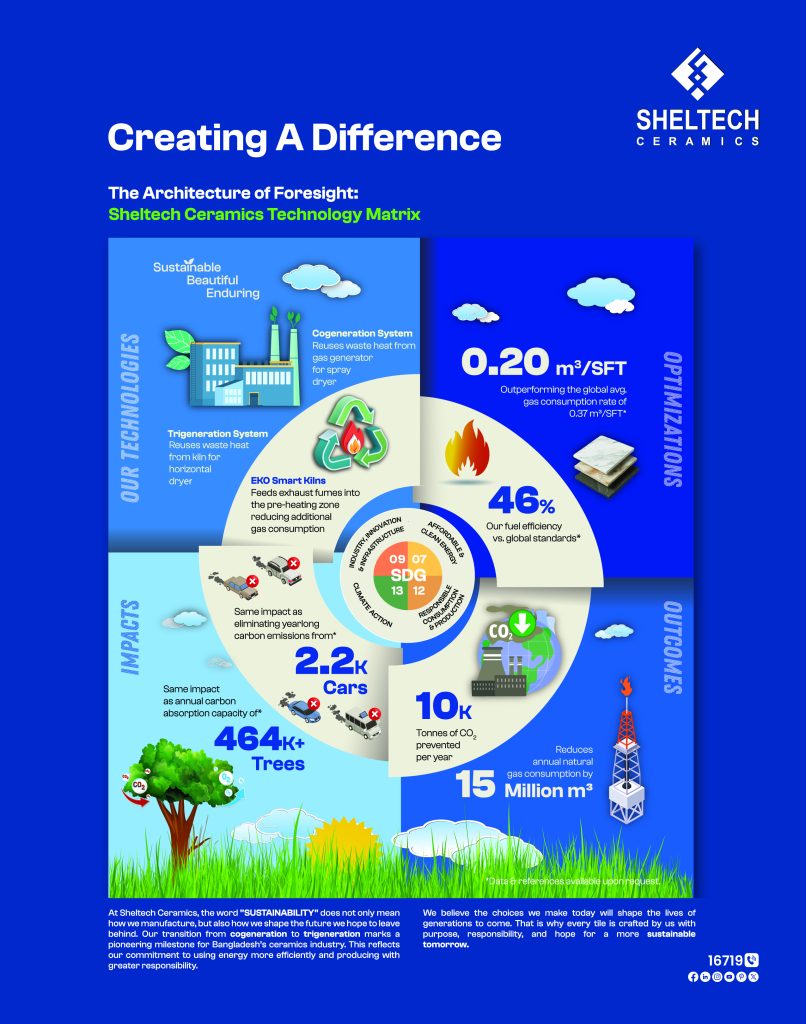
Location is only one part of the calculation. Inside the factory, the emphasis is also on using energy more intelligently. Sheltech Ceramics has invested in an integrated energy-efficiency ecosystem built around EKO Smart Kilns, heat-recovery cogeneration, and trigeneration systems.
The idea is straightforward: use less gas and recover the heat that would otherwise be lost. It saves around 15 million cubic meters of natural gas annually while reducing an estimated 10,000 tons of CO2 emissions each year.
That matters in a country where energy security is increasingly becoming an industrial question. Sheltech Ceramics’ decision to build its factory in Bhola and invest in technologies that make every unit of gas work harder shows the value of planning beyond today’s production needs.
In a time when an uninterrupted gas supply can no longer be taken for granted, perhaps the smartest industrial decision is one made before the shortage arrives.