Introduction: Navigating New US-Bangladesh Trade Relations
The US is Bangladesh’s largest apparel importer, accounting for approximately 19.18% of its total RMG exports, valued at $7.54 billion in FY25. The US goods trade deficit with Bangladesh reached $6.2 billion in 2024. President Donald J. Trump’s administration is now enforcing “reciprocal tariff rates” to address perceived trade imbalances and non-tariff barriers. Bangladesh’s economy is highly dependent on its RMG sector, which contributes over 80% of total export earnings, 10% to GDP, and employs over 4 million people, mostly women. This concentration makes the economy vulnerable to external trade shocks.
US Tariffs on Bangladesh: A Timeline
The current tariff actions follow a history of US trade leverage. In 2013, the US withdrew Generalized System of Preferences (GSP) benefits for Bangladesh due to “insufficient progress” on worker rights and safety, following tragedies like the Tazreen Fashions factory fire and Rana Plaza collapse.
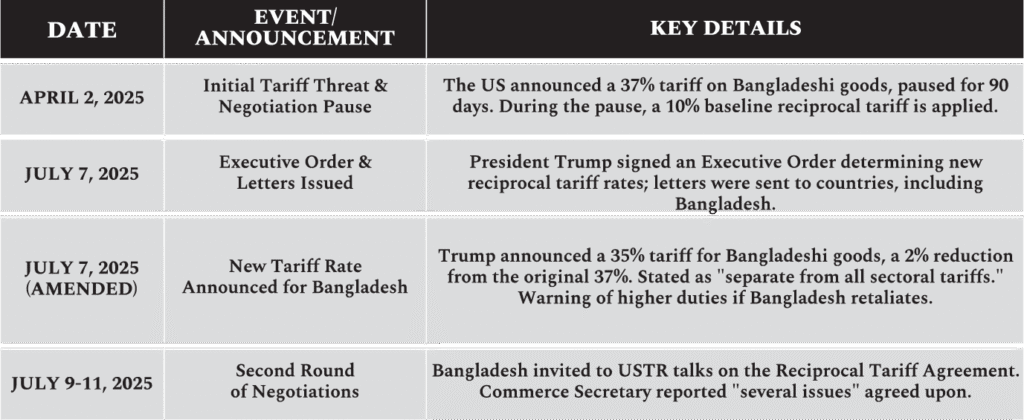
The recent tariff developments unfolded as follows:
- April 2, 2025: The US initially announced a 37% tariff on Bangladeshi goods, with a 90-day pause for negotiations. During this period, a 10% baseline reciprocal tariff was applied.
- July 7, 2025: President Trump signed an Executive Order determining new reciprocal tariff rates, sending letters to countries including Bangladesh.
- July 7, 2025 (Amended Rate): The rate for Bangladeshi goods was revised to 35%, a 2% reduction from the initial announcement. This 35% tariff is “separate from all sectoral tariffs,” and any retaliatory tariff increase by Bangladesh would prompt higher US duties.
The US rationale for these tariffs centers on achieving trade reciprocity, citing Bangladesh’s “tariff and non-tariff barriers” and a persistent “long-term trade imbalance”. A key demand is a 40% local value-addition requirement for goods to qualify as “Made in Bangladesh,” posing a significant challenge for the woven sector that imports over 70% of its fabric from China. The US also demands the elimination of various “Tariff (Customs duty), and non-tariff (different rule and bureaucratic control etc.), Policies (licensing, customs procedure and other formalities) and Trade Barriers (in banking, transportation, delay in permission)”.
Bangladesh has engaged in “one-to-one negotiation” with the USTR, with a second round of talks held from July 9-11, 2025. Concessions considered by Bangladesh include waiving import duties on 110 products, promoting US cotton imports, prioritizing US food grain purchases, and ordering Boeing aircraft.
Table 1: Key Milestones in US-Bangladesh Tariff Talks (2025)
Economic Impact on Bangladesh: RMG Vulnerability
The RMG industry is Bangladesh’s economic backbone, contributing 10% to GDP and employing over 4 million people. In 2024, Bangladesh exported $8.4 billion in goods to the US, with $7 billion from garments.
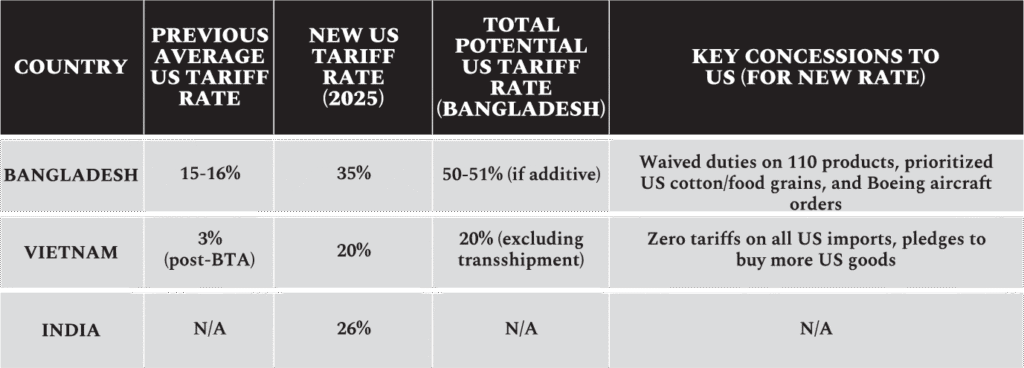
The 35% US tariff on Bangladeshi garment exports is a sharp increase from the previous average of 15-16%. Combined with existing duties, the total tariff burden could reach 50-51%. For example, a $10 polo shirt, previously 16% duty, could now cost $15.10 in the US, making Bangladeshi garments less competitive than those from Vietnam (20% tariff) or India (26% tariff).
This uncertainty has led US retailers like Walmart, Gap, and Levi Strauss to pause or suspend new orders from Bangladesh. A decline in US orders could cause factory slowdowns, closures, and significant job losses, disproportionately affecting women. The garment sector supports numerous ancillary industries, and its contraction risks destabilizing these sectors, deterring foreign investment, and slowing GDP growth. Economists warn of a potential foreign exchange crunch, limiting imports of essential goods. The tariff also threatens to reverse social gains, such as women’s empowerment and poverty reduction.
Beyond tariffs, the US has highlighted Bangladesh’s “complex and non-transparent” tariff structure and non-tariff barriers like Intellectual Property Rights (IPR) issues, cumbersome licensing, and inefficient customs. Internal challenges include low technological advancement, inconsistent trade policies, skill shortages, and inadequate logistics.
Table 2: Comparative US Tariff Rates on Apparel Exports: Bangladesh vs. Key Asian Competitors
Vietnam’s Tariff Experience: A Strategic Counterpoint
Vietnam’s experience offers a valuable comparison. After the US lifted its trade embargo in 1994, the US-Vietnam Bilateral Trade Agreement (BTA) in 2000 granted Vietnam Most-Favored-Nation (MFN) status, reducing US tariffs on Vietnamese goods from 40% to 3%. Vietnam joined the WTO in 2007 and elevated its relationship with the US to a Comprehensive Strategic Partnership in 2023. Vietnam’s “Doi Moi” reforms, initiated in 1986, fostered a market-oriented economy and deep global integration.
In the recent tariff wave:
- Initial Threat: Vietnam faced a 46% “reciprocal” tariff threat in April 2025.
- Negotiated Reduction: On July 2, 2025, President Trump announced a trade deal reducing the tariff on Vietnamese exports to 20%.
- Transshipment Tariff: A 40% tariff was imposed on “transshipped” goods, targeting products routed through Vietnam to evade higher US tariffs.
- Concession: In exchange for the lower tariff, Vietnam agreed to eliminate all tariffs on US imports and pledged to increase purchases of American goods like aircraft and agricultural products.
Vietnam’s proactive strategies include diversifying trade partnerships (e.g., with China and India), upgrading manufacturing capabilities to increase regional value content, and cracking down on illegal transshipment by centralizing certificates of origin. These efforts position Vietnam as a resilient global supply chain hub.
Comparative Analysis: Bangladesh vs. Vietnam
The differing outcomes highlight strategic differences:
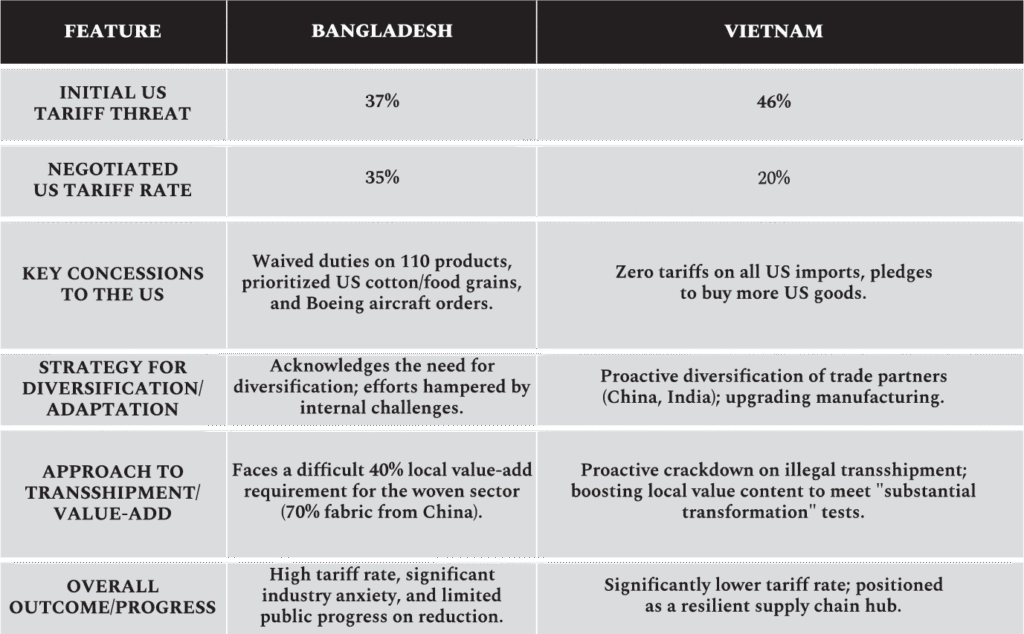
- Tariff Rates: Bangladesh faces a 35% tariff (potentially 50-51% total), while Vietnam secured a 20% tariff.
- Negotiation Outcomes: Vietnam’s success is linked to its comprehensive market access concession (zero tariffs on US imports) and pledges to buy more US goods. Bangladesh offered specific product-based concessions (waiving duties on 110 products, prioritizing US cotton/food grains, Boeing orders), which appear insufficient to secure a comparable rate. The US perceives Bangladesh’s trade regime as less reciprocal and transparent.
- Strategic Approaches: Vietnam has a comprehensive, proactive strategy, diversifying partners and upgrading manufacturing to address US concerns about transshipment and supply chain integrity. Bangladesh appears more reactive, focusing on tariff reduction through bilateral talks while grappling with internal challenges and RMG reliance. The US’s focus on “transshipment” and “local value-addition” indicates a broader aim to reshape global supply chains, rewarding countries that align with this objective.
- Competitiveness: Bangladesh’s higher tariff puts it at a serious competitive disadvantage in the US market, threatening market share loss to rivals like Vietnam and India.
Table 3: Strategic Responses to US Tariffs: Bangladesh vs. Vietnam
Progress and Future Outlook for Bangladesh Trade
Despite official optimism, tangible progress in reducing Bangladesh’s 35% tariff seems limited. The industry is “extremely jittery” about the August 1 deadline, with US retailers already pausing orders.
To enhance trade resilience, Bangladesh must implement comprehensive long-term strategies:
- Bilateral Trade Agreements: Actively pursue a bilateral treaty or Free Trade Agreement (FTA) with the US to secure duty benefits.
- Export Diversification: Urgently diversify beyond RMG (over 80% of exports) into sectors like pharmaceuticals, IT, leather goods, agro-products, and light engineering.
- Address Domestic Challenges: Improve efficiency and reduce the cost of doing business by tackling low technological advancement, skill shortages, and inadequate logistics. Streamline customs, licensing, and bureaucratic controls. Support SMEs with access to finance.
- Policy Consistency: Ensure consistent trade policies to attract foreign direct investment.
- Risk Management: Develop mechanisms to mitigate risks from international trade policies.
Conclusion
Bangladesh faces a critical challenge with the 35% US reciprocal tariff, which threatens its vital garment industry and broader economy, especially compared to Vietnam’s more favorable 20% rate. This disparity underscores the need for a comprehensive and proactive trade strategy. Bangladesh must pursue bilateral agreements and undertake deep structural reforms to diversify its export base, enhance trade facilitation, and improve its business environment. Long-term stability hinges on reducing RMG dependence, investing in higher-value products, and addressing systemic challenges. Failure to adapt could lead to significant economic contraction, job losses, and social setbacks.
Author: Abu Yousuf Abdullah