For a profession that was once built almost entirely on ink, paper, and the quiet hum of a newsroom, journalism today feels more like a survival sport. Every year, a new platform rises, another fades, reader habits shift again, and the entire media industry collectively checks its pulse. Traditional ad revenue has thinned out, subscription fatigue has become real, and social platforms – once the promised land – have become unpredictable landlords. Publishers can’t afford to rely on platforms that change the algorithm like changing outfits. And journalists, who once wrote for deep readership, now often write for algorithms they never met.
And in the middle of this chaos sits a platform once dismissed as “for entertainment only” that quietly grew into one of the world’s biggest news ecosystems: YouTube.
Today, more and more publishers, media houses, and independent journalists are planting their flag on YouTube – not as a side channel, but as a core, long-term strategy. And the shift is no longer subtle; it’s a real migration. If the future of journalism lives anywhere outside the traditional web, it just might be in the world of autoplay, watch-time graphs, and thumbnails.
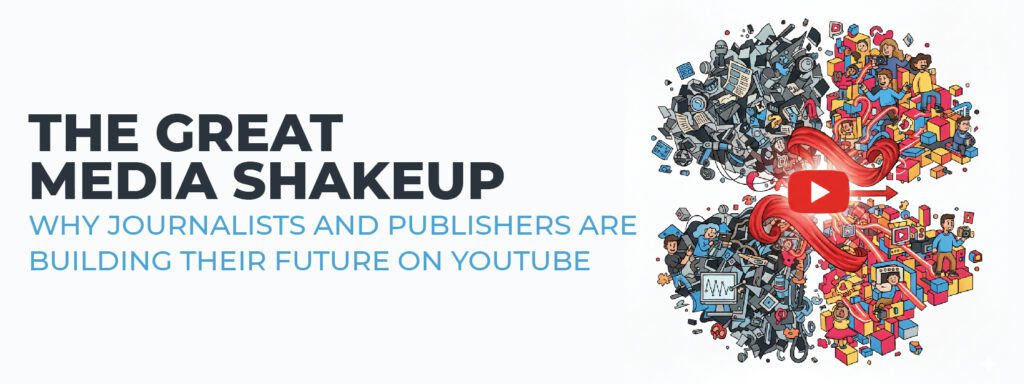
The Great Media Shake-Up
To understand why publishers are doubling down on YouTube, you first need to understand the landscape they’re escaping from.
Digital publishers spent the last decade chasing platforms: Facebook Instant Articles, Snapchat Discover, Twitter Moments, the whole buffet. At one point, a huge portion of news traffic globally came from Facebook alone. Some years, studies estimated that over half of referral traffic for many outlets was social-driven. Journalists built careers around optimising headlines for feeds instead of homepages. Media companies hired “audience growth teams” whose entire job was to impress algorithms.
Then the ground shifted.
Referral traffic dropped. Algorithms deprioritised news. Platforms moved to short-form. Some pivoted to entertainment only. Some waged public battles with newsrooms. Publishers woke up and realised that their audiences weren’t theirs; they were borrowed. Their business models were built on sand.
Meanwhile, YouTube stayed relatively stable. For all its controversies, YouTube has been remarkably consistent in one thing: it rewards watch time, not platform politics. It doesn’t push news out of the feed. It doesn’t bury publishers. It doesn’t remove external links. And crucially, YouTube remains one of the few digital platforms where the business model works for both creators and companies.
The Democratisation of Journalism: YouTube Accelerates It
One of the most profound shifts YouTube has triggered is the democratisation of journalism itself. For decades, entering the world of reporting required access to institutional resources: newsrooms, presses, broadcast studios, editors, and distribution networks. The barriers were high, the gatekeepers were many, and the definition of “journalist” was reserved for a select circle. But YouTube flipped that hierarchy. With nothing more than a smartphone, a mic, and curiosity, anyone can produce reportage, analysis, or commentary that reaches thousands. Sometimes millions. And audiences, especially younger ones, don’t differentiate based on job title; they differentiate based on clarity, value, and credibility. This shift has turned journalism into a more open ecosystem where independent creators compete with legacy publishers not because they have equal resources, but because they have equal access.
What makes YouTube powerful is that its algorithm doesn’t ask whether you work at a major newspaper or operate out of your bedroom. It looks for watch time, relevance, and audience satisfaction. This levels the playing field between institutions and individuals in a way that the traditional media environment never could. It also pushes legacy publishers to rethink the stiffness of “formal journalism” and adapt to a more conversational, personality-driven style that resonates with modern viewers. Meanwhile, independent creators, fact-checkers, explainers, analysts, and storytellers contribute to a richer information landscape that doesn’t rely solely on big media corporations.
Of course, democratisation comes with its complications. More voices mean more noise, and credibility becomes a precious currency that viewers must evaluate themselves. But overall, YouTube’s accessibility has made journalism feel alive again.
Newsrooms Need Stability: YouTube Offers It
If you sit with any publisher long enough, you’ll hear the same fear echoing in different words: “What if the algorithm changes and our audience disappears overnight?”
This fear destroyed entire studios during the “pivot to video” era. It hollowed out newsrooms when Facebook deprioritised publishers. But YouTube has built something journalists crave: predictability.
YouTube’s algorithm isn’t simple, but it’s legible. If viewers watch longer, you do better. If your content is trustworthy, contextual, and engaging, YouTube boosts it. If you consistently upload, you grow.
Journalists understand “consistent work leads to a consistent audience.” That’s the heart of reporting. And YouTube aligns with that mindset far more than the volatile feed-based platforms.
Another reason? Users actually go to YouTube intentionally. They don’t stumble on videos while scrolling; they search for topics, explanations, and deep-dive content. When a viewer watches a 12-minute investigative piece, they’re not doing it out of boredom; they’re choosing to consume journalism.
Audiences Have Changed – And They Prefer Video
You can blame TikTok, Instagram Reels, or short-form dopamine loops, but the truth is bigger than that: people prefer consuming information in a format that feels alive. Reading will never die, but video is increasingly becoming the default way younger audiences understand the world.
Over the past decade, global video consumption has grown massively, with many reports generally estimating annual increases in the double digits. Even older audiences – people in their 40s, 50s, 60s – have adopted YouTube as their go-to source for news explainers, opinion breakdowns, and current affairs.
The Revenue Equation Actually Works Here
Ask any publisher their biggest struggle and the answer will come fast: “Monetisation.”
Ads on websites? Declining. Programmatic revenue? Barely predictable. Subscriptions? Hard to scale unless you’re a giant. Branded content? Competitive and seasonal.
YouTube, on the other hand, offers something shockingly rare: reliable monetisation tied directly to audience engagement. Publishers don’t need to invent exotic revenue models. They just need to make videos that people watch.
YouTube offers:
- Ad revenue (still one of the strongest creator payout systems in the world)
- Channel memberships
- Super Chats
- Sponsorships
- Long-tail revenue from evergreen videos
- International discoverability, meaning revenue from global viewership, not just local markets
For publishers accustomed to squeezing pennies from banner ads, this ecosystem feels almost generous.
Journalists Are Becoming Personalities and That’s Not a Bad Thing
The industry used to celebrate faceless bylines. But today’s audience connects better with people than brands. This is why independent creators in the news niche—people doing explainers, commentary, fact-checking are exploding.
YouTube lets reporters become the face of the story, not just the name under the headline. Viewers follow them, trust them, and return for their take on the news. It turns journalists into micro-brands – something media companies can actually invest in.
Instead of hiring “anchors,” publishers now build “on-camera journalists.”
Instead of promoting “the brand,” they promote “the reporter.”
It’s a different relationship with the audience, and a healthier one.
The Format Freedom Is Addictive
In traditional newsrooms, formats are rigid. The front page has rules. The homepage has rules. The app has rules.
But YouTube?
You can run a 45-second update.
Or a 45-minute documentary.
Or a casual newsroom vlog.
Or an animated explainer.
Or a behind-the-scenes feature on how you built a story.
The platform doesn’t punish experimentation. You can run shorts, long videos, livestreams, community posts – whatever keeps the audience engaged. This is a playground for creative journalists who were once limited to column inches and editorial guidelines.
Publishers love structure. Creatives love freedom. YouTube is the overlap.
Long-Form Content Is Making a Massive Comeback
Paradoxically, the rise of short-form video made people crave long-form again. As attention spans are fragmented, there’s a counterculture that seeks depth, and YouTube is the home of depth.
The platform is filled with mixes and matches:
- 20-minute explainers
- 1-hour deep dives
- Multi-part investigations
- Documentary-style coverage
People spend billions of hours every month watching this kind of content. Publishers realised something profound: audiences aren’t afraid of long content; they’re afraid of boring content.
This is the part that scares traditional media the most: younger users search for news on YouTube before they search on Google. When a big story breaks, they want to see what happened, hear the context, and feel the stakes.
This means a strong presence on YouTube doesn’t just help distribution, it future-proofs a newsroom’s relevance.
If Gen Z and Gen Alpha grow up consuming news through YouTube explainers, then publishers who aren’t there simply won’t exist in their world. It’s less a choice and more a necessity.
The Community Element Is Underrated
Legacy media has always been one-directional. You publish, the reader reads, end of story. But YouTube creates a feedback loop.
Comments, discussions, live chats, polls, community posts, these give journalists something they rarely had before: a sense of audience in real time. Readers can critique, correct, praise, debate, and even help shape the direction of future stories.
This doesn’t just build engagement; it builds loyalty. When an audience feels like they’re part of the news process, they come back, share more, and trust the brand more deeply.
For journalists fighting misinformation and polarisation, this two-way engagement isn’t optional. It’s essential.
So, Is YouTube the Future of Journalism? Or Just the Latest Phase?
The interesting thing about journalism is that the profession doesn’t change, but the platforms always do. Storytelling, integrity and curiosity stay the same. The only thing that evolves is where we tell stories.
And right now, YouTube happens to be the most promising home for modern journalism, not because it’s trendy, but because it aligns with how audiences actually behave.
It rewards quality, consistency, depth, and trust.
But there’s also a bigger philosophical shift happening. Journalists are no longer gatekeepers – they’re communicators. Publishers aren’t just institutions – they’re creators. And video allows journalism to feel human again.
Will YouTube replace traditional newsrooms? Absolutely not. But will it become the biggest distribution engine for journalism in the next decade? Many industry trends point in that direction.
The migration has already started.
The audiences are already there.
The incentives are aligned.
And the publishers who embrace this early won’t just survive, they’ll lead.
Author: Mohaimenul Solaiman Nicholas