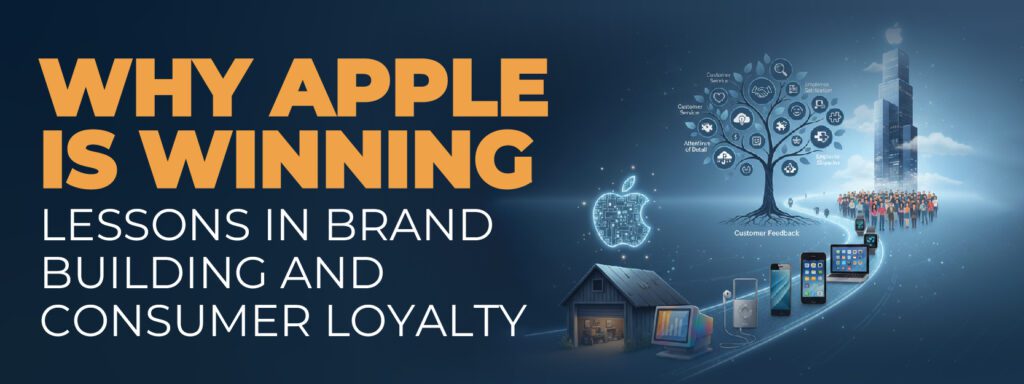
In a world brimming with endless noise and shrinking attention spans, how does a brand create a message that not only gets heard but deeply resonates?
In plain English, Apple is the brand we are talking about. Few businesses have had such a democratic influence on the history of technology as Apple. Apple’s ascent from its modest origins in a California garage to its present situation as one of the most valuable and inspirational tech companies in the world is a tale of major creativity, superior design, and indomitable will.
The Rise of Apple
For Apple, the road to success was far from smooth. The late 1980s and early 1990s were a rough time. Following a power struggle with then CEO John Sculley, Steve Jobs left the company in 1985, marking one of Apple’s most uncertain chapters.
Apple’s market share decreased in the years that followed, as it struggled to compete with Microsoft’s dominant Windows operating system. During this time, several new launches failed to pique consumers’ interest. Apple suffered financial losses and lost focus due to its inability to innovate and adapt.
When Steve Jobs rejoined Apple as its interim CEO in 1997, the company’s prospects drastically changed. His quality of leadership and vision rekindled Apple’s inventive spirit. The first action he took was to establish a strategic alliance with Microsoft, which stabilized the business and provided much-needed funding.
Jobs aimed to concentrate on a few essential goods and simplify Apple’s product line. When the iMac was first released in 1998, it was a vibrant and recognizable desktop computer that appealed to customers. It signaled the start of Apple’s comeback.
With the release of the iPhone in 2007, the tech industry saw a dramatic change. The first Apple smartphone was a stylish device that combined an iPod, a mobile phone, and an internet communicator. A year later, the App Store and the iPhone’s multi-touch interface completely changed how we work, communicate, and access information. Beyond technology, the iPhone had a profound cultural impact. Apple’s “There’s an app for that” slogan represented the device’s boundless potential.
Apple kept coming up with new ideas for all of its products. A new class of portable computing was established in 2010 with the release of the iPad. The MacBook Pro, preferred by professionals for its power and performance, and the MacBook Air, renowned for its thin design, followed.
Apple entered the wearables market in 2015 with the release of the Apple Watch. With features such as heart rate tracking and ECG functionality, the Apple Watch entered the fitness and health companion market.
The following factors will help you build and maintain client trust and retention, whether you are building or owning a related or unrelated brand, and want to take true inspiration from Apple’s unbelievable success.
Purchasing Anxiety
People are very smart nowadays. Before purchasing something, they think twice, especially when it’s about purchasing an expensive or unique product. The main reason behind this is anxiety about whether or not it will work as it should. Getting an answer from the company might be very difficult if the product doesn’t work properly, which then raises the concern.
Apple handles this anxiety very smartly through its customer service, showing clients that with every product they buy from Apple, they will receive the support they need to the fullest. Any product review is worthless without an understanding of the company’s policy or customer service. Customers are no longer fools; they make purchases not just based on product quality, but also on service quality.
High Attention to Details
From the very beginning, Apple understands that each and every detail is important. That’s why Apple doesn’t just stick to offering quality and reliable products. The company goes the extra mile and pays close attention to the smallest details. And factually, consumers notice that. In fact, if you Google “ Apple attention to detail,” you will come across lots of articles talking about the brand’s “fanatical” and “insane” attention to detail.
Employee Satisfaction
If you have no knowledge about eNPF, it stands for Employee Net Promoter Score, and it’s a derivative of the NPS methodology. The research works pretty much the same way, but instead of focusing on customer satisfaction, they focus on employee satisfaction. They keep the satisfactory level high for the employees because they know very well that happy employees produce happiness.
Why is that relevant? Because happy, satisfied employees are productive employees. According to research, happy employees are 20% more productive than their unhappy counterparts. Also, companies with engaged employees outperform those without by a whopping 202%. What’s more, companies with highly engaged employees can see revenue growth around 2.5 times that of their competitors, and high employee engagement can also reduce expensive staff turnover by approximately 40%.
Customer Experiences
Experience is everything; if the customer does not have the best experience, then the customer takes their business elsewhere. It was predicted that by 2020, customer experience would overtake price and product as the key drivers of brand differentiation in the market, but that actually happened years ago.
Apple was always ready for this shift. A simple Google search is enough to see how many Apple customers are pleased with the unique experiences the brand offers. From replacing a phone to having new features on the new model. Every year, a new model comes on the board. It is really a cool experience for the customer to replace old ones with new ones, just by spending some money. Also, experiencing excellent customer service makes the customer more interested in the brand.
Customer feedback plays a key role in user-oriented personalization, too. For Apple, feedback is clearly important for growing the business because it opens the way for improvement.
Power of Simplicity
“That’s been one of my mantras – focus and simplicity. Simple can be harder than complex: You have to work hard to get your thinking clean to make it simple.” – Steve Jobs
Apple’s work on simplicity is immediately noticeable when you consider that most Apple services support single sign-on features. For instance, you can use your Apple ID to access all Apple-hosted services, which is much simpler than having users keep track of multiple IDs for different services. It looks fun and fantastic.
Innovation
Its unique hardware and software are the biggest selling points. And for these reasons, they focus on innovation. We are not saying they just create new products; they also ensure they are useful, easy to adopt, and likely to lead to change.
From AirPods and Apple Watch to Apple MagSafe Charger, everything they put on the table is the perfect example of building a market with innovation. And this innovative idea makes Apple a powerful brand indeed.
The brand never stopped learning and progressing. Apple was always looking for new opportunities and new ideas, aiming to give customers not only what they want but also anticipate their needs. Therefore, they were ready to lose sight of the shore – of what was popular with many users- to come up with better, bolder solutions. Today, 89% of successful businesses agree that predicting customer needs is critical to growth.
Considering all of that, it’s easy to see how Apple’s NPS score can get a charge from its innovative products.
Customer Satisfaction
There is a myth that Apple doesn’t like to listen to its customers, but truly, it is not true. Fred Reichheld’s popular book, The Ultimate Question, explains how Apple used Net Promoter Score prior to 2006 to influence its practices.
According to Reichheld’s book, internal studies showed that Detractors whom Apple contacted within 24 hours were significantly more likely to buy Apple products in the future than Detractors who couldn’t be reached. Apple found that each hour spent on the phone with a Detractor was worth $1,000 in additional revenue.
Today, Apple is one of the world’s most successful and profitable technology companies. It holds over 40% of the US smartphone market (48,6% in 2022 to be precise) and has a fantastical 87% brand loyalty across the US and Europe. So think less about profit and more about customer value, how your company and your product or service can create more value for your customers.
From Apple to other industry-leading companies, the best way to learn about retention is to survey your customers, read their feedback, and use it to improve your product, service, and experience.
Author: MD Nadim Ahmed
M.A. in English Language Teaching
Jahangirnagar University
Email: nadim@bangladeshbrandforum.com