It is 7:42 in the morning in Dhaka. A 26-year-old graphic designer opens her phone before she opens her eyes. She checks her bKash balance, splits last night’s dinner bill via Nagad, pays her internet subscription through her bank app, and books a Pathao ride — all before stepping into the shower. By the time she reaches her coworking space in Mohakhali, she has completed four financial transactions across three platforms. She has not touched cash. She has not thought about a bank branch. For her, it is simply life.
This is not an edge case. It is the defining financial behaviour of Bangladesh’s largest demographic cohort. Approximately 39% of Bangladesh’s 175 million people are between 15 and 35 — a youth population representing both the country’s largest consumer segment today and its primary economic engine for the next three decades. How this generation transacts, saves, borrows, and builds wealth will shape the entire financial system. And right now, they are doing it overwhelmingly on their phones.
The Numbers Behind the Shift
The scale of Bangladesh’s digital financial transformation is extraordinary. Total MFS transactions in 2024 reached Tk 17.42 lakh crore — a 28.5% increase over 2023, according to Bangladesh Bank. MFS accounts crossed 239 million by January 2025, adding roughly 20 million new holders in a single year. Daily MFS transaction value stands at approximately Tk 5,000 crore, with projections suggesting it could double within two years.
Underpinning this is a smartphone penetration rate exceeding 72% at the household level (Bangladesh Bureau of Statistics) and mobile phone presence at 98.9% of households. Internet banking adoption rose from 25% of the population in December 2019 to nearly 44% by March 2025 (Bangladesh Bank), while MFS now covers 54% of the population. In 2024, Bangladesh recorded a 33% increase in mobile wallet users — among the fastest rates globally. For tens of millions of young Bangladeshis, mobile-first finance is not an alternative to banking. It is banking.
Why the 21–35 Cohort Is the Decisive Battleground
Demographics alone make this cohort strategically critical. But the more important variable is behavioural: young Bangladeshis formed their financial habits at the exact moment MFS achieved critical mass. Their baseline expectation is instant, frictionless service available at 3 a.m. A 22-year-old student in Rajshahi receives tuition support from family via bKash, pays hostel rent through Nagad, and earns freelance income deposited directly to a mobile wallet. Her relationship with a physical bank branch is peripheral, if it exists at all.
bKash, Bangladesh’s only tech unicorn valued at over $2 billion, recorded a 67% year-on-year increase in profit in 2024 — Tk 315.77 crore — reflecting the depth of its integration into daily life. Nagad, operating under Bangladesh Bank administration since August 2024, retains substantial market presence. Between them, these platforms have established behavioural infrastructure that traditional banks must now compete with, not merely complement.
From Utility to Lifestyle Platform
The most significant shift in Bangladesh’s fintech landscape is the progressive integration of financial services into non-financial moments. When a user pays for a Shajgoj order through bKash, books a Shohoz bus via an integrated gateway, or splits a restaurant bill through a bank app in Banani, they are not performing a banking transaction consciously — they are completing a lifestyle moment in which a financial platform is the invisible infrastructure.
This is the logic of ‘super app’ behaviour. bKash now integrates merchant payments across nearly one million businesses and has enabled micro-savings through DPS partnerships with IDLC Finance, Mutual Trust Bank, Dhaka Bank, City Bank, and BRAC Bank — over 3.5 million DPS accounts opened within the app. City Bank, through its bKash partnership, has disbursed approximately Tk 1,565 crore in digital loans to 500,000 unique customers, a scale impossible through traditional branch infrastructure. As City Bank’s Deputy Managing Director Md. Arup Haider has noted, mobile banking has ‘significantly eased everyday financial activities’ — a reality now reaching well beyond the unbanked into the urban professional class.
The Competitive Landscape at a Glance
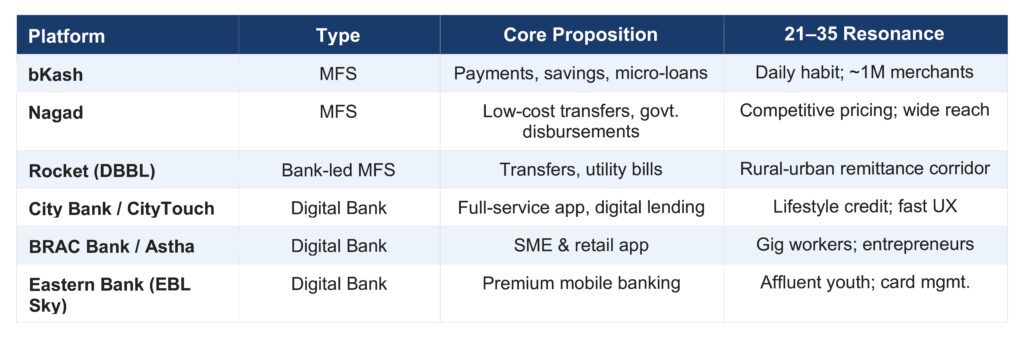
Source: Company disclosures, Bangladesh Bank, BBF Research. Market positions as of early 2026.
UX, Gamification, and the Design of Financial Habit
Behind every successful fintech product is a behavioural design logic. The apps winning the 21–35 demographic are engineered for engagement — progress indicators for savings goals, instant transaction notifications, streamlined onboarding. bKash’s interface presents a curated dashboard of payments, utilities, savings, and lending, designed to become the default financial home screen. Eastern Bank PLC’s EBL Sky platform targets higher-income urban users with card management, investment options, and lifestyle rewards in a single experience. BRAC Bank’s digital offerings increasingly serve young entrepreneurs and gig workers whose financial needs conventional banking products poorly address.
The design principle is straightforward: an app opened once a week for a utility payment is a tool. An app opened multiple times daily — for payments, balances, credit, and spending tracking — is infrastructure. Every serious player in Bangladesh’s digital finance market is trying to make that transition.
Bangladesh Bank’s Structuring Role
Bangladesh’s digital finance expansion has not been unguided. Bangladesh Bank has invested in the interoperability infrastructure that makes the customer experience work: the National Payment Switch Bangladesh (NPSB), Bangla QR for merchant payments, and real-time settlement platforms BEFTN and BD-RTGS. It has also demonstrated willingness to intervene when governance fails, as with the appointment of a Nagad administrator in August 2024 following reported financial irregularities. Its broader roadmap — simplifying e-KYC, expanding rural broadband, promoting digital literacy — will determine how quickly the digital finance revolution extends beyond major urban centres.
Trust remains a live variable. For the 21–35 demographic, trust is increasingly experiential rather than institutional: users trust the platform that has never failed them, not the institution with the longest history. Platforms that have built consistent, positive experience across millions of transactions hold a meaningful advantage that legacy brand alone cannot replicate.
Financial Inclusion as a Generational Dividend
The lifestyle banking revolution carries a dimension beyond urban convenience: it is extending formal financial access to populations previously excluded. Over 3.3 million bKash customers have linked their wallets to formal bank accounts, many for the first time. Female-owned deposit accounts grew from 33.4 million in 2019 to 55.3 million by 2025. Agent banking, with over 85% of outlets in rural areas, has become the connective tissue between MFS adoption and full-service digital banking — a pathway from cash economy to formal financial participation that no previous generation had access to at this scale.
The Road Ahead: Embedded Finance and AI
The next phase will be shaped by embedded finance — banking services delivered within e-commerce, ride-sharing, and social platforms — and by AI-driven personalisation: spending analysis, alternative credit scoring using behavioural data, automated savings nudges, and intelligent fraud detection. Bangladesh’s 52 million social media users and expanding e-commerce sector create a natural substrate for this model. The 5G rollout beginning in Dhaka, Chattogram, and Sylhet in 2025 will further deepen the capabilities available to digital finance platforms. Institutions investing now in data architecture and product design will hold the competitive advantage of the next decade.
The New Infrastructure of Daily Life
The transformation in Bangladesh’s financial sector is not primarily a technology story. It is a story about how an entire generation has redefined what a bank is supposed to be and feel like. For the 21–35 cohort, banking is ambient — the layer beneath every commercial decision, social payment, savings goal, and credit need that their lives generate. The institutions that earn a place in this generation’s daily financial stack will capture not just their current transactions but their financial futures.
Bangladesh’s young majority is not waiting for traditional banking to catch up. It is building its financial life around tools that are already there. The only question for every institution in this market is which side of that divide they intend to be on.
Author: Nusrat Arah