EXECUTIVE SUMMARY
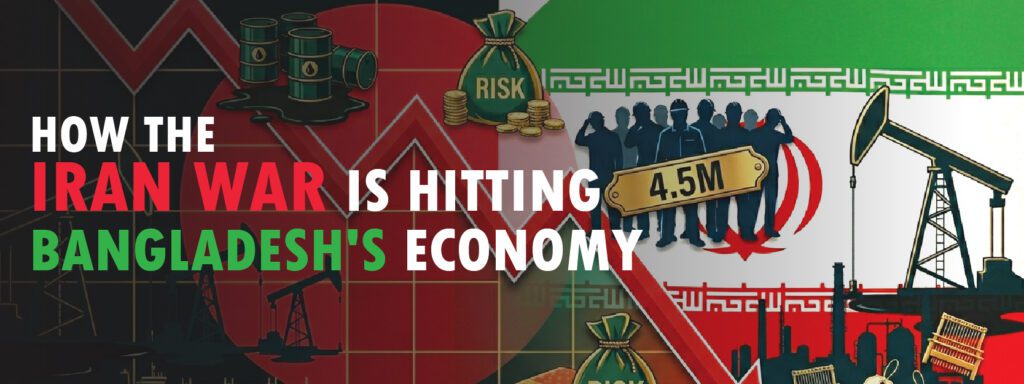
When the United States and Israel launched military strikes on Iran in late February 2026, the shockwaves reached Dhaka within hours. Crude oil surged past $114 per barrel, LNG prices spiked 183 percent from January levels to $28.28 per mmBtu, and the Strait of Hormuz — through which roughly one-fifth of the world’s oil and LNG normally flows — was closed by Iran. For a country 4,000 kilometres from the frontlines, Bangladesh’s economic exposure has proved startlingly direct.
The South Asian Network on Economic Modeling (SANEM), using the Global Trade Analysis Project (GTAP) computable general equilibrium model, estimates that a prolonged conflict could wipe up to 3 percent from Bangladesh’s GDP over two years — a contraction that would eliminate years of hard-won development gains and push millions back into poverty. This article traces the four primary transmission channels through which the war is reshaping Bangladesh’s economic landscape: energy costs, the ready-made garment (RMG) sector, remittances and labour migration, and agriculture and food security.
1. THE GEOPOLITICAL FAULT LINES AND BANGLADESH’S EXPOSURE
Bangladesh’s economic integration with the global trading system has long been its greatest strength — and its most consequential vulnerability. The country earns over 80 percent of its foreign exchange from RMG exports and remittances, both of which are deeply entangled with Middle Eastern geopolitics.
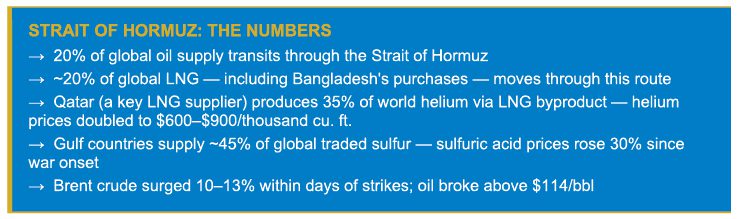
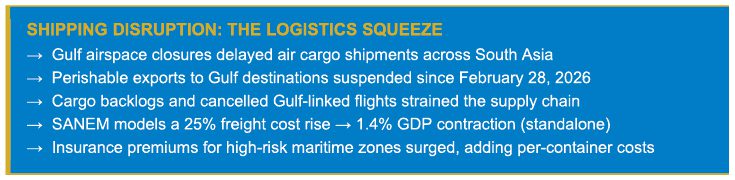
The Strait of Hormuz is the chokepoint at the heart of this crisis. Approximately 20 percent of the world’s crude oil and LNG transits through this narrow waterway between Oman and Iran. Iran’s decision to close the strait following US-Israeli strikes has interrupted energy flows to Asia, spiked shipping insurance premiums, and forced vessel rerouting — adding days to delivery schedules and hundreds of millions to logistics costs.
Former World Bank lead economist Zahid Hussain identified three primary exposure channels for Bangladesh: energy pricing, dollar dynamics, and trade and finance.
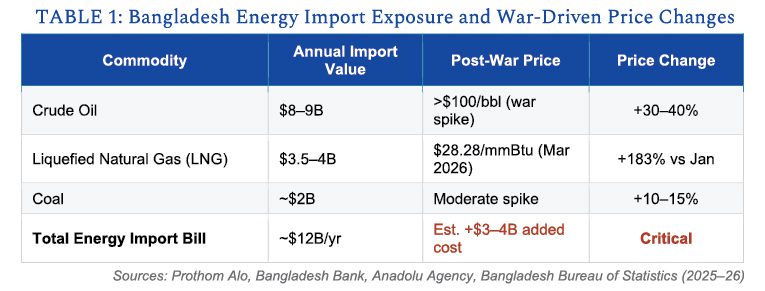
Bangladesh’s position is structurally fragile: it is an import-dependent economy with an annual energy import bill of approximately $12 billion, limited foreign exchange reserves, and an export base concentrated in a single sector. The International Energy Agency’s head described the war’s effect as ‘the greatest global energy security challenge in history’ — a characterisation Bangladesh’s policymakers cannot afford to dismiss.
2. THE ENERGY SHOCK: COSTS, CASCADES, AND CRISIS MANAGEMENT
2.1 Bangladesh’s Energy Import Dependency
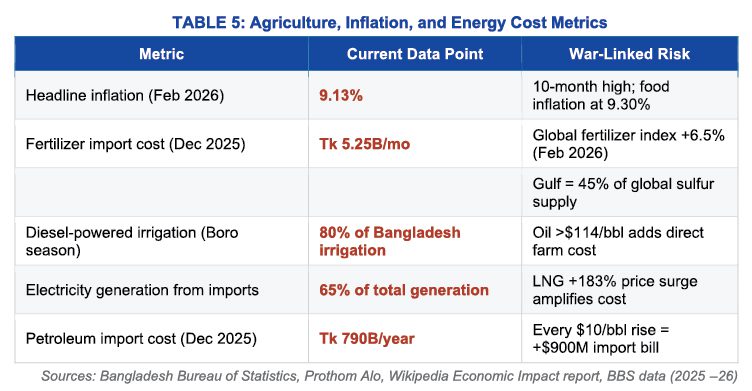
Approximately 65 percent of Bangladesh’s electricity generation depends on imported energy — oil, coal, and LNG. This structural dependency means that every dollar rise in global oil prices translates almost immediately into domestic cost pressures. Policy analysts estimate that each $10 increase in global crude prices adds roughly $900 million to Bangladesh’s annual import bill.
 2.2 The LNG Crisis: From Long-Term Contracts to Spot Market Vulnerability
Bangladesh’s failure to secure long-term LNG contracts has left it exposed to spot market price swings. In January 2026, LNG spot prices stood at approximately $10 per million British thermal units (mmBtu). By March 2026, they had surged to $28.28/mmBtu — a 183 percent increase in just ten weeks. This is not a marginal cost adjustment; it is a structural shock to the energy economy.
The government’s response has included fuel rationing, diesel-sale restrictions, gas conservation measures, and the shutdown of four of five state-run fertilizer plants to protect electricity generation. Universities were closed early to conserve power. The government has simultaneously sought over $2 billion in external financing to secure fuel and LNG imports — negotiations are underway with the IMF ($1.3B existing programme + $250–500M additional), the Asian Development Bank ($500M budget support), the World Bank, and the Islamic Trade Finance Corporation.
Key data point: China’s temporary ban on fuel exports further tightened regional diesel, gasoline, and jet fuel supplies — amplifying Bangladesh’s cost exposure beyond the Gulf alone.
2.3 Sector-Level Cost Cascades
Higher energy costs are not confined to the power sector. They propagate across the entire economy through a series of cost cascades:
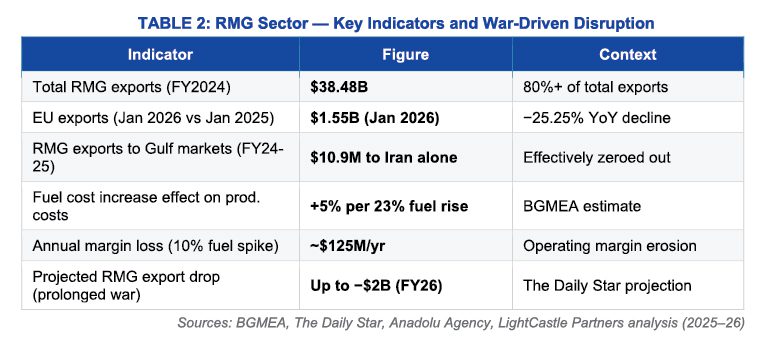
Manufacturing: Higher fuel costs raise unit production costs across all industries. For the RMG sector specifically, BGMEA data shows that a 23 percent rise in fuel prices increases production costs by approximately 5 percent.
Transport & Logistics: Diesel price rises directly increase the cost of moving food, goods, and raw materials across the country — feeding into consumer price inflation.
Shipping & Freight: Marine insurance premiums have surged for vessels in high-risk zones. Freight rates have climbed as shipping companies reroute around the Gulf, adding days to journeys and costs to every container.
3. THE READY-MADE GARMENT SECTOR: CRACKS IN THE BACKBONE
3.1 Scale and Strategic Importance
The ready-made garment sector is Bangladesh’s economic engine. Accounting for more than 80 percent of total export earnings, the industry generated $38.48 billion in FY2024 and employs roughly 4 million workers, the majority of them women. It is, simultaneously, the country’s greatest source of foreign exchange and its most concentrated vulnerability.
3.2 The EU Market Collapse and Double Exposure
Bangladesh’s largest export market — the European Union — has already shown signs of retreat. Apparel exports to the EU fell to $1.55 billion in January 2026, a sharp 25.25 percent year-on-year decline. The war now threatens to deepen this trajectory through two simultaneous pressures: cost competitiveness erosion (as fuel and freight costs rise) and delivery schedule disruption (as shipping rerouting adds transit time).
3.3 The Margin Compression Calculus
LightCastle Partners has quantified the cost impact precisely: a 10 percent rise in fuel prices — well below the actual shock experienced — could add 2.17 percent to unit production costs. With an industry profit margin of roughly 15 percent (approximately $5.77 billion annually), this translates to an annual operating margin reduction of around $125 million under a conservative scenario. The actual margin erosion, given oil prices above $114 per barrel, is likely considerably larger.
Bangladesh’s RMG exporters now face a structural competitive dilemma: absorb rising costs and sacrifice margins, or pass them on and lose price-sensitive buyers in Europe and North America to competitors in Vietnam, India, and Cambodia — countries with different energy exposure profiles.
4. REMITTANCES AND THE GULF LABOUR MARKET: 4.5 MILLION WORKERS IN THE CROSSFIRE
4.1 The Scale of Gulf Dependency
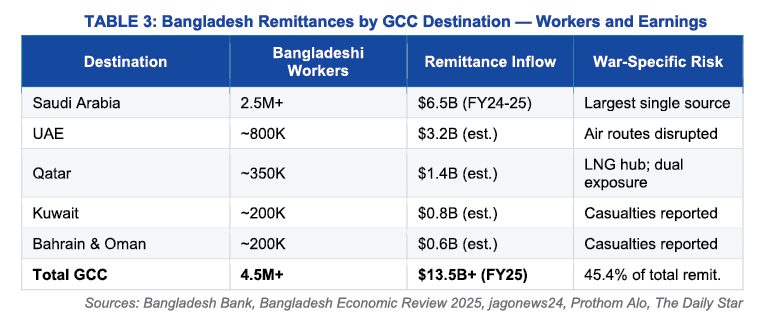
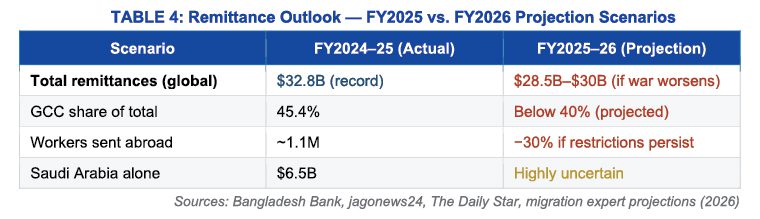
Remittances are the second pillar of Bangladesh’s economy. In FY2024–25, Bangladesh recorded a historic high of $32.8 billion in total remittance inflows — equivalent to 6.6 percent of GDP. Of this, more than $13.5 billion originated from the six Gulf Cooperation Council (GCC) countries, accounting for 45.4 percent of all remittance income. Saudi Arabia and the UAE are the two largest individual sources, together responsible for nearly $9.7 billion.
4.2 The Immediate Disruption: Flights, Visas, and Stranded Workers
The war’s immediate effect on labour migration was severe and swift. Following the onset of military strikes, several Middle Eastern countries closed their airspace. In the first nine days of the conflict, approximately 300 flights from Dhaka and Chattogram to Gulf destinations were cancelled. At least 40,000 Bangladeshi workers found themselves stranded — unable to reach their workplaces, with contracts and work visas at risk of expiry.
The war has also turned deadly for Bangladeshi nationals abroad. At least 3 Bangladeshi workers have been killed (casualties confirmed in the UAE, Bahrain, and Kuwait) and seven others injured — a reminder that for the 4.5 million Bangladeshis in the Gulf, this is not an abstract economic story but a crisis of personal safety.
4.3 The Short-Term Paradox: A Record March, But Clouds Ahead
March 2026 delivered a headline statistic that might seem contradictory: remittances hit a record $3.75 billion — a 14 percent increase year-on-year, driven largely by pre-Eid-ul-Fitr sending and a surge in migrant workers remitting funds home during crisis conditions (a pattern also observed during the early Russia-Ukraine war). Overall remittance for July–March FY2025–26 rose 20 percent to $26.20 billion compared to the prior year.
However, analysts caution strongly against interpreting this as resilience. The surge reflects a one-time behavioural spike — workers sending more before travel disruptions worsen. The surge provides ‘meaningful short-term relief’ but does not change the structural risk outlook. The Bangladesh Bank’s own Q1 data showing GCC countries accounting for 45.4 percent of all remittances underscores how concentrated — and therefore how fragile — this income stream is.
5. AGRICULTURE AND FOOD SECURITY: THE HIDDEN FRONT
5.1 The Diesel-Fertilizer-Food Chain
Bangladesh’s agriculture sector faces a war-driven cost spiral that runs directly from the Gulf to the paddy fields of rural Bangladesh. Two inputs are critical: diesel (for irrigation pumps) and fertilizers (for soil nutrition). Both are acutely exposed to Middle Eastern supply disruptions.
Approximately 80 percent of Bangladesh’s irrigation system relies on diesel-powered pumps. With oil prices exceeding $114 per barrel, the cost of running these pumps during the critical Boro season (the winter rice harvest) has risen sharply, squeezing farm-gate margins and threatening food production targets.
5.2 The Fertilizer Crisis: A Supply Shock Within a Supply Shock
Nitrogen-based fertilizers are derived from natural gas — a commodity whose supply chain now runs directly through the conflict zone. The government shut down four of five state-run fertilizer plants to protect electricity generation, making Bangladesh more dependent on imports at precisely the moment global fertilizer prices are rising.
The global fertilizer price index rose 6.5 percent in February 2026. Sulfur — a critical input for fertilizers and pesticides — has seen a 30 percent price spike because the Gulf (Qatar, Kuwait, and Iran together) supplies roughly 45 percent of globally traded sulfur. If the conflict disrupts Qatar’s LNG and associated natural gas output, the global nitrogen fertilizer market could face additional supply shortfalls, pushing prices still higher.
China’s export ban on fertilizers (including urea) to prioritize domestic agricultural needs has further tightened the global supply picture, removing a major alternative source at a moment of peak demand.
6. MACROECONOMIC SCORECARD: WHAT THE MODELS SAY
6.1 The SANEM-GTAP Analysis
The most authoritative quantitative assessment of the war’s impact on Bangladesh comes from SANEM, using the Global Trade Analysis Project (GTAP) computable general equilibrium model. The researchers modelled three distinct scenarios:
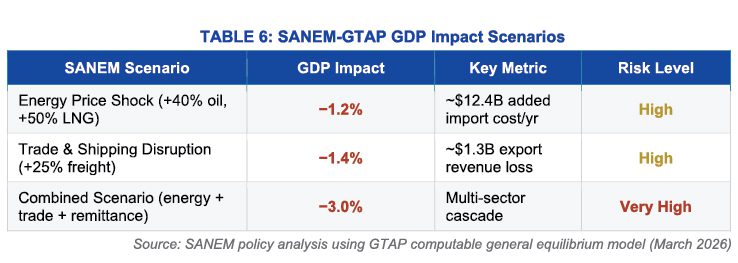
The combined scenario — in which all three shocks materialise simultaneously — produces the most alarming outcome: a 3 percent GDP contraction. Bangladesh’s nominal GDP is approximately $460 billion at current prices. A 3 percent contraction represents roughly $13.8 billion in lost economic output over two years — a figure comparable to Bangladesh’s entire annual remittance inflow from the Middle East.
6.2 Inflation: Already Elevated, Now Worsening
Bangladesh entered this crisis with inflation already entrenched. The country has sustained headline inflation above 9 percent since March 2023, with food inflation at 9.30 percent in February 2026 — a 10-month high. The war’s energy price surge has arrived into an economy that has no slack to absorb additional cost pressures.
The LightCastle Partners analysis notes that while a $10 per barrel oil price increase adds roughly 0.2 percentage points to inflation in advanced economies, the effect in Bangladesh — where energy costs represent a higher share of household budgets and production costs — is meaningfully larger. With oil above $114 per barrel (a $34+ increase from pre-war levels), the inflationary pass-through is severe.
6.3 Foreign Exchange Reserves: A Constrained Buffer
Bangladesh’s foreign exchange reserves stood at approximately $21 billion as of May 2024–25 (per BPM6 methodology), having partially recovered after a severe drawdown in 2022–23. The war threatens this fragile recovery on two fronts simultaneously: it increases the import bill (requiring more foreign exchange outflows) while potentially reducing remittance inflows (the primary source of foreign exchange earnings).
7. POLICY RESPONSE AND STRATEGIC RECOMMENDATIONS
7.1 What the Government Has Done
Faced with an acute energy and economic shock, the Bangladesh government has moved quickly on several fronts. The economic and planning adviser to Prime Minister Tarique Rahman, Rashed Al Mahmud Titumir, confirmed that the government is ‘trying everything to make sure that the industrial belt gets enough fuel supply’ and has deliberately held domestic gas prices stable to shield manufacturers — a politically costly but economically rational short-term choice.
The government has also diversified fuel sourcing, pursued spot LNG purchases (despite the premium pricing), and initiated discussions with major multilateral lenders for emergency financing. Diplomatically, it has activated consular support for stranded workers in the Gulf.
7.2 What Must Come Next: Structural Reforms
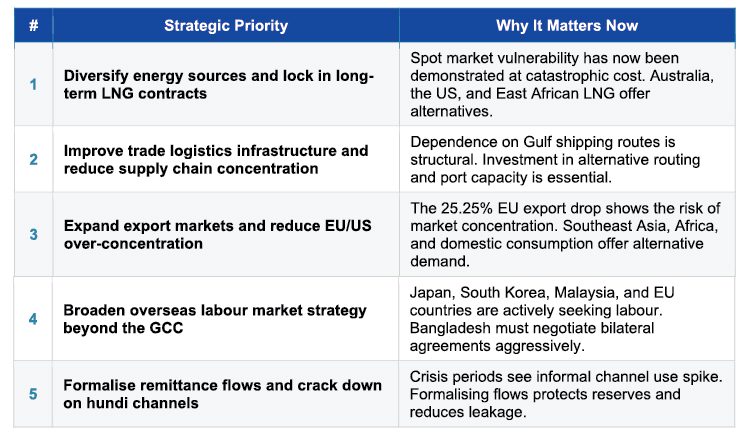
Short-term crisis management, while necessary, is insufficient. The structural vulnerabilities exposed by this war — energy import dependency, remittance concentration, single-sector export dominance — will persist and worsen with each future geopolitical shock unless systematically addressed. SANEM’s analysis recommends four strategic priorities:
8. CONCLUSION: A STRUCTURAL RECKONING
The Iran war is not merely a geopolitical event unfolding 4,000 kilometres from Dhaka. It is a stress test of Bangladesh’s entire development model — one that has delivered extraordinary growth over the past two decades by leveraging cheap energy, cheap labour, and open global trade routes. All three of those foundations are now under simultaneous pressure.
Bangladesh has shown remarkable economic resilience in the past — navigating the 2008 financial crisis, the COVID-19 pandemic, and the 2022 energy shock better than many comparable economies. But the combination of factors converging now — a prolonged energy crisis, remittance disruption affecting 4.5 million workers, a deteriorating RMG export picture, entrenched inflation, and constrained foreign exchange reserves — represents the most severe external shock the country has faced in recent memory.
The SANEM GTAP model’s 3 percent GDP contraction estimate for the worst-case scenario is not a prediction — it is a warning. Bangladesh has both the policy tools and the institutional capacity to mitigate the worst outcomes, provided it acts with urgency and strategic coherence. The choices made in the coming months — on energy diversification, labour market strategy, export market expansion, and fiscal management — will determine whether this war marks a temporary disruption or a structural turning point in Bangladesh’s development trajectory.