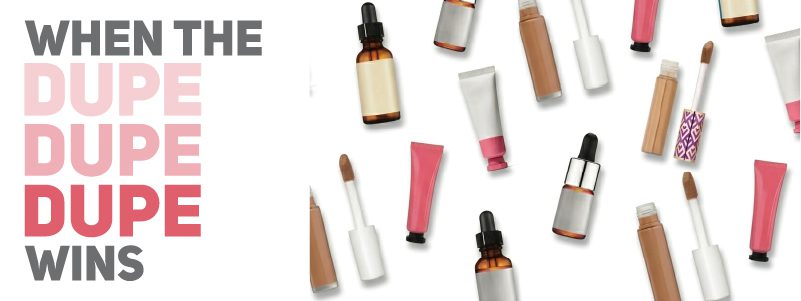
Scroll through TikTok or Instagram today and you will quickly encounter a phrase that has quietly redefined modern shopping: “run, don’t walk — I found a dupe.” Whether it is a Tk 1,200 alternative to a Tk 12,000 skincare product or a fast-fashion version of a designer silhouette, the dupe economy has moved from the edges of consumer culture to its centre. And it is no longer just a story about cost.
Dupe culture — the practice of deliberately seeking out affordable alternatives to premium products — has crossed income lines, age groups, and geographies. A recent study by Cashew Research, based on surveys of over 1,000 consumers across Canada and the United States, found that 17% of dupe buyers earn over USD 150,000 annually. “Dupe culture is not just a cost-saving tactic, it’s a cultural filter,” said Addy Graves, CEO of Cashew Research. “Even affluent consumers are increasingly asking brands to prove they’re worth the price. If they can’t? A cheaper alternative will win.”
This is not simply a recession-era behaviour. It is a structural shift in how a generation of consumers thinks about value, status, and the relationship between price and quality. For brands — locally and globally — understanding this shift is no longer optional. It is strategic.
The Numbers Behind the Shift
The scale of dupe adoption is significant. According to a survey by Business Insider and YouGov, 71% of Gen Z consumers sometimes or always buy cheaper versions of name-brand products. Among Millennials, the figure is 67%. But the more telling statistic is what happens after consumers make the switch: 45% say they have permanently converted to a private label or alternative product after finding it met or exceeded expectations. This is not trial behaviour. It is a new loyalty pattern.
Perhaps most strikingly, when shown side-by-side images of national and store-brand products in a recent study, 72% of consumers were unable to identify which was the private label. The quality gap — once the defining argument for premium pricing — has narrowed to the point where most consumers can no longer reliably detect it.
What Is Driving It
Three forces are converging to make dupe culture more powerful than at any previous point in consumer history.
The first is pricing pressure from premium brands. In the fashion and beauty sectors particularly, the price of luxury goods has increased significantly over the past decade. Jennifer Hyman, Co-founder and CEO of Rent the Runway, speaking at the NRF Big Show 2025, was direct: “Over the last few years, you’ve seen luxury players take the price of a Chanel bag and almost double it. It’s insane, even for a wealthy person.” The luxury market responded to this pressure with declining numbers: after exceeding a record EUR 1.5 trillion in 2023, the luxury market declined between 1% and 3% year over year in 2024, according to Bain & Company.
The second force is social media. What was once a private compromise — buying the cheaper version — has become a public identity. Influencers and content creators openly review and recommend alternatives, celebrating the discovery of a quality product at a fraction of the expected price. The “thrill of the find” has become a social currency in itself. Hashtags like #DupeAlert have generated hundreds of millions of views globally, turning dupe-hunting into a lifestyle activity that carries status of its own.
The third is that private label quality has genuinely improved. Retailers have invested heavily in product development, design, and packaging for their own-brand lines. Aldi, for example, now generates nearly 80% of its sales from private label products. Brands like Trader Joe’s have built entire cult followings around their store-brand alternatives. The result is that the argument “you get what you pay for” no longer automatically holds.
Expert Perspectives
GLOBAL VOICE
Jennifer Hyman
Co-founder & CEO, Rent the Runway — Speaking at NRF Big Show 2025
“The consumer is not as snobby as she was 20 or 30 years ago. Back then, if you were rich, you only wore luxury goods. Now, if you’re rich, you’re smart — you’re going to buy some of your stuff at Bergdorf, and some of your cashmere at Quince. High fashion has priced itself out.”
“Today the dupes are awesome. Fifteen years ago, fast fashion dupes were poor quality. But today, fast fashion dupes have gone up in quality. Luxury has come down on quality, yet Zara has gone up in quality. It’s a really interesting shift.”
RESEARCH VOICE
Addy Graves
CEO, Cashew Research — Dupe Culture Report, October 2025
“Dupe culture is not just a cost-saving tactic — it’s a cultural filter. Even affluent consumers are increasingly asking brands to prove they’re worth the price. The old assumption that premium pricing signals premium quality is no longer automatic. Brands that cannot demonstrate genuine value will find themselves replaced, regardless of how established their name is.”
RETAIL STRATEGY VOICE
Liza Amlani
Principal & Founder, Retail Strategy Group
“Not only is dupe culture now acceptable, but we’re seeing influencers lean into it. What has changed is not the existence of cheaper alternatives — those have always been there. What has changed is the pride consumers feel in choosing them. Being caught with a knockoff was once embarrassing. Today, finding a great dupe is something to celebrate publicly.”
How Brands Are Responding
The most instructive brand responses to dupe culture are neither defensive nor dismissive. They are strategic — using the phenomenon as an opportunity to demonstrate genuine value, build community, and deepen consumer trust.
Olaplex, the premium haircare brand, faced an explosion of dupe products on TikTok, with the hashtag #olaplexdupe garnering over 30 million views. Rather than responding with legal action or complaint, the brand created its own fake dupe. “Oladupé No. 160” was sent to over 700 influencers — and turned out to be Olaplex’s actual No. 3 Hair Perfector. The reveal generated over 400 posts and 21.9 million views, and USD 1.1 million in global earned media value. The brand turned a potential threat into proof of quality.
Lululemon took a different approach. When knockoffs of its Align Leggings appeared, it invited consumers who had bought fake versions to trade them in at pop-up sites. The brand even promoted the swap on TikTok — using dupe culture’s own platform to demonstrate the quality difference and highlight the ethical sourcing of its genuine products. The campaign also addressed sustainability: the traded-in knockoffs were recycled.
Meanwhile, Lululemon has also taken legal action against Costco, alleging that Kirkland-branded apparel closely copies signature elements of its Define jackets and Scuba hoodies. The case — which focuses not on logos but on design elements, visual characteristics, and trade dress — could shape how courts draw the line between legitimate competition and unlawful imitation.
The legal response reflects a broader reality: as dupe culture becomes mainstream, it creates genuine tension around intellectual property, design rights, and brand investment. Fast-fashion companies can replicate a design before brands can respond. The legal system is being asked to define, with increasing urgency, how much of a brand’s identity can be legally copied.
The Bangladesh Dimension
Bangladesh has its own version of this story — and it runs in a fascinating direction. Here, the shift from international to local has already happened, and it carries lessons for the global dupe conversation.
Over the past two decades, Bangladeshi consumers have increasingly chosen local brands over international ones — not as a compromise, but as a preference grounded in quality, relevance, and value.
In this context, the dupe logic works in reverse. Bangladeshi consumers did not simply find cheaper alternatives to global brands — they found better alternatives. Local brands competed on price initially, then built genuine quality and consumer trust until the international name no longer carried a meaningful premium. This is precisely the dynamic that dupe culture is now accelerating globally.
The question for Bangladeshi brand builders is what comes next. As the middle class expands, aspirational consumption grows, and international access deepens through e-commerce, will a new generation of Bangladeshi consumers begin to seek global alternatives to established local brands? And if so, what should local brands be doing today to build the kind of demonstrable quality, experience, and community trust that can hold through that pressure?
The answer from dupe culture globally is consistent: what protects a brand is not its name or its price point. It is the genuine quality of its product, the transparency of its claims, and the depth of its relationship with the consumer. These are things a dupe cannot replicate.
What It Means for Brand Strategy
Dupe culture does not represent the death of brand loyalty — it represents its evolution. Consumers are not turning against brands. They are demanding that brands earn their loyalty through proof, not assumption.
For brands navigating this landscape, several strategic directions are emerging. The first is radical transparency — being clear about what goes into a product, where it is made, and what makes it worth the price. Consumers who understand what they are paying for are far less likely to seek an alternative. The second is quality as a living demonstration, not a historical claim. Brands that invite consumers to compare — as Lululemon did with its dupe swap — are building the kind of trust that a cheaper alternative cannot manufacture.
The third is community. Dupe culture thrives in shared discovery — the pride of finding something, telling people about it, and being validated. Brands that build communities where consumers feel that same sense of shared knowledge and belonging are competing on the same emotional terrain.
Finally, there is the question of pricing honesty. In a market where consumers can increasingly verify quality for themselves, price premiums must be grounded in genuine value — craftsmanship, sustainability, experience, or exclusivity — rather than brand heritage alone. The consumer of 2026 is more informed, more connected, and more willing to make their own judgement than any previous generation. The brands that will thrive are those that welcome that scrutiny — and can stand behind what they offer.
Author: Tanvir Hossain
Sources: Cashew Research Dupe Culture Report (Oct 2025) · First Insight Private Label Study · Business Insider / YouGov Consumer Survey · Pearlfisher Brand Strategy Report · Bain & Company Luxury Market Data 2024 · The Business Standard Bangladesh Brand Data · Retail TouchPoints / NRF Big Show 2025 · IPWatchdog (2026)