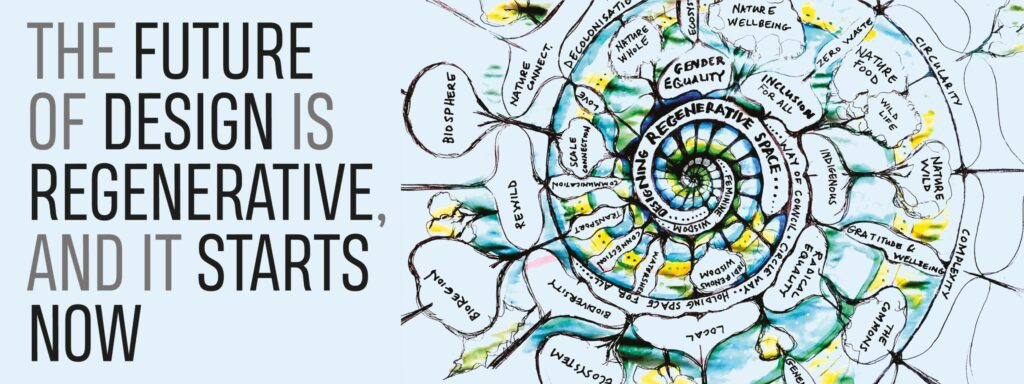
Let’s think about a world where nothing goes to waste. Even the smallest element of organic or inorganic “waste” or the place we live or work in produces reusable energy. The day-to-day things that we dispose of as garbage, or a simple structural design, can be used to regenerate power. Even though it sounds like an extravagant idea, it is actually not so sparse. The desire to restore the balance between nature and human lives has given inspiration for the idea of “Regenerative Design”.
REGENERATIVE DESIGN AND ITS IMPORTANCE
After decades of exploiting nature and consuming numerous amenities from the environment, humans have finally realised it’s time to make a change. The 80s widespread phrase “Sustainable Development” inspired John T. Lyle to write his book “Regenerative Design for Sustainable Development” in 1994, where he discussed the positive environmental changes due to regenerative design. Here, he explained that different aspects of life can include complex systems that are both functional and sustainable.
Human development has already caused the natural system to lose its balance severely. Regenerative design is a human approach to heal and recover natural resources that will benefit both us and the environment. The idea of regenerative design is not to bring back the past dynamics of the ecosystem but to strategically utilise current resources to co-exist and prevent the loss of nature anymore. While economical, structural and technological advancement has damaged the environment, regenerative design gives humans the rare opportunity to somewhat reverse that damage and restore planetary integrity for the future.
REGENERATION IN PRACTICE
Although the concept of regenerative design is still relatively new, several projects have already been launched that aim to achieve the respective goals.
Hammarby Sjöstad, Stockholm, Sweden, is one of the most accomplished examples of urban revitalisation in the world. The once highly polluted industrial area is now a thriving ground for both humans and nature due to its sustainable planning. From structure to transport, every aspect of life includes an eco-cycle system that uses natural sources to regenerate at least 50% of its required power.
Bullitt Center, Seattle, USA, is referred to as the greenest building in the world. The sustainable projects regarding this building included self-recycling of organic waste, exclusion of toxic material, strict water and energy usage that made it 83% more efficient than other commercial sites.
Apart from structures, regenerative agriculture has also made some positive changes in the food and fashion industry. The Reinforest Alliance’s 2025 standard is expected to add to its climate friendly certification and the collaborative collection of Under Armour and Unless has launched a line of regenerative compostable activewear navigating the fashion industry in an eco-friendly direction.
BRANDING BUT MAKE IT REGENERATIVE
With every passing generation, people are becoming more and more eco-conscious. And to meet the requirements and expectations of this highly conscious generation, brands need to evolve and adapt to regenerative strategies. The ultimate purpose is to transform brands that not only consume but also run parallel with the environment and cause zero harm. Beyond sustainable branding, regenerative branding is a holistic approach with the idea of connecting humans across culture, generation, and ecology.
Implementation of regenerative design is quite simple. It fundamentally requires utilizing resources in a way that doesn’t harm the environment but helps to rejuvenate it. This very idea has inspired the Berlin-based eco search engine ECOSIA. Reports show that the internet accounts for around 3.7% of global gas emissions, and the more people are getting used to the internet, the more harm it is doing to the environment. ECOSIA was built to revamp the use of the internet to help the environment from previous destruction. By planting trees in several countries with a percentage of their profit, ECOSIA aims to heal the planet one click at a time.
Regeneration projects result from the human desire to reverse environmental destruction. From food brands like Goodsam Foods to fashion brands like Patagonia, these advocate for environmental healing and human functionality. Reports show that approximately 81% of the generation is interested in buying eco-friendly products, while 77% are willing to pay more for sustainable products.
DESIGN FOR THE FUTURE
Human-driven depletion of natural elements has become the key subject of every conversation, raising concerns for the future. No longer just a concept, the regenerative mindset has become a force for restoring the planet’s credibility. The constant use of fossil fuels and energy has resulted in an adverse environmental change that intensely threatens future generations, which is why regenerative designs are a must. With every effort to decrease the usage of single-use plastic, elevation of environment-friendly material and self-efficient structures, our surrounding heals very slowly but surely.
Decades of adverse carbon footprint cannot be reversed anytime soon. Still the search for practical solutions to planetary problems have driven people to look for regenerative approaches beyond sustainability, as just minimising harm to the environment is not enough anymore. Though transforming to regenerative ethics can be quite challenging, still certain measures must be taken for the sake of future.
Author: Jarin Subah Turaba