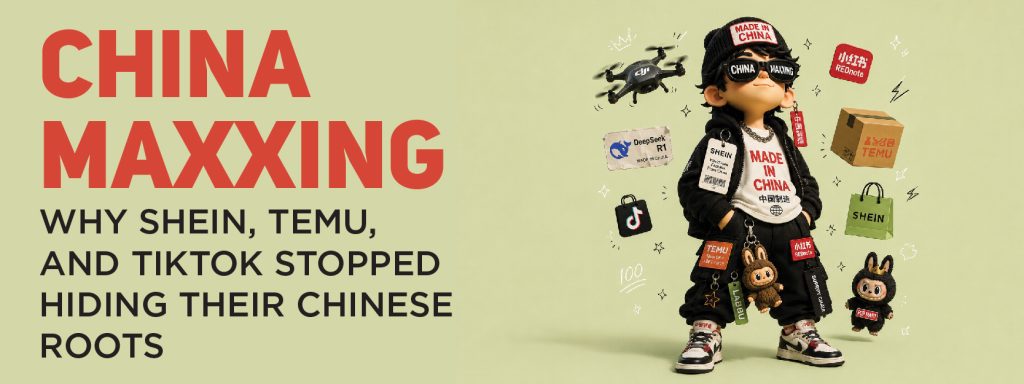
For a decade, Chinese brands chased global success by hiding where they came from. Now Shein’s reclusive founder is thanking his suppliers on a Chinese stage, Americans are flocking to a Chinese app in protest, and a plush monster from Beijing is outselling the Western toy giants. The disguise is coming off.
Last month, a man who had spent years avoiding cameras walked onto a stage in Guangdong and did something the old playbook would have forbidden. Xu Yangtian, the famously reclusive founder of Shein, stood before an audience and thanked the local government and the Chinese suppliers who had turned his company into the largest bargain-fashion retailer on earth. For a business that had spent a decade pretending it was not really Chinese, the appearance was a small bombshell. The disguise was coming off.
Shein is not alone. Across the most successful Chinese consumer brands, a strategy that defined the last decade is being thrown into reverse. Call it what the analysts now do: a pivot from “China shedding” to “China maxxing.” The brands that once worked overtime to hide their origins have started to wear them as a badge. Understanding why is a short lesson in how fast the meaning of three words, “made in China,” can change.
The shedding years
For most of the 2010s, the path to global scale for a Chinese consumer brand ran through camouflage. The logic was simple and, at the time, correct. In Western markets, “made in China” signalled cheap, mass-produced, and faintly untrustworthy, so the smart move was to obscure the connection and present as something placeless and global.
Shein perfected it. The company kept its operations rooted in the manufacturing clusters of Guangzhou but moved its headquarters to Singapore, sold nothing inside China, and built a brand so deliberately generic that millions of shoppers had no idea where it came from. Temu, launched by the Chinese giant PDD Holdings, played a similar game, presenting itself as a borderless bargain bazaar. And TikTok spent years and enormous sums insisting, to regulators and the public, that its link to its Beijing-based parent ByteDance was a technicality, and that it was really an American-run, globally minded app.
The instinct behind all of it was captured neatly by one brand consultant describing the old consumer mindset: take off the tag that says made in China, so no one thinks I am cheap. For a decade, hiding was the strategy. Then it stopped working.
The week the spell broke
In January 2025, the strategy backfired in spectacular fashion. The United States, citing national security, moved to ban TikTok unless its Chinese parent sold it. The expectation was that displaced users would scatter to American alternatives like Instagram Reels or YouTube Shorts. Instead, hundreds of thousands of them did something nobody predicted. They downloaded RedNote.
RedNote, or Xiaohongshu, is about as Chinese as an app can be. It is a Shanghai-based, Chinese-language platform whose roughly 300 million users are overwhelmingly mainland Chinese, with parts of its interface that had never even been translated into English. Americans flocked to it not in spite of its Chinese-ness but because of it, as a deliberate act of protest against the ban. Within days it topped the US App Store, and the trend spread to dozens of countries.
When they tell us you can’t have a Chinese app anymore, we go straight to another Chinese app. We’re going to go straight to the source.
— A US “TikTok refugee,” speaking to the Associated Press, January 2025
What followed surprised everyone. Rather than a frosty stand-off, the migration produced a wave of warm, faintly absurd cultural exchange. Chinese users jokingly welcomed their new “spies” and demanded a “cat tax” of pet photos; Americans and Chinese compared grocery prices, school systems, and health insurance. For a great many young Westerners, it was the first time they had interacted directly with Chinese people and Chinese content, and the experience dismantled assumptions a decade of suspicion had built. The “made in China” tag suddenly looked less like a warning and more like a destination.
| 2022–23 Shein moves its headquarters to Singapore. The “China shedding” playbook is at its peak. |
| JAN 2025 The US moves to ban TikTok; “TikTok refugees” flood the overtly Chinese app RedNote in protest. |
| JAN 2025 DeepSeek’s AI model rattles Silicon Valley and US tech stocks, a moment of Chinese national pride. |
| APR 2025 Trade-war “Chinese factory” videos reframe “made in China” as “made at the source.” |
| 2025 Pop Mart’s Labubu, proudly Chinese, outsells Western toy giants worldwide. |
| MAR 2026 Shein’s reclusive founder publicly thanks his Chinese suppliers in Guangdong. |
From shedding to maxxing: the pivot in six moments.
Bigger than one viral month
It would be a mistake to read all this as a single fluke. The RedNote moment landed the way it did because deeper currents had been building for years.
The first is generational. Younger consumers, particularly Gen Z, simply do not carry the reflexive distrust of Chinese brands that their parents did. They grew up with Chinese hardware they admired, from DJI drones to Anker chargers, and Chinese culture they sought out, from the blockbuster video game Black Myth: Wukong to short dramas and skincare. To them, Chinese origin is not a stain to be explained away; in many categories it reads as a mark of value, or even of cool. In the same month that Americans were flooding RedNote, a Chinese AI lab called DeepSeek released a model that rattled Silicon Valley and wiped hundreds of billions of dollars from US tech stocks, announcing China as a peer in the one field everyone assumed America owned.
Nothing illustrates the shift better than a plush, pointy-eared monster called Labubu. Pop Mart, the Beijing company behind it, made no attempt whatsoever to hide its Chinese roots, and it has become one of the most successful cultural exports of the decade. By 2025 its overseas sales were exploding, with US growth measured in four figures, a market value above 40 billion dollars that eclipsed the Western toy giants Hasbro and Mattel combined, and gross margins near 67 percent, higher than BYD or Xiaomi. A Chinese toymaker built a global, luxury-adjacent obsession while being openly, proudly Chinese. The old camouflage would have made it impossible.
There is a second current, sharper-edged. When the trade war escalated in 2025 and tariffs spiked, a wave of videos went viral in which Chinese factory owners spoke directly to Western consumers, claiming to manufacture the handbags and goods of famous luxury houses and offering to sell them direct, minus the Western markup. Whether every claim was accurate mattered less than the story it told. It reframed “made in China” from a mark of inferiority into a provocation: that China was not the cheap imitation but the source of the real thing.
Underpinning all of it is a movement the Chinese call guochao, or “national tide,” the embrace of Chinese identity and aesthetics in branding. What began as domestic pride has become an export, and the most modern Chinese brands are increasingly comfortable letting their origin be part of the appeal rather than a secret to keep.
| $40bn+ Pop Mart’s market value in 2025, openly Chinese and built without disguise, eclipsing Hasbro and Mattel combined. (Bloomberg; Fortune) |
When origin becomes an asset
For marketers everywhere, this is the useful part, because the principle travels well beyond China. Country of origin is one of the most powerful and least examined signals a brand carries. For decades, “German engineering,” “Swiss precision,” and “made in Italy” were assets to be amplified, while other origins were liabilities to be hidden. What the China-maxxing pivot shows is that those associations are not fixed. They move, sometimes quickly, and a brand that reflexively buries its origin may be burying an asset.
The lesson is not that every brand should suddenly flaunt where it comes from. It is that origin is a strategic variable to be managed honestly rather than a fact to be concealed by default. When a country’s products start winning on quality, design, or sheer cultural energy, the brands that lean into that story capture the upside, while the ones still apologising for their roots look both dated and faintly dishonest. Authenticity, it turns out, ages better than camouflage.
Not a victory lap
None of this is a clean triumph, and the smartest Chinese brands know it. The pivot is uneven and the risks are real.
TikTok itself is the clearest caution. Even as the cultural mood warmed, the political machinery did not, and the app spent 2025 navigating a forced restructuring of its US ownership; its survival depended on looking less Chinese to Washington, not more. Shein, eyeing a public listing, still moves carefully, and its founder’s appearance in Guangdong was aimed as much at the home market as at the world. The trust and security concerns that drove the original suspicion have not evaporated, and across much of the West the regulatory climate remains openly hostile.
The honest reading is that China maxxing works far better with consumers than with governments, and better with Gen Z than with legislators. It is a cultural and marketing shift running ahead of, and sometimes against, a political one. A brand that mistakes the cultural permission for a total one will eventually collide with the part of the world that has not changed its mind.
The tag stays on
Still, the direction of travel is hard to miss. For a generation of companies, the price of admission to the global market was to look like they came from nowhere in particular, ideally somewhere Western. That bargain is dissolving. The most dynamic Chinese brands are discovering that they can compete with their origins fully visible, and win.
The era in which a global brand had to disguise where it came from is not over everywhere. But the most interesting brands in the world have decided it is over for them. They have stopped hiding, and the tag is staying on.
Author
TASNIM SAFWAN