We are surrounded by lots of advertisements and discounts every day. The thing that really matters is how people feel about a brand. People usually do not remember what a brand says. They always remember how the brand makes them feel.
People look at thousands of advertisements daily. They stop and think about the stories that mean something to them. These are the stories that talk about the things people hope for, the things they’re scared of, the things they remember, and the things they want to achieve. Nowadays, people see many things on the internet, so it is hard to get their attention. When a brand can make people feel something, that is very powerful.
The poet Maya Angelou said something important a long time ago. She said, “People will forget what you said, people will forget what you did, but people will never forget how you made them feel.” Even though she said this before social media existed, her words are still very true today for brands.
Beyond Selling: The Rise of the Human Brand
Traditional marketing is about the products. Now branding is about the people. A company can make great products, spend a lot of money on ads, and be all over television. If the customers do not feel something for the brand, they will not be loyal for long. Another company can come along. Offer a lower price or a bigger discount, and the customers will go to them.
Human brands do things differently. They do not just try to sell things. They talk to people. They do not just make ads. They try to understand how people feel. Instead of saying “buy our stuff,” they say, “How can we be a part of your life?”
For example, Nike does not just sell shoes; it helps people be brave. Apple does not just sell computers and phones; it helps people be creative. Dove does not just sell soap; it helps people feel good about themselves. These brands are successful because they make people feel something, not just because they have ads.
The Psychology Behind Emotional Branding
Neuroscience tells us that emotions are really important when we make decisions. People often think they buy things because it makes sense. The truth is that our feelings have a big say in what we buy. We use facts to explain why we made a decision. It is our emotions that get us to make that decision in the first place.
Think about a kid who really wants a kind of chocolate. This is because it reminds them of times with their family. Think about someone who always buys the same brand of tea that their grandparents used to drink. These are not decisions that people make because they sat down and thought about it. They are emotional.
The marketing professor Philip Kotler said that “The best advertising is done by satisfied customers.” People are not usually happy just because something is cheap. They are happy when they trust a company, when the company’s consistent, and when they have good emotional experiences with the company. Neuroscience and emotions are closely linked to our decision-making and buying behavior.
Storytelling: The Soul of Human Branding
In plain English, every brand that people remember tells a story. People have been sharing stories for a long time, even before they started trading money. Stories help people understand things and give things meaning, whereas advertisements just make people aware of things.
Successful brands do not just list what their products can do; they tell stories about people who are facing real problems. A company that makes sportswear might tell a story about someone who never gives up. A bank might tell a story about people who achieved their dreams because the bank helped them with money. A healthcare company might focus on giving people hope rather than just talking about hospitals.
These stories make brands seem like friends, not big companies. The way symbols are used is also important. A simple picture of a heart can mean that a brand cares about people. A picture of a sun rising can mean hope and new beginnings.
Big brands use these symbols in a way that feels natural so people can understand them in their hearts, not in their heads. Brands like these use stories and symbols to connect with people. That is what makes them powerful brands. The brand tells a story. Uses symbols, and people start to feel like the brand is a part of their life.
The Digital Age Demands Authenticity
Social media has really changed things. It used to be that customers just listened to what companies had to say. Now customers ask questions they write reviews, and criticize companies. They tell their friends about the companies they like.
Being real and honest is more important than making advertisements. The Edelman Trust Barometer says that people want companies to be transparent, to care about society, and to really think about the community, not about making money.
People like it when companies are honest with them, and they can tell when companies are not being sincere.
People today like companies that say sorry when they do something, support good causes, and talk to them like real people, not just like they are trying to sell them something.
Advertising can get people to click on things. Being real is what makes people trust a company. Social media and authenticity are very important for companies. Authenticity is what generates trust in media.
 Emotion Creates Loyalty, Promotion Creates Attention
Attention. Goes. Feelings stay. A special offer might boost sales for a time, but a real customer experience can build trust for a long time.
Picture entering two coffee stores. One has coffee. The other knows your name, asks how your day is going, and makes your drink without you even asking. Most people would be willing to pay more for the choice because it meets an emotional need: the need to feel seen.
This idea works in all kinds of businesses—from banks and schools to hospitals and computer companies. Customers stay with a brand not because the brand is flawless. Because the brand makes them feel important.
A Snapshot of Consumer Sentiment
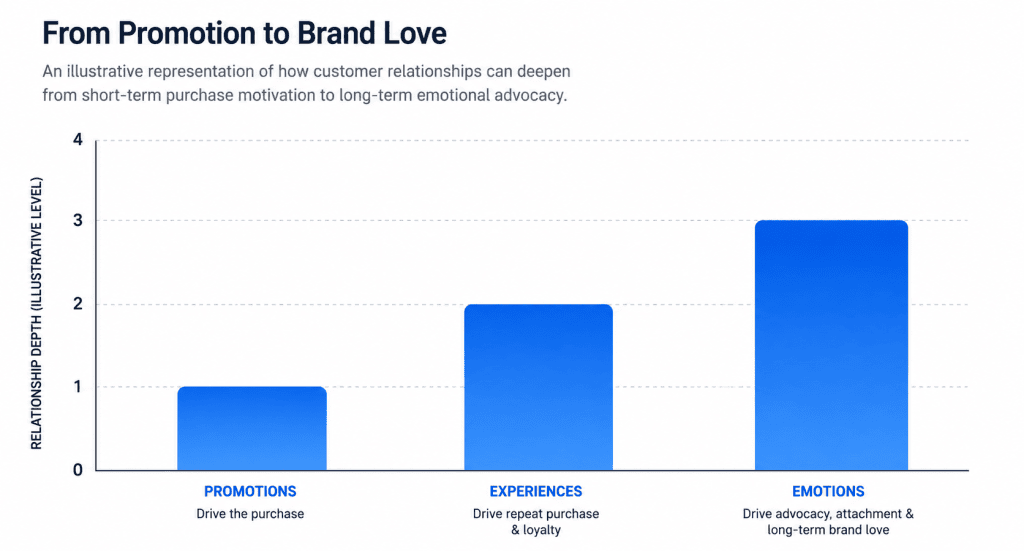
In the year 2024, Motista did a survey. This survey is often talked about when people study branding. It found that customers who really care about a brand are more valuable than customers who are just happy with it. These customers buy things from the brand often they stay loyal to the brand for a longer time, and they tell other people about the brand in a very excited way.
The survey teaches us something important:
- Promotions get people to buy from a brand for a time.
- Experiences make people come back to a brand again and again.
- Emotions make people love a brand so much that they tell everyone about it for their whole life.
The Human Touch in an AI Era
Artificial intelligence can now write advertisements. Recommend products. It can even predict what people will buy. This is really good at doing these things. Machines do not really feel things like empathy or love.
People and machines are different. Machines are getting smarter all the time. This means that what makes us human is becoming more important.
Some brands are using machines to make things easier. They are also making sure to be kind and understanding. People like it when things are fast and easy. They also want to feel like they are being treated well.
The future is going to be about intelligence and human feelings. Brands that use machines and also care about people will do well. Artificial intelligence will not replace feelings. Brands that make people feel good will be the ones that succeed. Artificial intelligence is good at some things. It is not a replacement for human feelings.
Winning Hearts Before Markets
The marketplace is not about products anymore; it is about the people and the relationships we make.
Price is what gets people to look at something. Promotion is what makes people know about something. Innovation is what gets people excited about something. It is the feelings that people have that make them really trust something.
The best brands are not the ones that spend the money on ads. They are the ones that really understand what people want, what they are afraid of, what they hope for, and what they remember. These brands listen to people before they try to sell them something. They care about people before they try to make a sale.
In the end, every good brand answers a question that’s more important than “Why should I buy this thing?”
Every successful brand answers the question that people have always asked:
“Why should I believe in this brand?”
Because when a brand is really genuine and honest, people do not need to be told to buy something. The brand doesn’t need to promote itself much because people already feel something for it. It is the feelings that people have that they remember long after they forget the ad.
Author: MD. Nadim Ahmed
M.A. in English Language Teaching
Jahangirnagar University
Email: nadim@bangladeshbrandforum.com