
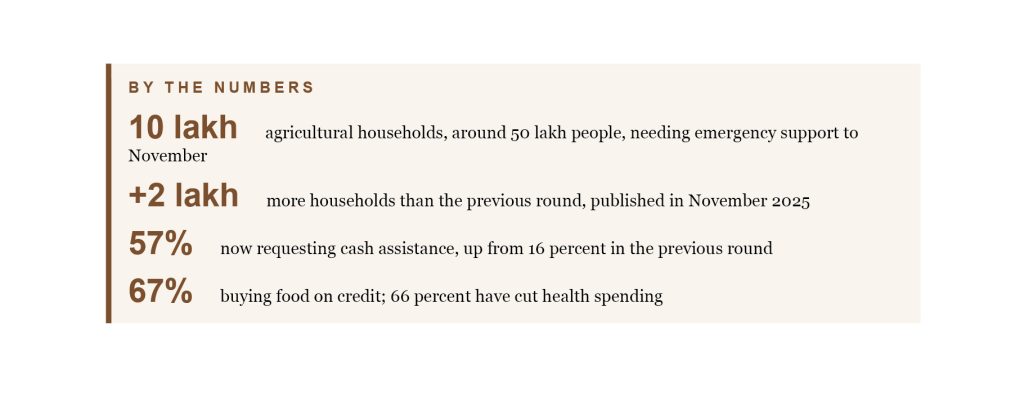
On 25 August the Food and Agriculture Organization published the fourteenth round of its Data in Emergencies monitoring for Bangladesh. It estimated that roughly 10 lakh agricultural households, about 50 lakh people, will require emergency agricultural assistance between June and November this year. That is two lakh households more than the previous round found when it was published in November 2025.
The number rose over a period in which Aman production rose 5.11 percent to 1.73 crore tonnes and Boro cultivation expanded 3.29 percent to 50.50 lakh hectares. Bangladesh remains nominally self-sufficient in rice. Both things are true at once, and the space between them is where this article sits.
 What the estimate actually measures
The methodology matters here, because the headline figure has travelled further than its definition. FAO conducted computer-assisted telephone interviews with 6,143 households across all 64 districts in April and May. A household is counted as needing assistance only when three conditions hold simultaneously: it is experiencing a relevant shock, whether economic, idiosyncratic, agricultural or a natural hazard; it is in acute food insecurity; and it has expressed a need for agricultural support.
That is a narrower test than the phrase emergency assistance suggests. It is not a famine measure. It describes households that have been hit, cannot absorb the hit, and have said so.
Where those households sit depends on how you count them. Measured as a share of the local farming population, the largest concentrations are in Sylhet, Mymensingh and Rangpur. Measured by headcount, Chattogram has the most, followed by Rangpur, Dhaka and Rajshahi, because divisions with large farming populations generate big absolute numbers from modest percentages. Rangpur appears on both lists, which makes it the clearest priority in the data.
The request changed, and that is the finding
The most revealing number in the round is not the headline. It is the shift in what households asked for.
The share requesting cash assistance rose 41 percentage points, from 16 percent in the previous round to 57 percent. Crop inputs remain the single most cited priority at 72 percent, so seed and fertiliser have not stopped mattering. But when more than half of a farming population asks for money rather than materials, it is describing a different problem from the one an input programme is designed to solve.
The coping data explains why. Sixty-seven percent of households in need reported buying food on credit. Sixty-six percent had reduced spending on health. Thirty percent had cut spending on agricultural inputs, which is the decision that converts one bad season into two.
Two crop failures in a single year
The shocks behind those numbers arrived in two waves, and the second is still being counted.
In April and May, pre-monsoon rain and upstream inflows submerged standing Boro across the haor basin during peak harvest, affecting districts including Sunamganj, Kishoreganj, Netrokona, Habiganj, Sylhet, Moulvibazar and Brahmanbaria. Boro is more than half of annual rice production, and the losses landed at the worst possible point in the calendar, when the crop was grown but not yet cut.
In July the rain moved southeast. The agriculture ministry’s final assessment, published on 27 July, counted more than 243,000 farmers across 43 districts and roughly 134,000 tonnes of crops worth about Tk 478 crore, across 24,138 hectares. The composition is the part that matters: 12,783 hectares of Aus paddy, around 9,000 hectares of vegetables, and 1,746 hectares of Aman seedbeds. A damaged seedbed means a farmer spends again before the season has produced anything at all.
One caution on those figures. The ministry’s final count is far below its own interim estimate of 114,723 hectares, and the gap between the two has never been publicly explained. The final assessment is the right number to use, and the revision is worth noting rather than quietly adopting.
The price problem nobody expected
Here the data turns in a direction the flood narrative does not predict.
Among crop producers reporting difficulty, the share struggling to sell their crops nearly tripled, from 9 percent in the previous round to 30 percent, and FAO attributes this mainly to low selling prices. Reports of plant disease rose 30 percentage points. Difficulty accessing fertiliser rose 17 points.
Read those together and the picture is worse than crop loss. A farmer whose field survived the water then found the price had gone. Roughly half of surveyed crop producers reported production difficulties in both rounds, with excess water, plant disease and fertiliser access as the leading causes, so the households that lost output and the households that lost margin overlap considerably. Needs concentrated in river systems, haors and flash-flood hotspots, which is where both problems compound.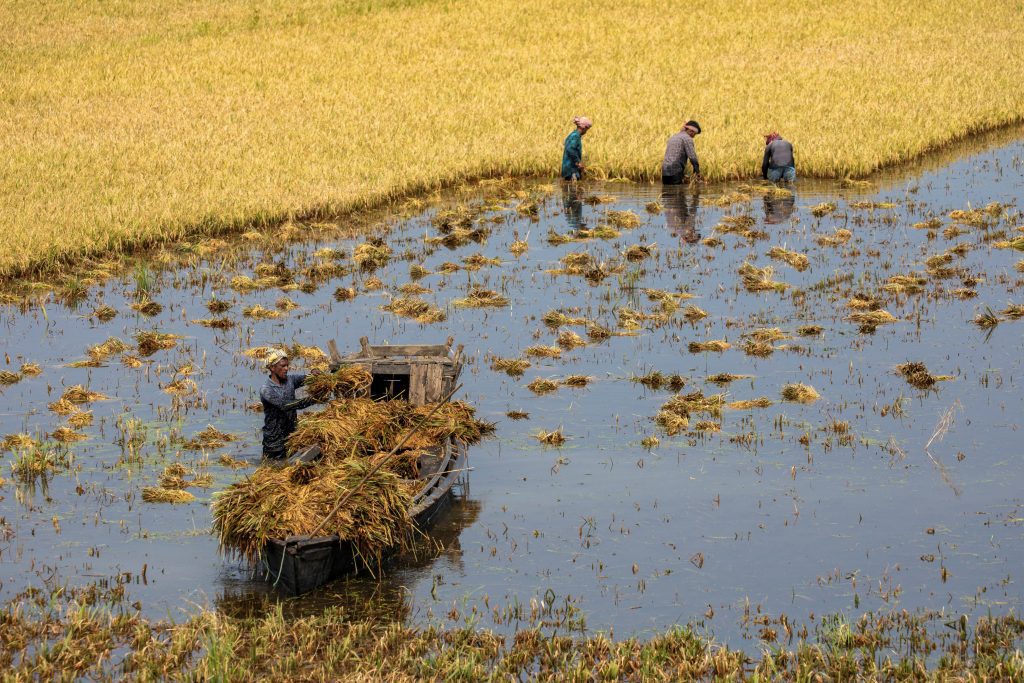
Why the national figures hold anyway
Bangladesh produces somewhere between 37 and 39 million tonnes of rice against demand of 35 to 38 million, and the crop is grown almost everywhere. That dispersion is a genuine strength. A disaster in the haor basin gets absorbed by a decent season in Rangpur, and the aggregate barely moves.
It protects the country. It does nothing for the household. The same geography that keeps national supply stable also guarantees that a total loss in one district disappears inside a national average, which is why food policy discussion in Dhaka can remain calm while a million households are not.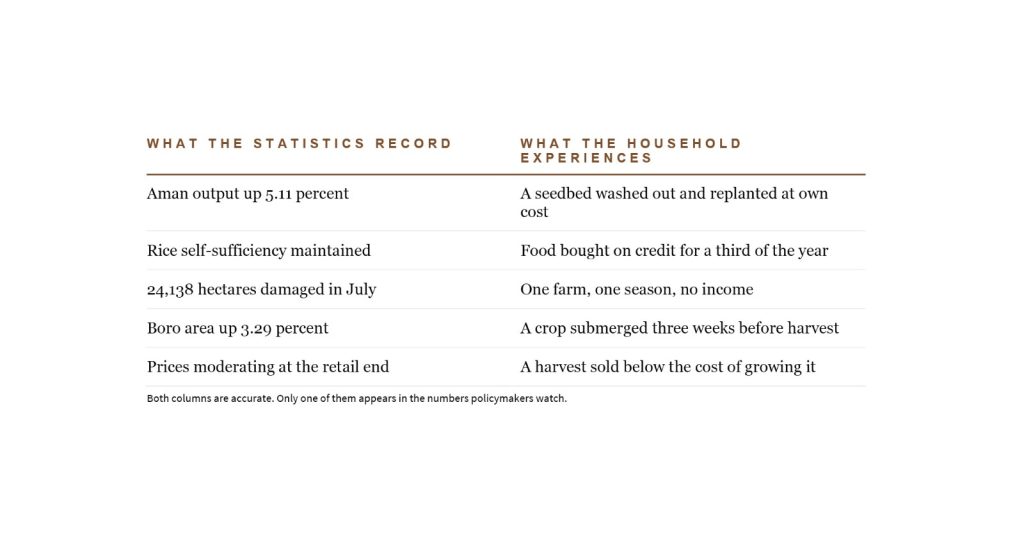 The instrument that does not exist
All of which leads to the absence at the centre of this story. When a Bangladeshi farmer loses a crop, nothing transfers the loss anywhere. It stays with the household, and if the planting was financed, it stays as debt.
Fewer than 5 percent of farmers in Bangladesh hold crop coverage of any kind. Agricultural insurance is voluntary, and where it exists it is often bundled into a loan rather than chosen, which means some farmers hold cover without knowing it. Sadharan Bima Corporation, the state insurer, remains the primary provider and has run pilot schemes in selected districts.
The pilots have a long history. SBC first offered multiperil crop insurance in 1977, and the scheme failed on adverse selection, weak claims administration, poor product design and a single premium charged regardless of land conditions. In 2014, SBC and the Bangladesh Meteorological Department launched a $2.5 million weather-index pilot under the Ministry of Finance. Later work with the Asian Development Bank trained 431 SBC staff and reached over 16,000 farmers with risk education, insuring around 9,500 smallholders with premiums split between farmer, government and financier, claims triggered automatically by weather stations and paid through mobile money. A separate programme with the Syngenta Foundation, Green Delta and SBC operated across 63 upazilas.
Nearly fifty years of pilots, and coverage still under 5 percent. Agricultural insurance operates in more than a hundred countries. The obstacle in Bangladesh has not been the concept.
The window is closing
FAO’s recommendation is a seasonally timed package of input support, cash, animal healthcare and water management, delivered ahead of Aman cultivation. Aman is transplanted in July and August and harvested in November and December, which means the window FAO described was already narrowing when the report appeared.
The government has approved rehabilitation funding for seven districts. Roughly a million households are in the estimate. Even if the assistance arrives in full and on time, it addresses this season and leaves the mechanism untouched, which guarantees the same report in another eight months with another number attached.
The thing worth arguing about is not the size of the relief package. It is that a farming economy of this scale still has no way of moving a bad season off the household that had it.
Sources: FAO, Data in Emergencies Monitoring, Bangladesh, Round 14, published 25 August 2026, based on telephone interviews with 6,143 households across 64 districts in April and May 2026, and Round 13, published November 2025 · Ministry of Agriculture, final assessment of the 7–19 July rains, published 27 July 2026 · Department of Agricultural Extension and Bangladesh Bureau of Statistics, Aman and Boro area and production · Green Delta Insurance, on agricultural insurance penetration (2026) · Sadharan Bima Corporation and Bangladesh Meteorological Department weather-index pilot (2014), Ministry of Finance · Asian Development Bank, Pilot Project on Weather Index-Based Crop Insurance · Syngenta Foundation for Sustainable Agriculture, InsuResilience Solutions Fund and Green Delta · World Bank, Agricultural Insurance in Bangladesh · The Daily Star and The Business Standard reporting on the FAO release.
Author: Rifat Ahmed


