Bangladesh’s climate migration story has usually been told in the future tense. Its best known number, the World Bank projection of 13.3 million internal climate migrants by 2050, describes a country that has not arrived yet.
Last autumn the International Organization for Migration did something simpler. Field teams went to all 64 districts, covering 4,579 unions, 329 municipalities and 480 city corporation wards, made 5,388 visits and interviewed more than 29,000 key informants, and asked how many people in each place were living away from home because of a disaster. The count came to 4,955,527 people. It is the first nationwide estimate of its kind in Bangladesh.
The figure needs a caution before anyone uses it. It is not a count of five million climate migrants. IOM measured displacement associated with hazards, mainly floods, cyclones and river erosion. No single flood can be attributed wholesale to a warming climate, and almost nobody leaves home for one reason. What the count establishes is the size of the base that climate pressure is now acting on, and the shape of it is the surprising part.
Most of it is old displacement
Roughly 63% of the people IOM identified were displaced before April 2020. Another 25% moved between April 2020 and April 2024, and the remainder since. Bangladesh is not mainly carrying a queue of people who left during the last bad season. It is carrying a residue, built up over years, of households that were moved by an event and never got back.
IOM Displacement Tracking Matrix, Bangladesh Round 1, September to October 2025. Shares of 4,955,527 identified disaster IDPs.
The residue is concentrated. A quarter of the identified population sits in four districts: Chattogram, Sirajganj, Bhola and Noakhali. Chattogram division alone holds about 1.21 million, Dhaka division 0.79 million and Rajshahi 0.66 million. And 85% of those counted are living in unions rather than in municipalities or city corporation wards, which is the finding most likely to unsettle the standard picture of climate migration in this country.
Read alongside the annual figures, that pattern points at recovery rather than exposure. Bangladesh is hit every year and is unusually good at the hours either side of a cyclone, moving hundreds of thousands of people into shelters before landfall. What a stock of five million measures is the part that comes afterwards. Whether the house can be rebuilt, whether the land is still there, whether the pond is still drinkable, whether the household can absorb the cost before the next season arrives. A household can adapt to one shock. The harder question is what happens when the next one lands before it has finished recovering from the last.
This is a development crisis with humanitarian symptoms.
Mohammad Zaman, resettlement specialist, writing in September 2026
Four numbers that are not the same number
Part of the confusion in this subject comes from adding together statistics that measure different things. Bangladesh produces several every year, and they get stacked in headlines as though they were comparable.
Water leaving and land leaving are different events
The clearest recent evidence on what actually moves a Bangladeshi household comes from the Jamuna. Researchers publishing in Population and Environment in early 2025 followed 1,604 household heads across 36 villages in Manikganj, Tangail, Jamalpur, Sirajganj, Bogra and Rowmari, surveying them in 2021 and again the following year.
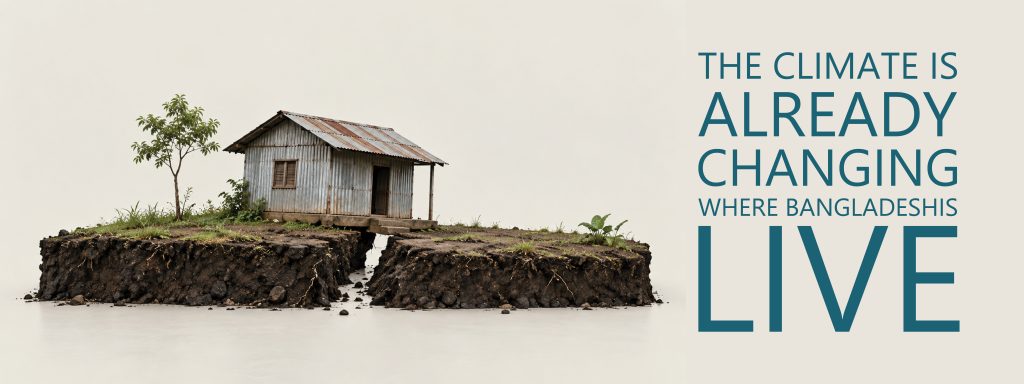
Riverbank erosion more than doubled the likelihood that a household migrated, raising it by 13 to 15 percentage points against unaffected households. Flooding, taken on average, did not significantly change migration at all. Only flooding severe enough to be irreversible produced the same effect. That distinction is worth holding onto, because flood displacement and erosion displacement get reported as one category. A flood asks a household whether it can go back. Erosion removes the thing it would go back to.
Most of the movement is short
The same study found that when whole households moved after erosion, they mostly moved less than five kilometres, permanently, and to another rural location. Individual, temporary moves toward cities were driven more by low household income than by the environmental shock itself. Set that beside IOM’s finding that 85% of the displaced are living in unions and the familiar arrow from the coast to Dhaka starts to look like the smallest part of the picture.
Urban movement has not stopped. IOM’s own 2026 planning for Bangladesh still records distress-driven movement toward Dhaka and other large centres, linked to salinity, storm surge, erosion and water scarcity. Both things are happening. Some people cross the country, more people cross a river, and some move to an embankment a few hundred metres from where the house used to be. Treating this as one national flow toward the capital gets the geography wrong and sends assistance to the wrong places.
For anyone planning services, the practical consequence is that most of this population never arrives at a city boundary where it can be counted. It is spread across unions, embankments, chars and roadside settlements inside the same districts it was displaced from, which is exactly where schools, clinics and land records have to function if the displacement is ever going to end.
The households that cannot leave
Movement is often read as the measure of how bad conditions have become. A study published in Regional Environmental Change in September 2025, working with 1,515 household heads in the same Jamuna villages, suggests the opposite reading is also available.
Among people who had not migrated, 82% were classified as staying by choice. But 13% were trapped, meaning they wanted to move and lacked the means, and another 5% had given up on the idea. Erosion raised the probability that a household’s immobility was involuntary by 7.9 percentage points, and it did so while pushing the same household further down the income distribution. The shock creates the wish to leave and destroys the savings that would pay for leaving in the same season.
That makes mobility itself a form of resilience, and one that is unevenly distributed. Counting who moved will systematically miss the households in the worst position.
The coast is lost slowly, not suddenly
Coastal displacement does not usually arrive as a wall of water. It accumulates. Work published in Scientific Reports in March 2024, based on monitoring in Dacope in Khulna, traced what a storm surge does to drinking water long after the surge has gone. Salt pushed into ponds settles into the sediment underneath and keeps leaching back. Left alone, a pond can take five years or more to return to usable salinity on rainwater alone. Cleaned out within about a week of the surge, it recovers quickly. Cleaned two years later, it can get worse, because emptying it draws saline groundwater back in.
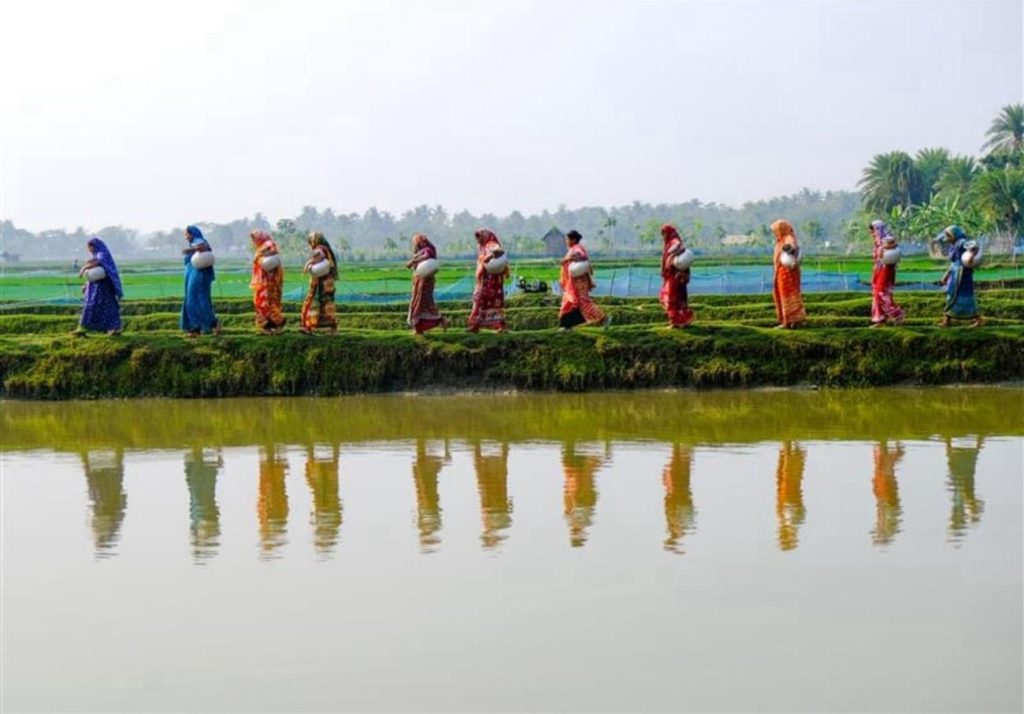
Around 35 million people live in the low-lying coastal belt, and soil salinity affects 20 to 30% of net cultivable land. A social audit run by Wave Foundation and the Centre for Social Research across four upazilas and 32 unions of Patuakhali and Barguna, reported in December, found 87.4% of respondents directly affected by cyclones, tidal surge, salinity, erosion or waterlogging, and about 6.9% already relocated, mostly onto embankments, into informal settlements or to nearby towns. Nothing in that sequence looks like a disaster on the day it happens. It looks like a pond, then a crop, then a decision.
What each move costs
The part of this that belongs in a business magazine rather than a relief bulletin is what repeated displacement does to human capital. A study of 416 households in Bhuapur, Tangail, published in Progress in Disaster Science in January, compared children in erosion-displaced households with children nearby who had not moved. Between 38 and 42% of displaced children had dropped out of school temporarily or permanently, against 18 to 21% of the others. Attendance fell by about a quarter immediately after displacement, and displaced children lost an average of 1.2 to 1.5 years of schooling. Housing loss, repeated relocation, longer journeys to school and child labour did the damage between them.
The districts carrying the heaviest displacement burden are also labour supply districts for the garment sector, for construction and for internal remittances. A year and a half of lost schooling in Sirajganj or Bhola shows up a decade later in the skills available to employers in Dhaka and Chattogram, and in what those workers can earn. The immediate cost of displacement is humanitarian. The durable cost is economic, and nobody is currently measuring it.
The projection is a horizon, not a forecast
The 13.3 million figure still earns its place, provided it goes at the end rather than the beginning. It comes from the World Bank’s Groundswell modelling of what happens to water availability, crop productivity and sea level by 2050 under a pessimistic pathway, and the Bank’s own finding is that concerted action could cut the number by as much as 80%. It describes a scenario. The 4.96 million describes today. They count different populations and should never be set side by side as though one were becoming the other.
Bangladesh has adopted a national strategy on internal displacement management, and it remains better at evacuating people before a cyclone than at settling them afterwards. The 63% displaced before April 2020 are the evidence. Climate change does not need to empty a coastline to redraw where Bangladeshis live. It has been doing it household by household, mostly within a few kilometres of where those households started, and mostly out of sight of the number everyone quotes.
Author: FARIHA ZAHIN