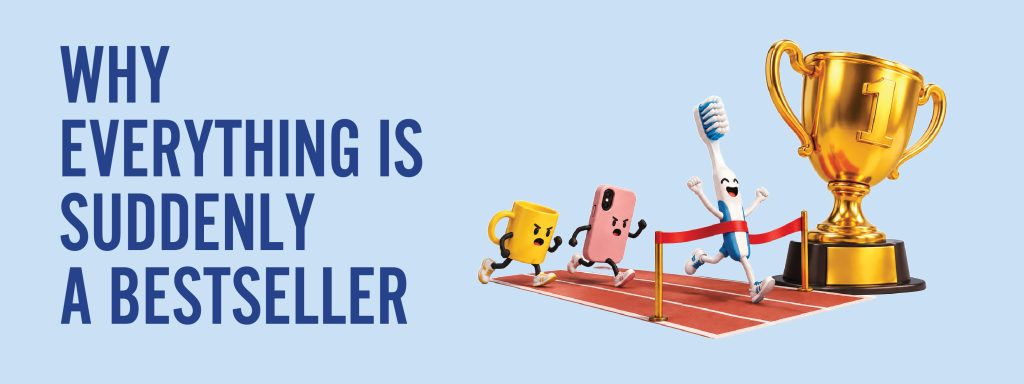
Somewhere on the internet right now, a toothbrush is a bestseller.
So is a phone case, a chilli grinder, a pair of socks with cartoon cats on them, and a three-in-one hair styler nobody has ever heard of. Open any shopping app and the products turn up already wearing medals. Bestseller. Top Rated. Most Loved. Popular Pick. Trending. 10K+ bought this month.
It has the energy of a school prize-giving where nobody is allowed to go home empty handed. First in class. First in section. First in the row by the window. Most Improved. And because everyone is politely not saying it out loud, we will: how is everything winning?
The trophy is real. The tournament is tiny.
The word used to belong to books, where it meant something brutal. One title beat every other title in the country that week, and the rest went quietly back to the shelf. Now it belongs to a category system, and category systems are generous.
Amazon, to its credit, publishes the rules. The Best Seller badge goes to a product that clears a sales threshold and ranks number one in a category holding at least a hundred products. A hundred. That is not a national championship. That is an inter-house match on a Thursday afternoon.
The ranking itself is straightforward enough. It counts sales, and it counts recent sales more heavily than old ones. Reviews do not touch it. Amazon even says in its own guidance that a sales rank does not tell you whether the product is any good. And since one item sits inside several categories at once, a steel tumbler can be the undisputed king of Tumblers while being nobody at all in Kitchen and Dining. Same tumbler. Same afternoon. Two entirely different life stories.
In fairness, we asked for this
Before we laugh too hard at the badges, a confession is in order. We need them.
A shop lets you pick the thing up, turn it over, press the buttons, and glare at a salesman until he admits which one his own family uses. Online you get four hundred near-identical listings, a seller name that reads like a forgotten wifi password, and photographs that may have been taken on another continent, of another product, in 2019.
Bestseller cuts through that fog in a single word. It says other people already took this risk, and not enough of them came back angry to stop it selling. That is genuinely useful information. It is also more or less how all of us choose a restaurant.
Bought, rated, loved: pick your flattery
This is where the vocabulary gets funny, because platforms have quietly built a hierarchy of praise.
Read that ladder again and notice the confession inside it. Somebody at a very large company looked at the word bestseller, concluded it had stopped reassuring anybody, and built a second badge to supervise it.
The 28% that should interest anyone selling here
Two researchers, Aaron Barnes and Sharon Shavitt, ran the experiment nobody had bothered to run: does lots of people bought this persuade as well as lots of people liked this?
In the United States, Britain and Canada, barely any difference. Shrug, same thing, next question.
In more interdependent cultures, the gap opened up properly. Tested in India, participants were willing to pay 28% more for a tablet described as widely loved than for the identical tablet described as widely bought. Mexico and South Korea leaned the same way.
The explanation is a little too accurate for comfort. In places where people buy things partly because everyone else is buying them, everyone buying it is not evidence of quality. It is evidence of a crowd. We should recognise this immediately. We have all watched one neighbourhood buy the same air fryer inside a fortnight.
Which means the badge most Bangladeshi sellers shout loudest about, the sold counter, the top-selling tag, the little countdown timer sweating away in the corner, may be the weaker of the two signals available. The star rating, the low return rate and one calm reply to a furious review are sitting right there, unclaimed, working harder than anybody is letting them.
Your badge is now auditioning for you
Walmart has taken this somewhere slightly absurd. Between 15 and 20% of the products a shopper scrolls past qualify for more than one badge, and there is room on the tile for exactly one. Bestseller, reduced price, popular pick, you looked at this last Tuesday.
So the company built a system that works out which badge is most likely to work on you, specifically, looking at this product, right now. It ran across all of Walmart’s traffic for three weeks. People bought more.
The product does not change. The flattery does. You get told it is popular. The person beside you gets told it is cheap. Neither of you ever learns there was another option on the shelf.
None of which is a scam. The labels mostly mean what they say. What has quietly changed is the meaning of winning, because a platform can slice its shop into so many categories, subcategories, time windows and audiences that almost everything can honestly finish first somewhere.
So a bestseller is no longer the thing everybody is buying. It is the thing that won whichever small, strange race the platform arranged around you while you were looking for a phone case. Congratulations to it.