
Vague purpose statements are losing credibility. Brands that attach specific, measurable commitments to their purpose are commanding loyalty and premium pricing that no mission statement has ever managed. Here is why that gap is widening — and what brands on the wrong side of it are risking.
In 2011, Patagonia ran a full-page advertisement in the New York Times on Black Friday. The headline read: Don’t Buy This Jacket. The copy explained the environmental cost of producing the jacket — water, waste, carbon — and asked customers to consider whether they actually needed it before buying. Patagonia’s revenue increased by 30% that year.
The advertisement worked because it was not a purpose statement. It was a demonstration. It showed, at real commercial cost, that Patagonia was willing to act on its environmental values even when that action ran against its short-term interest. Customers could see the choice the company had made. They could evaluate it. They could trust it — or reject it — on the basis of something concrete. That is what distinguishes a measurable commitment from a declaration.
Most brand purpose today is declaration. ‘We are committed to a sustainable future.’ ‘People are at the heart of everything we do.’ ‘We exist to make the world better.’ These statements commit to nothing, promise everything, and give the consumer no basis for evaluation. In the trust environment of 2026, that is not a neutral position. It is an actively damaging one.
| 62% — the share of consumers globally who say business is the most trusted institution. That trust is highly conditional and easily lost.
Edelman Trust Barometer 2025. Business has overtaken government, media, and NGOs as the institution consumers trust most — but that trust now carries a weight that most brands are not equipped to bear. It requires demonstrated accountability, not stated intention. |
The trust environment that makes specificity essential
The 2025 Edelman Trust Barometer found that 61% of global respondents hold a moderate or high sense of grievance — a belief that government and business make their lives harder while benefiting the wealthy. Into that environment, business has emerged as the most trusted institution precisely because government, media, and NGOs have lost credibility faster. But the trust extended to business is conditional in a way it was not a decade ago. Consumers are not extending goodwill. They are extending a provisional judgment that can be reversed the moment the gap between what a brand says and what it does becomes visible.
Gen Z, who are now entering their peak purchasing years, operate on what researchers at Hiebing call a buy-cotting logic: a deliberate choice to purchase or actively avoid brands based on whether those brands demonstrate ethical practice and transparent operations. This generation is not moved by purpose language. It watches what brands do when purpose conflicts with profit — and it remembers.
The AI content surge has compounded the problem. As generative AI floods every channel with polished, confident, and often fabricated text, the ability to distinguish authentic brand communication from generated noise has become structurally difficult. In that environment, the only credible signal is verifiable action. A brand that says ‘we care about our suppliers’ can be dismissed as generated copy. A brand that publishes its supplier audit results quarterly cannot.
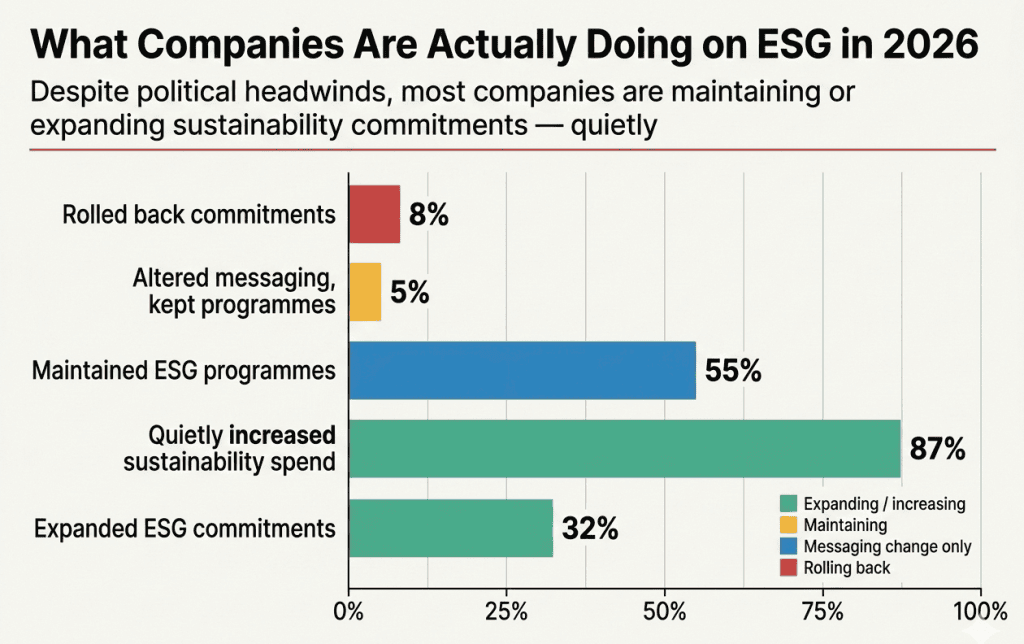
Source: EcoVadis 2025 Study, SLR Consulting ESG Report Jan 2026, Clarkston Consulting Sustainability Trends 2026. Despite political headwinds against ESG in the US, most companies are maintaining or expanding their sustainability commitments — the majority doing so quietly.
What vague purpose actually costs
The risks of purpose without accountability have moved beyond reputational inconvenience into legal territory. H&M faced regulatory action in the EU after its sustainability claims were found to be unsubstantiated. Volkswagen’s diesel emissions scandal was partly a failure of environmental purpose claims that could not survive scrutiny. Deutsche Bank’s asset management arm faced investigation by US and German authorities over ESG misrepresentation. In each case, the gap between claimed purpose and demonstrable practice was the liability.
Regulatory pressure is tightening the accountability framework further. California’s Climate Corporate Data Accountability Act, effective from 2026, requires companies with annual revenues over $1 billion to disclose Scope 1, 2, and 3 greenhouse gas emissions data. The EU’s supply chain due diligence requirements are extending accountability across supplier relationships. The direction of regulatory travel in every major economy is the same: vague environmental and social claims are becoming legally exposed in ways they were not three years ago.
“Broad claims and lofty ambitions may invite scepticism. Disclosures and strategies should be authentic, backed by detailed action plans, and supported by measurable data.”
— SLR Consulting, What the ESG Backlash of 2025 Means for Corporate Strategy, January 2026
The consumer cost is less dramatic but more pervasive. Research consistently shows that consumers who feel misled by brand purpose claims become active detractors — they do not simply stop buying, they warn others. In the social media environment, a brand whose sustainability claims are shown to be unsubstantiated faces a speed of reputational damage that no communications strategy can adequately manage after the fact. The cost of building specific, auditable commitments is a fraction of the cost of managing the consequences when vague ones fail.
What measurable purpose looks like — and what it produces
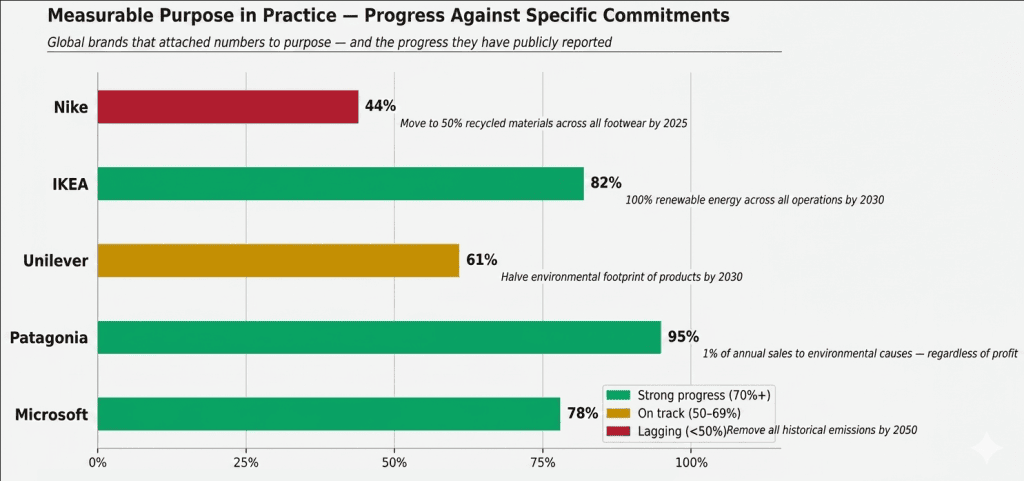
The brands that have built durable trust through purpose share one characteristic: they attached a number to the commitment before they knew for certain they could hit it. Microsoft pledged to be carbon negative by 2030 and to remove all the carbon the company has ever emitted by 2050. Unilever committed to halving the environmental footprint of its products by 2030. IKEA committed to 100% renewable energy across all operations by the same year. Patagonia formalised its 1% of annual sales commitment as a legal obligation, regardless of whether the company was profitable in any given year.
These commitments are not comfortable. They create accountability structures that public companies have historically resisted. Unilever has hit some targets and missed others — and the public record of both is visible. Microsoft’s progress reports show quarters where emissions tracking has been complicated by the energy demands of AI infrastructure, which the company has disclosed rather than buried. That transparency — the willingness to report setbacks alongside progress — is what converts a stated commitment into a trusted one. Consumers understand that hitting every target is unrealistic. What they do not forgive is the absence of targets, the absence of reporting, or the discovery that the numbers were being managed.
Source: Company sustainability reports 2024–2025, CDP disclosures, Clarkston Consulting 2026. Global brands that attached specific numbers to their purpose commitments — and what their public progress reporting shows. The specificity of the commitment is what makes the progress (or the shortfall) meaningful.
The commercial return is measurable. Research across ESG and brand equity consistently shows that consumers are willing to pay a premium for brands that demonstrate values alignment through action rather than assertion. The mechanism is not altruism — it is risk reduction. A consumer who trusts that a brand’s commitments are real is less likely to face the reputational exposure of being associated with a brand that is later shown to have misrepresented its values. Brand attachment of this kind reduces price sensitivity, increases advocacy, and improves retention — outcomes that show up in revenue lines, not just in brand tracking surveys.
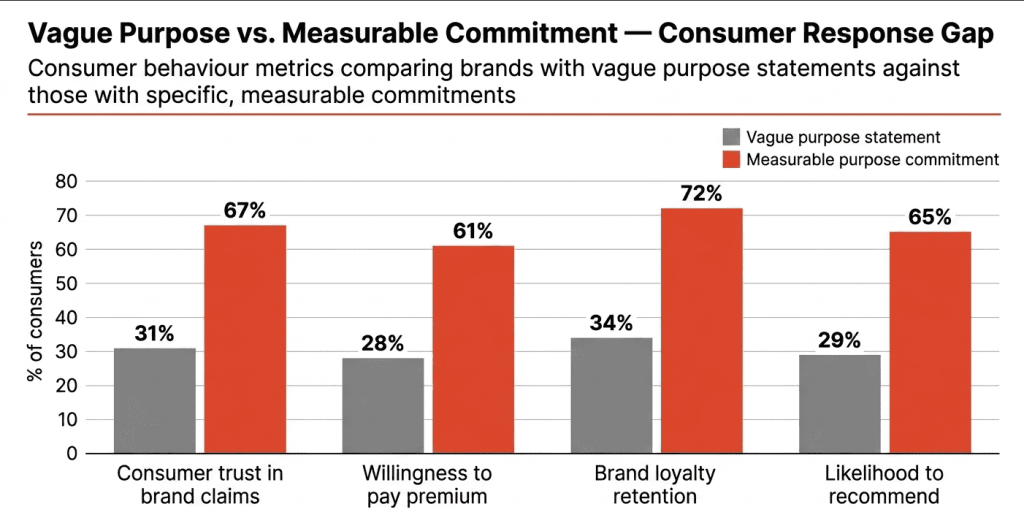
Source: Edelman Trust Barometer 2025, Hiebing State of Trust 2026, Directors Institute ESG & Consumer Trust Study 2025. Consumers respond measurably differently to brands with specific, auditable purpose commitments versus those with vague statements. The gap is largest in loyalty retention and willingness to recommend.
What has changed is tolerance. Broad promises no longer carry weight. Specific decisions do.
What to measure — and how to communicate it
The most common objection to measurable purpose is scale: that this is a commitment available to large multinationals with sustainability teams and disclosure infrastructure, not to mid-sized businesses operating in markets where ESG reporting is not yet mandated. The objection misunderstands the principle. The specificity of a commitment is not determined by its ambition. A local food brand that commits to sourcing 80% of ingredients from within 200 kilometres of its production facility by 2027 is making a measurable purpose commitment. A fashion retailer that commits to publishing the audit results of every factory on its approved supplier list is making a measurable purpose commitment. A bank that commits to deploying 30% of its SME lending to women-owned businesses within three years is making a measurable purpose commitment. None of these requires a global sustainability function. All of them require honesty about what the brand can actually commit to — and discipline about reporting whether it got there.
The communication question is equally important. Purpose reporting that reads like a compliance document does not build consumer trust. The brands that have converted measurable commitments into brand equity have done so by communicating progress in human terms — specific stories, named outcomes, visible accountability — rather than presenting annual sustainability reports that few consumers read. Patagonia does not publish a corporate responsibility report and call it purpose communication. It builds its entire brand voice around the tension between commerce and environmental impact, and it communicates that tension honestly. The number — 1% of sales — is the anchor that makes every other piece of communication credible.
What this means for brands in Bangladesh
Most Bangladeshi brands have purpose statements. Vanishingly few have attached numbers to them. In a market where consumer scepticism is rising alongside digital literacy, where international buyers are beginning to apply ESG standards to their sourcing relationships, and where the garment sector faces specific and growing scrutiny on labour practices, environmental impact, and governance, the brands that build verifiable purpose commitments earliest will carry a structural advantage into the next decade.
The EU’s Carbon Border Adjustment Mechanism and broader supply chain due diligence requirements are not abstract future considerations for Bangladesh’s exporters. They are present compliance pressures that will determine which factories retain access to European buyers and at what price. A factory that can demonstrate measurable progress on energy consumption, chemical management, and worker welfare — with auditable data rather than assertions — is more competitive in that environment than one that cannot, regardless of price. Purpose with a number attached is not just a consumer brand strategy. For Bangladesh’s export sector, it is an increasingly literal competitive requirement.
For domestic consumer brands, the argument is more forward-looking but no less real. The generation of Bangladeshi consumers now entering their peak purchasing years is the most digitally connected, the most globally informed, and the most attuned to the gap between brand communication and brand behaviour of any generation in the country’s history. Building the habit of measurable commitment now — before regulatory pressure makes it mandatory and before consumer scepticism makes it necessary — is the kind of strategic early move that compounds over time.
Brand purpose is not going away. The appetite for it among consumers, employees, and investors is genuine, growing, and well-evidenced. What is going away is the tolerance for purpose as decoration — the mission statement on the about page that no one monitors, the sustainability commitment with no timeline, no baseline, and no accountability mechanism. Patagonia did not tell its customers it cared about the environment. It told them not to buy its jacket, explained precisely why, and took the revenue hit that came with that honesty. That is what a number attached to purpose looks like. Everything else is a statement.