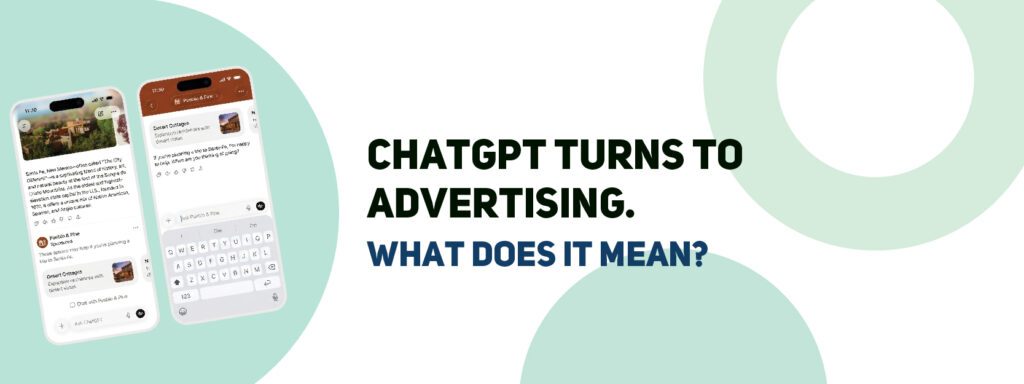
The past two decades have established the digital advertising sphere of business owners as follows: Study Google Ads, dominate Facebook Ads and forecast your path to clicks. This is coming to an end. The recent OpenAI chatbot ad announcement is much more than just another digital marketing tool. It marks a significant paradigm shift in the relationship between brands and their consumers, and in how consumers find products/services.
There are over 800 million weekly active users of ChatGPT. The platform is one of the biggest and most active communities on the planet, with a massive user base. When OpenAI announced that it would start placing ads in ChatGPT, it was not another product feature. It was an indication that one of the most booming platforms in tech is shifting its revenue mix, which is mainly subscription-and-enterprise-based, toward advertising to drive scale. The decision poses a myriad of questions for a business audience. Why now, what are they testing, how do the tradeoffs likely weigh in leadership, how will this alter the conversational user experience, and how would OpenAI compare to competitors who are moving in other directions? We unravel those threads today.
The Short Version – What Happened
OpenAI publicly announced a strategy to test explicitly labeled advertisements in ChatGPT, first to U.S. logged-in adults on the free plan and the $8 Go plan, with more expensive plans being advertisement-free. The company claims that the advertisements will not have an influence on model answers and that the content of the conversation will be kept confidential among advertisers.
The move is framed by independent reporting as an attempt to increase revenue and cover very high infrastructural and R&D expenses, and an attempt to maintain trust. Observers raised the red flag over the conflict between monetization and the very idea of unbiased, private assistance.
Why Would OpenAI Start Ads Now?
In an interview, Asad Awan, one of the ad leads at OpenAI, said that it goes back to their mission, which is to bring AGI (Artificial General Intelligence) for the benefit of all of humanity. OpenAI has a consumer product with a consumer base of 800 million+. And to take the best version of that product to everyone, there is no alternative to ads. It is one of the most proven models for doing that for consumer products. Awan also mentioned that another part of the mission is figuring out how to benefit all of humanity. Which raises issues like taking the best model to the users or offering the highest usage limits of those models. Large generative models are extremely expensive and increasing in terms of infrastructure and compute expenses. Ads can open up a new volume-based revenue channel. A recent Reuters report on company statements shows that revenue diversification and the affordability of access are the driving factors behind the decision to integrate ads into the system.
Subscriptions are effective, but they can only cover a fraction of users. Advertisements enable OpenAI to offer a giant pool of free users an opportunity to contribute without requiring all of them to buy it. That forms a freemium funnel: free with ads, paid without ads.
Another decisive factor is the intense competition in the industry. Microsoft, Google, and other companies are integrating commerce and advertisement products into AI experiences. Failure to pay attention to ads would be tantamount to abandoning a promising new channel to competitors. Microsoft specifically has been clear on conversational AI as an advertising and commerce surface.
ChatGPT Ads – Format & Conversation Experience
The format in which ChatGPT ads are released is essentially a banner ad that appears at the bottom of answers or responses. That means they do not impact the answers themselves. They are completely separate advertisements that appear at the bottom based on the user’s chat history. So the chats the user had, which are stored in the user’s ChatGPT profile, are used to show personalized ads.
For instance, let’s say you are looking for a weekend getaway and based upon your chat history, ChatGPT knows that you are in a relationship. And because of that it might recommend ads of romantic getaways for you to go on.
There is an option that is almost like a chat experience. Basically, this is where you can chat with the ad itself. This whole concept is moving towards a “lead generation model”. This could be an opportunity for users to chat directly with the business to get more information, thereby compressing the purchase journey.
A recent report by Search Engine Land showed that ChatGPT’s response to a user’s question, “What’s the best way to book a weekend away?”, had the sponsored result appear at the bottom. But it was slightly different from the mock-ups ChatGPT provided. Ads will be contextualized by the conversation. ChatGPT will match ads with the topic of your conversation, your past chats, and past interactions with ads. So a chat about recipes could yield food-related ads, while a trip-planning query might show vacation rentals. Importantly, advertisers themselves do not get access to your chat. At the same time, ChatGPT is evidently taking a very privacy-first approach, specifically stating that ads do not influence the answers you receive from it and that your chat stays private.
Critics of the Ad-based Model
OpenAI envisions an ad that you could actually talk to. You might click on a sponsored product and then ask the chatbot more questions about it, right in the flow of conversation. A user chatting about travel and seeing a “sponsored listing” for a New Mexico cottage had recently surfaced on various media platforms. In the interface, the user could continue the chat with the advertised travel brand (“Pueblo & Pine”) by clicking a button. This hints at how AI chat ads could go beyond static links and could become mini-agents you can query.
However, critics indicate that that is precisely where the issues of trust are concerned. The team at Anthropic noted that chatbots differ significantly from other media in that users tend to disclose private information, become more active, and thus are more vulnerable to influence than users of other digital products. That is, when an AI begins to creep into advertisements, users may begin to suspect, is this assistant really assisting me, or is it selling me something under the carpet? According to the blog of Anthropics, users do not need to guess whether an AI is really assisting them or merely trying to steer the discussion toward a more commercially viable direction.
OpenAI counters that its ad formats will ensure it does not give that feeling by making the assistant algorithm’s recommendations algorithmically independent and labeling the sponsored content in a highly noticeable way. It observes that the advertisements in chat will not just be the message and links, but will hopefully be useful to the extent that they will be incorporated into the experience. But even a helpful advertisement is an advertisement in a place formerly untouched by business. The idea of conversing with a salesperson-bot or viewing product recommendations among responses is inherently novel, and the majority of users in that context have very little prior notion of advertising. It will be time-consuming (and well-designed) to ensure that the boundary remains clear.
Competitors and Contrasting Paths
ChatGPT is not the only player in the field, and the manner in which its competitors use advertisements reflects the decisions to be made. Microsoft, an important ally of OpenAI, is approaching it in a different direction. They are promoting the integration of commerce rather than conventional advertising. Microsoft is implementing tools such as Copilot Checkout and brand-specific agents in its own Copilot AI assistant and Bing Chat. The concept is to transform AI-assisted browsing into purchases. According to Microsoft’s press release, Copilot Checkout allows users to make purchases in chat without redirects. Basically, the Copilot Checkout instantly transforms conversations into conversions.
Practically, it implies that a user may command Copilot to locate running shoes and they can buy them on the spot without having an advertisement section visible. It is more of an in-store shopping experience. The partners of Microsoft (such as Etsy or Shopify) become participants in the AI conversation, which is trained on their catalogs. But it does not pay to be shown in advertisements. This commerce-first model avoids most of the trust problems. The user is aware that he is dealing with a bot operated by a retailer, and is not being secretly sold to by an advertiser.
Google is developing its own path. It has been the king of online ads for a while. And now, it is incorporating AI in search. Google Search already displays advertisements in the section of its AI Overviews that is similar to regular result pages. In the case of Google AI chatbot Gemini, the general public’s attitude toward the project remains apprehensive. DeepMind CEO Demis Hassabis has indicated that Gemini has no current plans to add ads and that Google is concentrating on trust and capabilities.
What it means is that Google’s time frame will be subject to resolving the puzzle of trust initially. Nevertheless, according to industry observers, Google is advertising in nearly everything it can that has an AI-flavored brand. Which means that ads in AI assistants are practically unavoidable in the long term.
Smaller AI startups have bet to the contrary. Perplexity is an artificial intelligence company that has not engaged in advertising. At the beginning of 2026, it declared that it would not proceed with in-chat advertising. According to a Perplexity executive, a user must believe this is the best possible answer to continue using the product and be willing to spend money on it. That is, Perplexity ruled that the presence of adverts in the answers would harm the credibility. The company is targeting subscriptions and enterprise sales. According to WIRED, the founders of Perplexity once assumed that ads would become a huge venture. However, the executives now add that since they do not have the size of Google/Meta, ads might make people suspicious of AI responses.
The upshot is a split landscape. On the one hand, the large players are seeking a monetization strategy for large free user bases, be it through advertising or embedded commerce. On the other hand, other competitors have decided that trust and subscription money are more valuable. At least in the short run, than advertising money. The conflict between these strategies indicates that AI monetization is in its early stages.
The Future of Ad-supported AI
OpenAI CEO Sam Altman had been reluctant to advertise in the past, but now claims that, given the financial realities of building and maintaining large language models, the only possible way to make such AI available at a global scale is through advertising. Although revenue is important, it is equally important to ensure that people do not lose trust in the AI.
This transition is an unparalleled opportunity for small business owners, where the cost of doing business is rising and the complexity of utilizing traditional ad channels is growing. Replicating the past is not the way to success. ChatGPT advertising opens up a different form of advertising called “Conversational Advertising” that transforms the way you think about your advertising, the content you produce and what you view as valuable. Individuals running small businesses who adapt to this new platform early will not only be competitive but also at the helm of the pack. In this pivotal moment, the real test of ChatGPT’s ads will be whether users notice them and, if they do, whether they object or accept.
Author: Irtiza Zaman