How AI, Human-Centered Design and Sustainability Can Shape the Next Generation of Cities
Keywords
Artificial Intelligence (AI); Human-Centered Design; Intelligent Built Environment; Sustainable Development; Digital Transformation; Smart Cities; Urban Innovation; Facility Intelligence; Climate Resilience; Built Environment; Predictive Infrastructure; Bangladesh.
Imagine waking up tomorrow in a city that quietly understands you!
Before you leave home, your apartment has already adjusted its ventilation according to the day’s air quality. The office you are travelling to has optimized its energy consumption based on occupancy. Traffic signals have adapted to unusual congestion caused by overnight rainfall. A nearby hospital has automatically activated emergency protocols after detecting seismic vibrations that most citizens have not yet felt. None of these decisions required human intervention in real time.
None of them happened because the city became bigger.They happened because the city became intelligent.
Perhaps this is the conversation Bangladesh should begin having—not about how many buildings we can construct, but about how intelligently those buildings, streets and public spaces can serve the people who depend on them every day.
Concrete has built our skylines. Intelligence must build our future.
For decades, Bangladesh has celebrated visible development. New expressways stretch across rivers. Metro rail lines redefine mobility. High-rise towers continue to reshape urban skylines, while industrial zones expand to support economic growth. These achievements deserve recognition.
Yet beneath this impressive physical transformation lies a quieter question.Can infrastructure, by itself, solve tomorrow’s challenges?
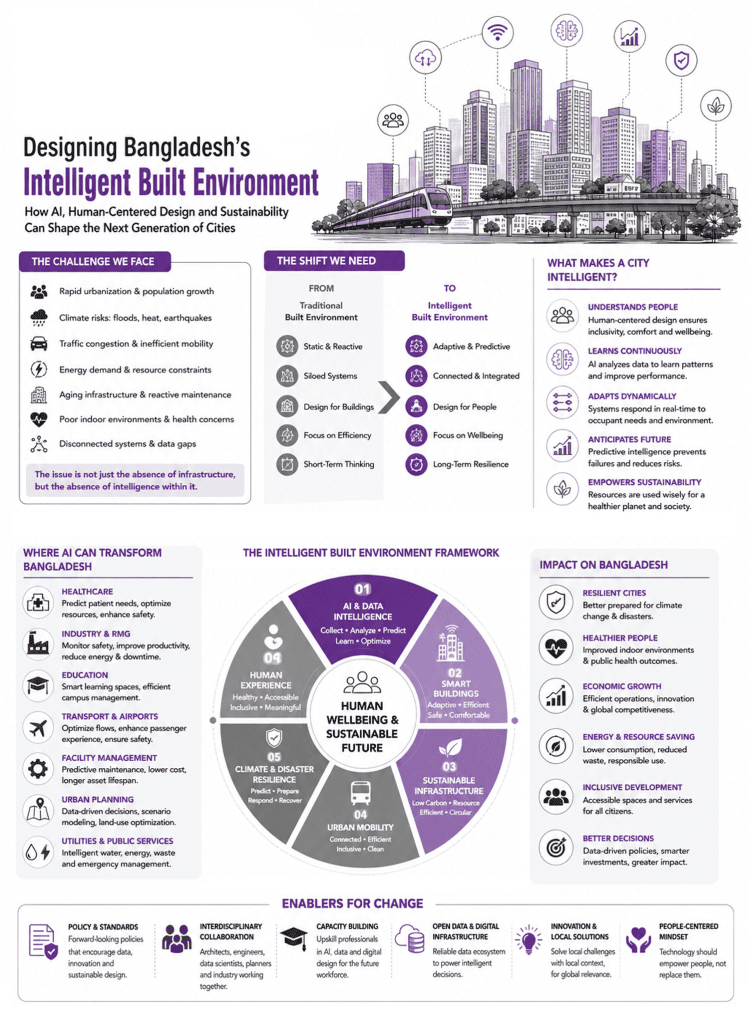
Traffic congestion continues despite wider roads.
Waterlogging persists despite drainage projects.
Rising temperatures make buildings uncomfortable despite modern facades.
Hospitals become overwhelmed during emergencies.
Earthquake preparedness remains limited.
Energy demand continues to grow while resources become increasingly constrained.
The lesson is becoming difficult to ignore. The challenge is no longer the absence of infrastructure.
The challenge is the absence of intelligence within that infrastructure.
Cities are beginning to think—and Bangladesh cannot afford to be left behind.
Across the world, artificial intelligence is quietly moving beyond smartphones and search engines. It is entering buildings, transportation networks, hospitals, airports and entire urban systems.
Buildings are beginning to monitor their own health. Facilities are learning how occupants actually use space. Infrastructure is predicting failures before they occur. Entire cities are being simulated digitally before new developments are even constructed.
This is not science fiction. It is the next evolution of the built environment.
And perhaps Bangladesh has arrived at precisely the right moment to embrace it.
The smartest city is not the one with the most technology.
The phrase smart city has become fashionable. But technology alone has never made a city intelligent. A city filled with sensors yet inaccessible to elderly citizens is not intelligent. A digitally connected hospital that confuses patients is not intelligent. A green-certified office that ignores employee wellbeing is not intelligent. True intelligence begins somewhere far simpler. It begins with people.
Human-centered design asks a question that technology alone cannot answer:
“How does this place make people feel, behave and thrive?”
Only after understanding human experience should artificial intelligence become part of the conversation.
Because AI should never replace human judgement. It should amplify human wellbeing.
Every building tells a story. AI allows us to finally listen.
For centuries, buildings have remained silent.
Walls slowly develop cracks.
Mechanical systems lose efficiency.
Indoor air quality deteriorates.
Energy is wasted.
Spaces become uncomfortable.
Yet most buildings communicate these problems only after they become expensive. Artificial intelligence changes this relationship entirely. Through sensors, digital twins and predictive analytics, buildings begin sharing their own stories.
They can report structural stress before visible damage appears.
They can anticipate maintenance needs before equipment fails.
They can recommend energy adjustments before costs escalate.
They can even learn how occupants move, gather and interact—helping designers create healthier, safer and more efficient environments over time.
Perhaps the greatest innovation of AI is not that machines become smarter.
It is that buildings become more aware of the people inside them.
Sustainability is no longer about building greener. It is about building wiser.
The conversation around sustainability often begins with solar panels, recycled materials or green roofs. These remain essential. But tomorrow’s sustainable buildings will be measured by something even more valuable: How long they continue serving society.
A building that lasts longer, consumes fewer resources, adapts to changing needs and prevents failures before they occur is inherently more sustainable than one requiring constant repair and replacement. Artificial intelligence transforms sustainability from a design feature into a continuous operational strategy.
Instead of reacting to problems, buildings begin preventing them. Instead of measuring yesterday’s performance, they continuously improve tomorrow’s.
That is the difference between sustainable construction and sustainable intelligence.
Bangladesh’s greatest opportunity may not be digital transformation alone. It may be design transformation.
Artificial intelligence is often discussed within software, finance or manufacturing. Yet one of its most profound impacts may emerge in the spaces where people spend nearly ninety percent of their lives. Homes, Schools, Hospitals, Factories, Universities, Workplaces, Public spaces.
Architecture is no longer simply about creating beautiful buildings. It is becoming the discipline of designing intelligent human experiences. This requires architects to collaborate not only with engineers but also with data scientists, behavioural researchers, healthcare specialists, software developers and policymakers.
The future architect may spend as much time interpreting data as drawing plans.
And that is an exciting evolution—not a replacement of design, but an expansion of its possibilities.
Perhaps the next landmark Bangladesh builds should not be our tallest tower.
Perhaps it should be our first truly intelligent district.
A place where buildings anticipate maintenance instead of waiting for failure.
Where schools adapt to environmental conditions.
Where hospitals coordinate through predictive systems.
Where garment factories protect both productivity and worker wellbeing.
Where public spaces become safer because technology quietly supports human life rather than dominating it.
Such places will not define success through architectural spectacle.
They will define success through human experience.
The future is rarely announced. It is designed.
History will remember Bangladesh not simply for how rapidly it urbanized, but for the wisdom with which it chose to shape that growth.
Artificial intelligence will undoubtedly influence every sector of our economy. The question is whether we will use it merely to automate existing systems—or to fundamentally redesign how people experience cities.
Our next generation deserves buildings that learn.
Communities that adapt.
Infrastructure that protects.
And cities that quietly work in the background so that people can live healthier, safer and more meaningful lives.
Because in the end, the most intelligent built environment is not the one that showcases the most technology.
It is the one where technology becomes almost invisible—allowing humanity, wellbeing and sustainability to become more visible than ever before.
Author’s Note
Bangladesh is entering a pivotal era where the future of development will be shaped not only by physical infrastructure but by the intelligence embedded within it. This article reflects my ongoing research and professional vision at the intersection of architecture, artificial intelligence, human-centered design and sustainability. I believe that the next generation of our built environment should be designed not merely to stand, but to learn, adapt and improve the lives of the people it serves. By fostering interdisciplinary collaboration among designers, engineers, technologists, researchers, policymakers and industry leaders, Bangladesh has the opportunity to create resilient, inclusive and intelligent environments that contribute meaningfully to both national progress and global sustainable development.
Sources & Further Reading
- United Nations. Transforming our World: The 2030 Agenda for Sustainable Development (SDGs).
- UNESCO. Recommendation on the Ethics of Artificial Intelligence.
- World Economic Forum. Shaping the Future of Construction and Infrastructure.
- World Bank. Bangladesh Country Climate and Development Report.
- UN-Habitat. World Cities Report.
- International Telecommunication Union (ITU). AI for Good.
- National Institute of Building Sciences. Digital Twin and Smart Infrastructure Resources.
- Government of Bangladesh. Bangladesh Delta Plan 2100.
- Government of Bangladesh. Bangladesh National Building Code (BNBC).
Suggested Quote:
“The future of Bangladesh will not be defined by how many buildings we construct, but by how intelligently those buildings understand, protect and serve the people who inhabit them.” — Ar. Sumaya Islam

By Sumaya Islam
Ar. Sumaya Islam is an architect, researcher and Managing Director of CREATO Design Research Lab Ltd. Her work focuses on the intersection of Artificial Intelligence, Human-Centered Design, Built Environment Innovation and Sustainability. She researches how intelligent design, digital technologies and user-centered thinking can transform cities, infrastructure and facilities into more resilient, inclusive and sustainable environments. Through research, practice and industry collaboration, she advocates for integrating AI into the future of Bangladesh’s built environment to improve human wellbeing and long-term urban resilience.