The Numbers Graduates Need to See
Start with the data, because it doesn’t flatter. A 2025 survey of 84 C-suite executives found that AI is eliminating entry-level positions at 52% of companies. Entry-level job postings dropped 15% year-on-year globally. The share of employees aged 21 to 25 at technology companies has been cut in half over the past two years, according to workforce analytics firm Pave, which analysed data from more than 8,300 firms.
In marketing specifically, Bloomberg found that AI can now automate 53% of tasks performed by market research analysts and 67% of tasks done by sales representatives — compared to just 9% and 21% for their senior counterparts. The work most exposed is the work that defined the entry-level experience: drafting briefs, scheduling social content, pulling keyword lists, A/B testing copy, building performance reports. For years, that grunt work was also how you learned the craft. Now, a well-prompted AI completes it in minutes.
And yet the story isn’t simply one of deletion. The same survey that found 52% of companies reducing entry-level roles also found that 55% reported stable or increased graduate hiring overall. Something is changing in what the entry-level role actually is. The jobs aren’t disappearing entirely. They’re being rebuilt from scratch — and the rebuild is demanding a great deal more.
“The junior roles being cut are the ones that already had the least creative oxygen in them. What replaces them will require significantly more.”
— MarTech, September 2025
The Ad Industry’s Reckoning
The scale of disruption is most visible in the global advertising holding groups — the companies that have historically been the largest employers of entry-level marketing talent. Ogilvy, part of WPP, shed 5% of its workforce in 2025. Interpublic Group cut 3,200 roles in the first nine months of the year. Omnicom eliminated 4,000 positions in December. AI efficiency is consistently cited alongside revenue pressure as a structural reason fewer people are needed to produce the same output. Deloitte’s 2025 AI in Marketing Survey found that 68% of CMOs now run hybrid teams — humans supported by AI co-pilots embedded in campaign tools.
Traditional SEO — once a reliable entry point for thousands of junior marketers — is being replaced by ‘generative engine optimisation,’ built around how AI-powered search tools like Perplexity and ChatGPT rank content rather than how Google’s algorithm does. Social scheduling and performance reporting are largely automatable. The ‘digital native’ roles created in the 2010s, once seen as the exciting frontier, are now the first to go. As Marketing Week’s Thomas Barta put it after Amazon’s 14,000-person corporate layoff in late 2025: AI is collapsing the space between strategy and execution — the white-collar layer where much of marketing used to live.
| CASE
STUDY WPP |
75,000 AI Agents and a Workforce Overhaul
WPP — the world’s largest advertising holding group — has built an internal AI platform called WPP Open and deployed over 75,000 AI agents across its business units by end of 2025. Rather than mandate a top-down tool, WPP empowered individual teams to build their own agents. The result: faster creative production, lower headcount needs for executional roles, and junior workflows restructured toward oversight and strategic thinking. WPP’s Elevate28 plan reorganises the group into four units — Media, Creative, Production, Enterprise — all AI-powered at scale. For entry-level hires, the message is clear: AI handles first-draft production. Your value must come from judgment, not volume. |
The Pipeline Problem Nobody Is Talking About
Here’s the uncomfortable irony: cutting junior roles to save money today may hollow out the industry in ten years. Entry-level positions have always been marketing’s training ground — where future creative directors, strategists, and CMOs learned the craft through repetition. Remove that layer, and you remove the pipeline.
Amazon Web Services CEO Matt Garman called the wholesale replacement of junior staff with AI ‘one of the dumbest things I’ve ever heard’ in a 2025 podcast. Junior employees are already the most AI-fluent people in most organisations, he argued. They’re also the cheapest. And they become the senior talent a decade later. New York Federal Reserve data backs the concern: by mid-2025, unemployment among recent graduates aged 22-27 had hit 5.8% — matching the rate for adults without a high school diploma. Underemployment exceeded 41%. For a generation that studied, built portfolios, and learned the tools, the market is sending a deeply disorienting signal.
What Hiring Actually Looks Like Now
So what does a company want from a marketing graduate in 2026? Not someone who can write a press release or schedule a tweet. Someone who can think at a level AI cannot — and use AI tools to execute faster than any human team could alone.
Agency leaders interviewed by Ad Age in late 2025 described a consistent shift: entry-level candidates are expected to demonstrate strategic thinking and creative problem-solving from day one. The executional tasks that used to fill a junior’s first six months have been AI-absorbed. What remains is the work requiring human judgement — understanding brand voice, reading client dynamics, generating original campaign concepts, and navigating the reputational dimensions of decisions that an algorithm will optimise its way around without a second thought.
LinkedIn’s 2025 Workforce Trends Report found that searches for ‘Prompt Engineer’ have now surpassed ‘SEO Specialist.’ Employers referencing AI in job descriptions surged 400% over two years. The new entry-level marketer is expected to be part strategist, part AI wrangler, part internal trainer — helping senior colleagues integrate tools they’re still figuring out. It’s a heavier brief than the role it replaced.
| CASE
STUDY Spire Agency |
Junior Marketers as AI-Empowered Strategists
Marketing agency Spire redesigned its entry-level roles rather than eliminating them. Where new hires once handled scheduling and basic reporting, they now take on real portions of campaign planning and strategic execution — with AI managing the executional layer beneath. As Spire’s leadership told MarTech: ‘AI is really giving them a chance to excel in their careers quicker. They’re learning more about strategy, critical thinking, and coming up with ideas.’ Junior staff also serve as internal AI educators, helping senior colleagues adopt tools and workflows. The result: junior marketers developing strategic instincts years earlier than they would have under the old model. |
What the Smart Ones Are Doing
The marketers navigating this transition best are the ones who accepted the job description change before the market forced them to. The advice from agency leaders and career researchers is consistent: build the skills AI finds hardest to replicate. Creative judgment. Strategic narrative. Emotional intelligence. Client relationships. Get genuinely fluent in AI tools — not as a party trick, but as a professional baseline. And understand data well enough to question what the algorithm produces, not just report it.
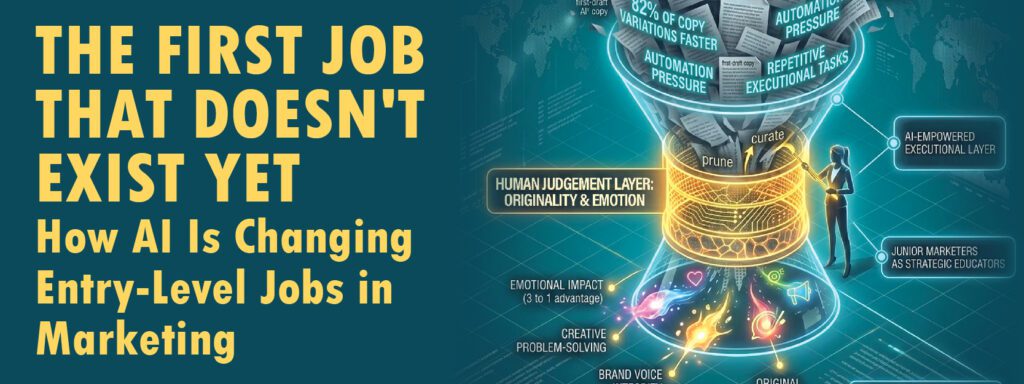
MIT Sloan’s Cognitive Creativity Lab provides a useful number: while large language models generate 82% of ad copy variations faster than humans, human creatives still outperform AI 3 to 1 on originality and emotional impact. That gap is the career opportunity. It won’t last forever — but it’s wide enough right now that marketers who develop in that direction have real runway. Universities are responding too: the University of Colorado Boulder launched a Master of Science in AI; Kellogg’s School of Management now runs a two-month course in Digital Marketing Strategies: Data, Automation, AI & Analytics. The infrastructure is catching up, if slowly.
“AI may bring rigour to an area marketers have long avoided: measurement. For a discipline often allergic to evidence, there’s a cultural reset coming.”
— Thomas Barta, Marketing Week, 2025
What This Means for Bangladesh
For marketing graduates in Bangladesh, these shifts are not distant signals from global agency networks. They are the direction of travel for every market integrating into the digital economy — and Bangladesh increasingly is. The same AI tools reshaping WPP’s workforce in London are available to every startup, agency, and brand team in Dhaka. The executional work that once justified a junior hire — content scheduling, basic copywriting, campaign reporting — is being compressed here as surely as anywhere else.
Bangladesh’s fast-growing digital marketing sector, driven by e-commerce expansion and surging social media penetration, has genuine demand for marketing talent. But that demand is shifting fast. The marketers who will thrive are those who get ahead of the automation pressure rather than waiting for it to catch them. Strategic thinking. Creative originality. Data literacy. AI fluency — not as optional professional development, but as the 2026 equivalent of knowing how to use a spreadsheet. These aren’t aspirational skills. They’re the minimum.
The Opportunity Inside the Disruption
It’s tempting to read the numbers — 52% of companies cutting junior roles, 81.6% of digital marketers anxious about their futures, a 15% drop in entry-level postings — and conclude that AI is simply eating the bottom of the marketing career ladder.
But the junior roles AI is absorbing were always the least interesting ones. The drafting, the scheduling, the reporting — necessary, but never the point. The point was always the thinking that came after: the creative instinct, the strategic judgment, the ability to understand what a brand needs to say and why anyone should care. AI can simulate many things. It cannot yet replicate that.
The first marketing job that doesn’t exist yet is the one built entirely around those capabilities — where entry-level means junior strategist, not apprentice executor. That job is harder. It expects more from day one. And for the marketers willing to build toward it, it’s a significantly better career than the one it replaced.
KEY SOURCES
Spark Admissions — C-Suite Survey on AI & Entry-Level Hiring, 2025 · WEF Future of Jobs Report 2025 · Bloomberg — AI Task Automation by Role, 2025 · MarTech — ‘AI Threatens Entry-Level Marketing Jobs,’ September 2025 · Marketing Week — ‘What Amazon’s 14,000 Layoffs Reveal About AI’s Grip on Marketing,’ November 2025 · Deloitte — State of AI in Marketing Survey 2025 · LinkedIn Workforce Trends Report 2025 · DemandSage — AI Job Replacement Statistics 2026 · MIT Sloan Cognitive Creativity Lab 2025 · Ad Age — ‘AI Is Reshaping Entry-Level Roles,’ November 2025 · Fortune — ‘WPP’s CTO Says AI Is Reshaping Advertising,’ January 2026 · New York Federal Reserve — Graduate Employment Data, 2025 · Pave / CNBC — Youth Employment at Tech Companies, July 2025