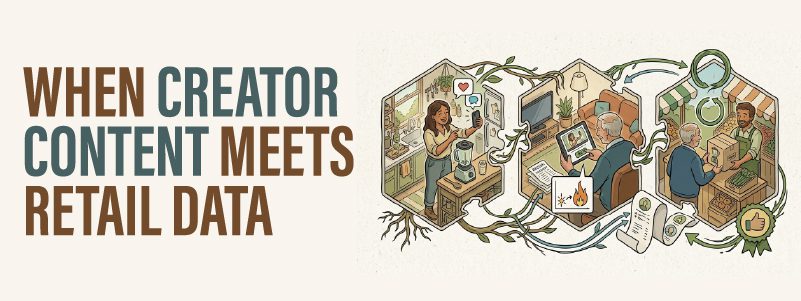
Advertising has always had a measurement problem. Brands could tell you how many people saw the campaign. They could tell you how many clicked. What they struggled to tell you — with the precision a CFO would accept — was whether anyone actually bought something as a result. The gap between exposure and transaction was where billions in budget went to die, justified by attribution models that satisfied nobody and proved nothing conclusively.
Retail media networks changed the terms of that conversation. Because retailers hold purchase data — the full record of what their customers buy, when, and how often — they can close the loop between ad exposure and commercial outcome in ways traditional digital advertising never could. US retail media ad spend reached $107.6 billion in 2025, nearly triple the investment from four years earlier. Amazon built its advertising empire on this capability first. Walmart, Albertsons, Best Buy, and Instacart have built their own versions. By 2026, brands consider retail media a must-have in their marketing mix — not an experiment but a commercial operating system.
The problem retail media has always had is creative. Its core inventory runs on display formats: sponsored listings, banner ads, search placements. These formats capture demand that already exists. They work on shoppers who have already decided to look for a product. They do not work on shoppers who had no intention of buying before they saw something. That demand-generation gap is where creator content operates — in the passive scrolling environments of TikTok and Instagram, where purchase intent forms before a consumer has consciously decided to buy anything. Two advertising systems solving different parts of the same problem. In 2026, they are being connected.
The logic shift that retail data makes possible
The most significant example of this convergence came from Walmart Connect in January 2026. Omnicom Media’s influencer agency Creo expanded its existing TikTok integration with Walmart to include Meta, using Walmart’s first-party purchase data to inform creator selection in a way that inverts the traditional influencer model entirely. The conventional approach starts with a creator — their follower count, their demographic profile, their engagement rate — and hopes the audience converts. Creo’s Influencer Discovery Agent starts with the purchase: which consumers actually bought this product at Walmart, and which creators were those consumers following? The selection runs backward from proven commercial behaviour to creator audience, rather than forward from creator reach to hoped-for commercial behaviour.
Megan Pagliuca, Chief Product Officer at Omnicom Media North America, described the question the system answers: “That audience that purchased this product at Walmart — who were they following?” The practical implication is that creator selection becomes a data-answered question rather than a demographic guess. Creators are chosen because their specific audiences have demonstrated purchase intent in the relevant category — not because they are famous or have high engagement rates on content that may have nothing to do with buying. Omnicom client Bimbo Bakeries USA is running campaigns through this system, using Walmart purchase history to connect social content to measurable sales outcomes rather than treating social engagement and commercial results as separate phenomena.
The finding that complicates the standard funnel model comes from Joanna O’Connell, Omnicom Media’s North American chief intelligence officer: of people who said they purchased because of an influencer, 42% described the decision as spontaneous. The awareness-to-consideration-to-purchase sequence that brand teams have drawn on whiteboards for decades does not describe how creators actually move people. The journey is shorter, less linear, and the creator touches awareness, desire, and purchase trigger simultaneously in the same piece of content.
What the broader market is building
Walmart Connect is the highest-profile case, but the infrastructure is being built across the sector. Albertsons Media Collective partnered with Linqia in September 2025 to bring creator content into retail media campaigns running across social media, connected TV, digital out-of-home, and in-store screens. Daniel Schotland, Linqia’s COO, described the creator selection logic as audience-first rather than reach-first — a network sorted by the retail product categories each creator’s audience actually buys in. The performance gap that emerges when creators are selected this way is significant: creator-sourced retail media content delivers three to four and a half times the engagement of traditional branded assets. And the highest-performing creators are not the most famous. They are the ones whose audiences buy things.
Best Buy took a single high-profile partnership approach, announcing a year-long deal with Dude Perfect — the sports and entertainment creator group with 60 million YouTube subscribers — in September 2025. The partnership gives brands access to Dude Perfect’s platform across the NFL season, the TGL golf league, and holiday periods, with Best Buy’s retail data measuring the connection between content exposure and conversion. Instacart went further, integrating its retail media data directly into TikTok Ads Manager in October 2025 — the first retail media network to offer closed-loop measurement natively inside the platform where the content lives, so that purchase intent data and creator content occupy the same environment.
Why measurement is the real frontier
The accountability pressure driving this convergence is specific. Since 2022, tighter CFO scrutiny and the collapse of third-party cookie measurement have forced brands to prove that advertising moves product — not just moves audiences. Only 15% of retail media advertisers report strong measurement confidence. Incrementality — proving causal impact rather than correlation — is the top measurement challenge for 75% of brands, according to Skai’s 2026 State of Retail Media report. The overreliance on ROAS is ending. “The overreliance on ROAS as the benchmark of value is over,” said Jason Wescott, Global Head of Commerce Solutions at WPP Media. Brands need to know what media caused, not just what it touched.
Logan’s diagnosis holds across the sector. Retail media networks have the data and the measurement infrastructure. What they have consistently lacked is the creative quality that makes full use of it. Display advertising converts shoppers already in market. Creator content reaches consumers before they are in market — building the cultural relevance and desire that later converts. The combination of retail purchase data with creator content addresses both ends of the funnel in a single connected system. Unilever, recognising this, has committed to shifting its social media spend from 30% to 50% of its total marketing budget with a primary emphasis on creators.
The data integrations being built today — between purchase systems and social platforms, between creator discovery tools and transaction databases, between measurement frameworks and content performance — will be standard infrastructure within two to three years. Eighty-six percent of commerce media decision-makers in North America and Europe say that strengthening measurement and attribution to prove ROI is a high or critical priority over the next year. The brands connecting creator programmes to retail data now are building performance evidence that compounds. The ones that treat this as a future consideration are building a gap they will find harder to close than they expect.