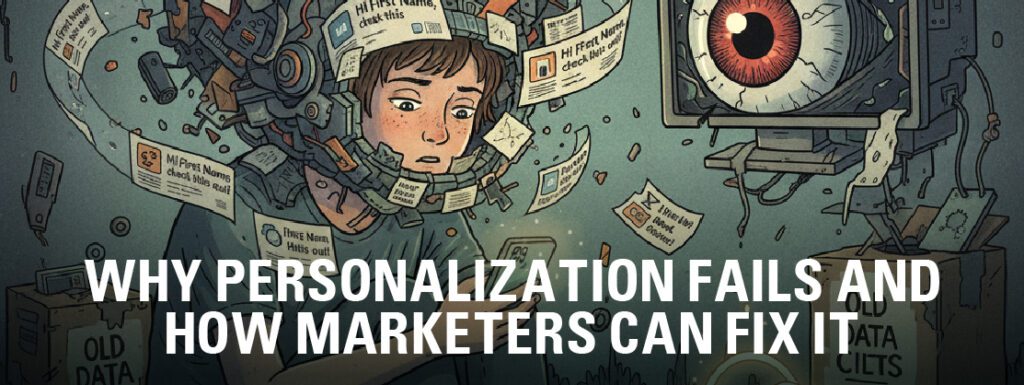
Over the past ten years, marketers have been in love with personalization. The concept is rather simple: treat every customer as an individual, serve them with content unique to their demographics or behavior and they will compensate you with loyalty, conversion or engagement.
This trend has been closely following me since I am the one who builds marketing campaigns during the day and trains AI-driven data systems during the night. In the long run, it has been clear though, that personalization does not always work. What seemed to be a golden ticket to greater customer relationships is now noise. The consequence: the users disregard so-called custom-made proposals, unsubscribe to desperate campaigns, or just turn a deaf ear.
Why does personalization so often disappoint? And how can marketers fix it, this time with more nuance, data sense, and respect for real human behavior?
When Personalization Crossed the Line
Not long ago, personalization meant something meaningful. A welcome email saying “Hi, Alex, we noticed you love street food recommendations. Here are three new spots near you.” It felt human. But over the years personalization has been diluted into: “Hi [First Name], check this out,” or “Because you browsed X five days ago, here is Y.”
Marketers and platforms increasingly rely on segmentation, basic demographics, and cookie-based triggers. The brilliance of real-time, adaptive personalization has given way to templated flows: someone abandons a cart, send template email. Someone visits a product page, trigger banner ad. That kind of personalization is shallow.
Users today are more aware. They expect experiences that actually reflect their context, not stale habits or blunt assumptions. What works in simple cases, such as recommending a bestseller after a recent purchase, fails when expectations evolve.
This is how personalization lost its shine.
The Hidden Weaknesses Behind Personalization
From working both in digital marketing and in the trenches with raw annotation of data, I have a close view of where personalization breaks. It is rarely one mistake. It is almost always a combination of weak data, rigid technology, and assumption-laden models.
Poor or outdated data leads to bad choices
Personalization depends on understanding users. But often, marketers rely on data that is old, incomplete, or irrelevant. A user may have subscribed using a workplace email six years ago, but since then they changed cities, roles, and interests. Yet systems treat them as static.
Tracking cookies expire. Users browse on multiple devices, and cross-device linkage fails. A user might search for baby clothes today because a friend is expecting, but that does not make them a target for ongoing baby essentials ads.
When data is stale or misaligned with reality, personalization becomes a guessing game. And guesses can feel intrusive or tone deaf.
Tech stacks built for the past decade, not the present
Many marketing platforms were built on rules like “if user clicked X then send Y.” These rigid workflows lack flexibility. They rarely support real-time adaptation or dynamic recombination of content.
As a result, campaigns become linear rather than intelligent. Even if someone’s intent changes overnight, such as a new job or a shift in interests, the system continues to follow last week’s rules. The outcome is content that no longer matches the user.
Treating behavior like identity
Often personalization assumes that past behavior is a reliable predictor of future behavior. Clicks, page views, and purchase history get coded into user profiles permanently.
But people change. Behavior reflects context. Maybe you bought running shoes last season, but now you live in a snowy region and your interests shifted. Or you browsed a recipe as a one off, not as a signal of lifelong preference.
Assuming past equals future is a trap. It brands users as fixed profiles instead of evolving individuals.
Internal silos limit holistic understanding
In many organizations, marketing operates separately from data analytics and from customer support. Each team has its own metrics and interpretation.
The marketing team sees click-through rates. The analytics team sees bounce rates. Customer support notes concern about personalization being creepy. None speaks a shared language. Without cross-team collaboration, personalization remains surface level, more of a cosmetic feature than a useful approach.
Why Traditional Personalization Approaches Are Failing in 2025
Simple segmentation and demographic-based marketing once worked. In 2025 it rarely measures up. Reasons include:
- Predictive models trained on old datasets cannot keep up with fast-changing user behavior.
- Templates and one size fits many personalization lead to repetitive user journeys that feel mechanical.
- Without continuous feedback loops, marketers rarely know whether personalization improves user experience or just clogs inboxes.
- As privacy awareness grows, users are less tolerant of opaque tracking practices. They expect value in exchange for data or they opt out.
In short, personalization built around assumptions and outdated pipelines is becoming a liability.
What “Relevance” Should Really Mean
If personalization is not about matching names to tags or recycling past behavior, what is it about? To deliver relevance that feels helpful, marketers need a shift in mindset.
Relevance means responding to current intent, not past behavior.
A user browsing cooking recipes today might simply be curious. Tomorrow, they might return to their usual sports or news content. A relevant system adapts rather than labeling them permanently as a food lover.
Relevance means respecting timing and context.
Sending a winter coat discount makes sense if the user is currently browsing outerwear during a seasonal change. It does not make sense if it is summer and their last purchase was years ago.
Relevance means giving users control and transparency.
If personalization depends on data, users should understand what is collected and why. They should feel valued rather than surveilled.
From Correlation to Causation and From Templates to Flow
Based on my experience working on both campaign building and data annotation, I see a clear path forward.
Adopt causal thinking rather than relying only on correlation
Instead of saying “people who clicked ad X often bought product Y,” ask why they bought Y. Which factors actually moved them? Time of day, review exposure, reminders, social influence, or something else?
Correlation spots patterns. Causal analysis shows triggers. Personalization must shift toward triggers.
Build real-time contextual decisioning
Use data pipelines that refresh frequently and decide engines that update context in the moment.
For example, if a user browses a jacket late at night, the system should treat that as temporary interest. A reminder may help later, but there is no reason to tag the user permanently.
Rethink content architecture with modular assets
Instead of hard coded messages tied to fixed segments, build small reusable content blocks. Combine these blocks dynamically depending on user behavior, current session, device, or time.
This reduces campaign fatigue and keeps experiences fresh without overwhelming users.
Break down team silos and align on shared metrics
Marketing, analytics, product, and UX should share data and goals. When teams evaluate performance together, personalization becomes a journey-building exercise rather than a channel-specific tactic.
Respect user boundaries with transparency and empathy
Intrusive personalization backfires. Explain why certain data is collected. Offer meaningful benefits for data sharing. Give users easy opt-outs.
What Good Personalization Looks Like in 2025?
Picture a more respectful, adaptive approach:
- A user browses winter jackets at night. The system notes the interest quietly.
- A few days later, a simple note appears: “The jacket you looked at is running low in stock.”
- If the user engages, great. If not, the system steps back.
- Later, the user browses summer wear. The system shifts focus accordingly.
This is personalization that listens. It is responsive, not aggressive.
Why This Matters in Bangladesh?
Working in Dhaka and observing user behavior across Bangladesh shows that global personalization playbooks often miss the local nature of digital usage here.
Rapid digital adoption but uneven data maturity
Mobile internet use is rising quickly. People switch devices often and depend on inconsistent connectivity. Long-term profiling through cookies becomes unreliable.
User intent shifts quickly. Someone browsing electronics during a fair might not be a long-term electronics enthusiast. Treating such actions as permanent signals creates noise.
Bandwidth constraints and inconsistent connectivity
Heavy tracking scripts slow browsing. Marketers should prioritize lightweight personalization that uses session context rather than heavy profiling.
Diverse user behavior shaped by culture and seasonality
Festivals, family needs, regional differences, and shifting priorities make behavior highly dynamic. Personalization must be flexible enough to treat each session as new input.
Growing desire for transparency
People in Bangladesh increasingly expect to know how their data is used. Clear communication and responsible data practice build trust better than aggressive targeting.
A Roadmap for Local Marketers
To improve personalization in Bangladesh:
- Audit your data. Remove old or irrelevant signals before building new workflows.
- Use lightweight decision engines with simple context signals such as device, time, and recency.
- Build modular content libraries that allow dynamic combinations.
- Align marketing, analytics, product, and UX teams on shared goals.
- Offer value and transparency. Make data usage clear and give users meaningful benefits.
- Treat personalization as a series of hypotheses. Test frequently and adjust.
Personalization Is Not Dead. It Needs a Reset.
Personalization once felt like magic. Over time it became routine and often disappointing. The problem is not personalization itself but the overreliance on static profiles and recycled assumptions.
Users change. Their context changes. Their intent changes. Personalization should reflect that.
With thoughtful design, real-time context, flexible content, and genuine respect for user boundaries, personalization can still deliver value. It can feel human again.
Whether in Bangladesh or beyond, across industries and cultures, effective personalization is not a trick. It is a practice shaped by humility, awareness, and continuous improvement.
Author: Nusrat Jahan