In the heart of South Asia lies a land stitched together by rivers, resilience, and revolutionary dreams—Bangladesh. For long, the narrative around this nation has been tethered to natural disasters, poverty, and political instability. But that is a partial story—a fading sketch of yesterday. Today, a deeper truth pulses through the veins of this country: Bangladesh is not just surviving—it is transforming. And as it does, there emerges an imperative that transcends strategy and marketing—it is the philosophical and deeply human act of nation branding.
The Soul of a Nation
Nation branding is not about logos or taglines; it is about essence. For Bangladesh, it is about translating its journey from blood-soaked independence in 1971 to a poised, self-assured nation on the verge of developed status. It is about capturing the indomitable spirit of a people who have transformed cyclones into stories of resilience and poverty into platforms of innovation. In essence, it is about showing the world the truth of Bangladesh, one built on courage, culture, community, and an unshakable commitment to progress.
Today, the global stage doesn’t just reward economic might; it reveres authenticity, purpose, and contribution. This is where the power of branding comes in. When framed not as propaganda, but as storytelling rooted in integrity, branding becomes a nation’s mirror— reflecting both its aspirations and its soul.
Why Now? The Pivotal Moment of Transition
The country’s demographic dividend—over 170 million people, most of them young and tech- savvy—is a powerful engine for change. The 2024 student movement that echoed across university campuses nationwide was not merely a protest—it was a declaration. Young people demanded justice, transparency, and purpose-driven leadership. This civic awakening, driven by students, artists, and digital creators, showcased a generation unwilling to accept inertia.
This is not just a narrative of economics. It is about human potential—about a people who have used adversity as an accelerant, and scarcity as a spark.
Bangladesh is poised at a historic intersection: graduating from the Least Developed Countries (LDC) group in 2026 and aspiring to be globally acknowledged as a developed and empowered nation. This moment is not merely symbolic—it is a metamorphosis. But with wings come winds.
As Bangladesh sheds the LDC label, it also steps into a world where international support mechanisms fade. No more preferential trade access. No more concessional loans. Instead, the nation must now compete head-on in a fiercely competitive global economy.
But herein lies the opportunity. This graduation is not an end, but a beginning—a signal to the world that Bangladesh is ready to stand tall, not as a beneficiary of aid, but as a contributor to global innovation, sustainability, and inclusive growth. A strong nation brand can become the bridge between this newfound identity and the global perception that still lingers in the past.
Reframing the Global Image
Despite progress, international perceptions of Bangladesh remain mired in old stereotypes— natural calamities, cheap labor, fragile governance. These outdated images are obstacles to investment, tourism, and diplomacy. They must be challenged, not through advertising slogans, but through an authentic, policy-backed, people-powered nation branding strategy.
This strategy must flow from the very soul of Bangladesh. It must integrate the energy of Nation’s tech hubs, the serenity of the Sundarbans, the entrepreneurial pulse of its villages, and the philosophical depth of its people. It must celebrate both diversity and unity—from indigenous cultures to urban startups, from heritage weavers to female-led microenterprises.
The Philosophy of Branding: From Surface to Substance
Let us be clear: nation branding is not a mask. It is a magnifying glass. It does not hide flaws; it reveals values. For Bangladesh, those values are:
- Resilience: A country that has adapted to floods, famines, and failures—and emerged stronger each time.
- Innovation: From microcredit to mobile banking, Bangladesh has consistently pioneered grassroots solutions.
- Inclusivity: Rising literacy, gender equity, and expanding healthcare reflect a commitment to leaving no one behind.
- Global Citizenship: As one of the most climate-vulnerable nations, Bangladesh has turned adversity into advocacy.
People: The Beating Heart of the Brand
Diaspora Bangladeshis—doctors, scientists, artists, and entrepreneurs across the globe—form an invaluable asset in this brand-building journey. Their remittances, knowledge transfers, advocacy, and global networks contribute profoundly not only to the economy but also to Bangladesh’s perception abroad. Their lived experiences allow them to bridge narratives between Bangladesh and the world, serving as cultural ambassadors, economic contributors, and innovation catalysts.
Whether mentoring startups, shaping development dialogues, or influencing policymaking through international institutions, NRBs (Non-Resident Bangladeshis) have the power to institutionalize Brand Bangladesh across key geographies. Nation branding must proactively
include this global community—not just as cheerleaders, but as co-creators of Bangladesh’s emerging identity on the world stage.
—doctors, scientists, artists, and entrepreneurs across the globe—form an invaluable asset in this brand-building journey. They carry with them the credibility and connectivity to tell Bangladesh’s story to a skeptical world.
The Methodology: A Mirror and a Map
The nation branding model proposed by Brandzeal Consultancy rests on four pillars: Input, Outlook, Equity, and Outcome. These interwoven elements capture the story, perception, value, and results of branding.
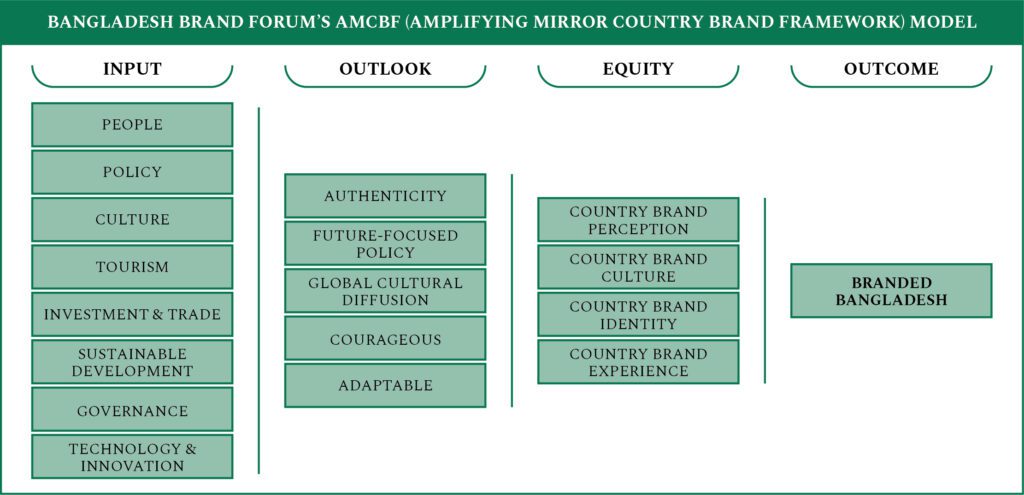
What makes the model unique is its embrace of authenticity and future-focus. Bangladesh is not trying to mimic Western branding frameworks. Instead, it is creating a model rooted in its own realities—its density, diversity, and dreams.
The above-mentioned strategic methodology requires an execution model in that spectrum we have also devised a phase-oriented execution plan. The execution model is crucial for several reasons:
- Guidance: It provides a structured roadmap and step-by-step approach for implementing the methodology, ensuring clarity and direction throughout the process.
- Efficiency: By breaking down the implementation process into manageable phases, the model helps optimize resource allocation, time management, and task prioritization, enhancing overall efficiency.
- Coordination: It facilitates coordination and collaboration among stakeholders involved in the branding initiative by clearly defining roles, responsibilities, and timelines for each
- Flexibility: The phased approach allows for flexibility and adaptability to changing circumstances, enabling adjustments to be made based on evolving needs, feedback, and insights gathered during the implementation process.
In essence, the execution model serves as a roadmap, guiding stakeholders through the implementation process, ensuring efficient coordination, flexibility, and effective management of resources and risks, ultimately leading to the successful execution of the nation branding initiative.
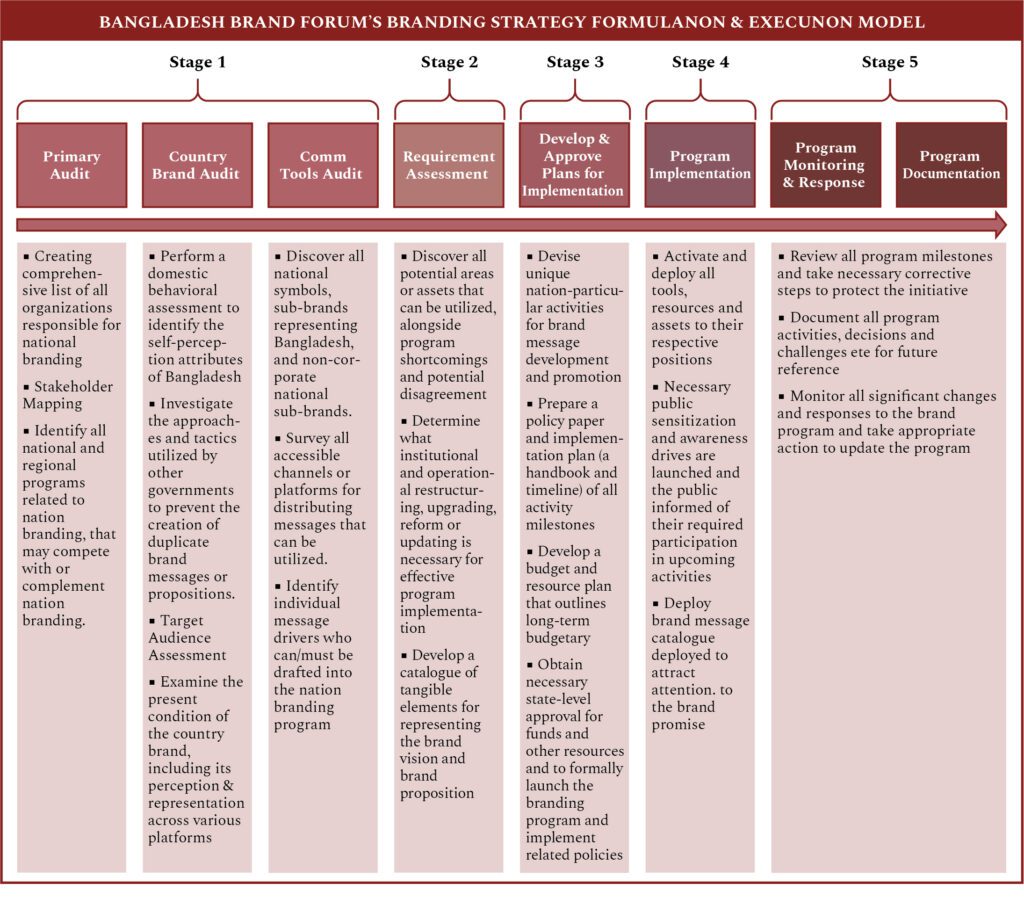
- Monitoring and Evaluation: The model includes mechanisms for monitoring progress, tracking milestones, and evaluating outcomes at each phase, enabling stakeholders to assess the effectiveness of the branding initiative and make informed decisions for course correction or refinement as needed.
- Risk Management: By identifying potential risks and challenges associated with each phase, the execution model helps stakeholders proactively mitigate risks, address issues, and ensure smooth progression towards achieving the desired branding objectives.
In essence, the execution model serves as a roadmap, guiding stakeholders through the implementation process, ensuring efficient coordination, flexibility, and effective management of resources and risks, ultimately leading to the successful execution of the nation branding initiative.
Soft Power: The Invisible Asset
In the 21st century, power is not only about armies or economies—it is also about ideas, values, and influence. Soft power is the ability to shape preferences and inspire admiration. For Bangladesh, soft power lies in its cultural depth, its resilient diaspora, its commitment to climate justice, and its example as a development model for the Global South.
Whether it’s through the universal appeal of Bengali literature, the innovations of Grameen Bank, or the leadership of its peacekeeping forces, Bangladesh has already begun to exert soft power. A coherent nation brand can amplify this influence, making Bangladesh not just a participant in global affairs, but a shaper of them.
Bangladesh is the only country born out of a language movement. Language, art, music, and literature are not accessories; they are the very foundation of its identity.
Any branding strategy that ignores culture is a half-built bridge. Fortunately, Bangladesh has an abundance of riches—its folk traditions, crafts, festivals, culinary diversity, and a cultural heritage that spans millennia. The world is hungry for authenticity, and Bangladesh can offer it—if it learns to tell its story right.
The Stakes: More Than Just Reputation
A brand is not just about external applause. It’s also about internal affirmation.
A strong nation brand will make Bangladeshi citizens walk taller. It will make children dream bigger. It will make investors look twice and tourists stay longer. It will help the country attract fairer trade terms, better global alliances, and a stronger voice in international forums.
It will also provide a psychological shift—from defensive nationalism to confident globalism.
Looking Ahead: From Vision to Velocity
By embracing a proactive approach to soft power, sustainability, and innovation, Bangladesh is positioning itself for a future of dignity, prosperity, and global relevance.
The National Development Trajectory:
Nation branding offers a strategic blueprint to turn this vision into reality. It allows Bangladesh not just to keep pace with the world—but to help shape it.
And let us not forget—this journey is not without risks. The loss of LDC privileges, rising global competition, climate threats—all are real. But Bangladesh has faced graver threats before and triumphed. This is a nation that believes in rebirth.
Conclusion: A Mirror of Possibility
Bangladesh today stands not at the edge of crisis, but at the cusp of greatness. And it must ask itself: how do we want to be remembered? As a footnote of struggle? Or a headline of hope?
Nation branding is more than a campaign. It is an act of collective introspection and intentional imagination. It is where policy meets poetry, and economics meets empathy.
Let us not just rebrand Bangladesh. Let us rediscover it.
Let us craft a narrative not just for investors or diplomats, but for the child in Rangpur who believes she can code, for the weaver in Tangail who dreams of Paris runways, for the young activist in Dhaka who wants his nation to lead the fight against climate injustice.
This is our story. And it’s time we told it—boldly, truthfully, and beautifully.
Author:
Sajid Mahbub
Group Chef Executive Officer and Executive Editor, Bangladesh Brand Forum
Chief Digital Officer, Asia Marketing Federation